
 Version imprimable
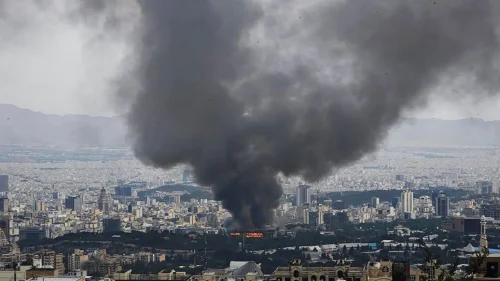
Trump declared war on Iran, and together with Israel, bombed several cities including Teheran, the capital, killing Ali Khamenei, the Supreme Leader, and other top Iranian officials, as well as striking military bases and nuclear facilities. Iran then retaliated by attacking Israel and U.S. bases in Bahrain, Qatar, the United Arab Emirates, Kuwait, Jordan, and Oman; so now there is a regional war.
A diplomatic resolution of U.S. differences with Iran was possible, but Trump, who calls himself “the peace president,” chose war. As is always the case in war, there are innocent victims, such as the 148 girls killed by a military strike on a school in Iran. The war has just begun and hundreds have already been killed in Iran, some in Israel and in other nations, as well as three U.S. soldiers.
Trump launched the war saying, “Our objective is to defend the American people by eliminating imminent threats from the Iranian regime. A vicious group of very hard, terrible people. Its menacing activities directly endanger the United States, our troops, our bases overseas, and our allies throughout the world.”
Trump suggested that war was necessary because Iran would soon have nuclear weapons and missiles that could reach the United States. U.S. government reports denied both claims. “For that reason, he promised, “We’re going to destroy their missiles and raze their missile industry to the ground.” He added, presenting himself as a liberator, “Finally, to the great proud people of Iran, I say tonight that the hour of your freedom is at hand… When we are finished, take over your government. It will be yours to take.” So, this appears to be just the sort of war for regime change that Trump when he was a candidate for president had promised to avoid.
Trump launched the war without consulting or even informing the U.S. Congress, which under the U.S. Constitution is the only arm of government with the power to declare war. Democrats had announced earlier that they planned to go to Congress on March 2 with a war powers resolution which would have prevented Trump from going to war with Iran. But Trump beat them to the punch. Democrats will present the resolution this week in an attempt to stop the war.
Both some Democrats and Republicans have criticized Trump’s turn to war. Rep. Thomas Massie, a Republican, who is co-leading the effort in the House to force a war powers vote, called the strikes on Iran “acts of war unauthorized by Congress.” Democratic Senator Ruben Gallego said, I lost friends in Iraq to an illegal war. Young working-class kids should not pay the ultimate price for regime change and a war that hasn’t been explained or justified to the American people. We can support the democracy movement and the Iranian people without sending our troops to die.”
In cities around the country there were small protest demonstrations as the war began, but the largest with only a few hundred participants. Some of those organizing these protests actually support Iran’s government, claiming it is, “anti-imperialist.” But there is little popular support for Iran’s regime since Khamenei had the Islamic Revolutionary Guard murder between 25,000 to 35,000 protestors who opposed the authoritarian regime in January.
Will the American people accept Trump’s war? Will his base turn against him for violating his promise to avoid just this sort of war? Will the Democrats stop him in Congress? Or can the anti-war movement stop him in the streets? That’s our challenge.
Updated 2 March 2026.