
 Version imprimable
1/ Under Trump’s leadership, the US empire—in its phase of decline, increasingly aggressive and unpredictable—views the entire continent as its area of direct control, rather than merely influence. “Western Hemisphere”, defined countless times in the National Security Strategy (NSS) of the neo-fascist administration, provocatively includes Canada, a traditional imperialist partner, and, above all, all of Latin America. It is collectively considered the backyard from which the still-hegemonic imperialism asserts itself politically and militarily to better compete with China for technological, economic, and geopolitical primacy. The unprecedented deployment of maritime, naval, and ground forces to the Caribbean, the blockade of Cuba, the pressure and blackmail against Mexico and Colombia (not a coincidence that they are governed by “progressive” administrations), under the pretext of drug trafficking, and the de facto seizure of power in Venezuela, through the kidnapping of the presidential couple and a strategic oil agreement with the former “Maduroist” government, highlight the colonialist and bellicose, blatantly interventionist nature of imperialism under the Trump administration.
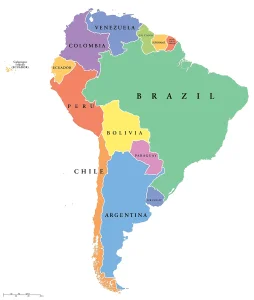
In these notes, we address South America, where the complexity of societies, scandalous socioeconomic inequality, the presence of a so-called “middle” economy with its own influence in the region (Brazil), a tradition of struggle and organization on the left, and governments less subservient than the liberal right (such as those of Colombia, Brazil, and Uruguay), imperialist interventionism faces more obstacles and has to moderate its attacks. In light of important electoral processes and tests in the class struggle posed by far-right and right-wing governments, such as those in Chile, Argentina, Bolivia, and Ecuador, it is worth considering the commonalities across national contexts in the region in the coming months.
2/The current global situation of the US creates difficulties for its strategy. On the Middle Eastern front (which the NSS does not consider a priority but was the target of its strongest military offensive outside the Americas), it has not yet easily achieved, as it had imagined, the goal of overthrowing the Iranian regime. This stalemate (for now), which feels like a defeat for Trump, adds to the growing wave of opposition and anti-democratic plans within the United States itself, creating a dangerous combination for Trump’s continued rule. Further US interventions in electoral processes (as occurred in Argentina and Honduras), support for coups, invasions, and new rebellions—with sudden reversals—cannot be ruled out. Today, Cuba is the most immediate target: the ideal scenario for the US is an agreement with the Díaz-Canel government (which would mean sidelining Raúl Castro), to present it to the domestic electorate as an international victory. Would the Cuban government do so, in the face of the shortages and hunger imposed by the US? The answer remains open. The elections in Colombia and Brazil this year, following the runoff in Peru, will also point to the balance of power.
3/ The South American political landscape is one of a growing (and, by all indications, enduring) clash between far-right governments and movements allied with the US—in power in Argentina, Chile, Paraguay, and Ecuador, and strong in Peru, Venezuela, Colombia, and Brazil—and their mass movements and liberal-democratic and left-wing political forces. Beyond their authoritarian ambitions and submission to Uncle Sam’s dictates, the neo-fascists in the South are the most consistent proponents of an ultraliberal and predatory agenda of pro-financial counter-reforms in labor, agrarian, health, environmental, and social security policies. Thus, it is inevitable that they will clash with the general interests of working people, women, Black communities, peasants, Indigenous peoples, and the LGBTQIAP+ community. Even with advantages in the culture wars, thanks to Big Tech’s and its networks’ support, it is most likely that the far right will fail to stabilize the region. The subcontinent is likely to remain in a state of chronic instability, with neo-fascism failing to establish a new cycle of lasting hegemony, and “progressivism” unable to revive its “golden years”. In the current phase of the global economic crisis, the major gains made by the bourgeoisie and states through raw material exports—which formed the basis of the success of the “pink tide” of the 2000s and 2010s, with Lula and the PT seeking to coordinate a heterogeneous bloc of South American countries during their first terms—will not repeat. On the contrary, tremendous battles lie ahead, with an open-ended outcome, significant polarization, and a tendency toward rapid shifts in the political landscape.
4/ In the Andean region, with its long history of social struggles, the trend toward worsening political and social contradictions persists. For now, the balance of power is heavily in favor of the right and imperialism. With Venezuela turned into a US colony, Peru in an electoral process led by Fujimorism, Ecuador under the right-wing Noboa, and Chile under a Pinochetist government, the rebellions of workers and peasants in Bolivia against the government of Rodrigo Paz represented a significant counterforce to the neo-fascist wave, despite the recent electoral defeat of MAS (2025). In Chile, despite the political strength of the Kast government, students have already staged major protests. The opposition is regrouping to challenge the austerity plan and the consolidation of the neo-fascist government’s regime, which is beginning to lose ground, according to recent opinion polls.
5/Just a few months after taking office, Bolivian President Rodrigo Paz found himself on the defensive in May, with the coalition divided and part of the workers’ and peasants’ movement demanding the fall of his government. (Contrary to the view of part of the left, which saw the electoral defeat of the MAS as a historic defeat for the mass movement, the social movements were not historically defeated at that moment—although the fragmentation of the MAS party-movement, which led the so-called “process of change” for 16 years, was a major setback for those at the bottom.)
The masses did not give Paz a “honeymoon”: in a first wave, there was an uprising against decrees that raised gasoline prices, removed subsidies, eliminated taxes on large fortunes, cut health and education, and expanded the plundering of natural resources. But the measures enacted by the hated “superminister” Branko Marinkovic did not pass. In the current and second wave of popular uprising, a decree from late April played a decisive role; it sought to reverse the agrarian reform inherited from the 1952 revolution (!) — which outraged the peasants. Added to this was the dissatisfaction of wage earners with the government’s refusal to negotiate a wage increase. The brutal repression of the May 16 protests, which left four dead, only fueled the anger of workers and the peasants. There were more than 70 roadblocks and the takeover of La Paz by a march organized by COB (Bolivian Workers’ Union) and the peasant union.
The combination of the peasant riot with the urban struggle, mobilizing farmers, teachers, drivers, miners (wage earners and cooperative members), students, and sanitation workers, echoed the characteristics of the great uprisings of the last century—from the 1952 revolution to the gas uprising in the early 2000s, through the popular assemblies of 1970–71, the struggles against the dictatorships in the 1980s, the dual power government-COB in the Siles Suazo’s years (1982 to 1985), the 1985 miners’ insurrection, and the struggles to defend the Constituent Assembly that established the Plurinational State in Evo’s early years (2006-2010). Imperialism and the local bourgeoisie know this history, which is why they were concerned about the movement’s breadth and radicalism. The reaction was swift: Marco Rubio spoke of a coup against Paz, the right-wing in Santa Cruz called for the Civic March and pressured the OAS to state defense of the democratic rule of law (read: Paz’s government), and the government severed ties with Petro’s Colombia, which had offered to mediate the conflict. The outcome of the process is still unfolding, with a violent crackdown on leaders in the search for a reactionary solution at the cost of bloodshed. In any case, the country’s history advises against hastily declaring “historic” defeats.
5/ In Peru, the bourgeois political system is experiencing yet another chapter of the “national crisis” (in the Leninist sense) that has been dragging on for at least 30 years, despite recent relative economic stability. The second round of this year’s presidential election, scheduled for June 7, will be polarized: early polls indicate a virtual tie between Keiko Fujimori, daughter of the former dictator and the strongest voice of the Peruvian right, and Roberto Sánchez, linked to former President Castillo and of a center-left tradition. Both probably have around 38% of the vote. The first-round results were not certified until a month after the ballot count. The classic far-right candidate, Rafael Aliaga, contested the vote count, which dragged on for weeks, alleging fraud in light of the extremely close second-place result. Combined abstentions, blank votes, and invalid votes accounted for 39% of the electorate, far surpassing any single party’s share. Keiko reached the second round with 17% of the valid votes. Sánchez had about 12%. The fragmentation of the parties (37 presidential candidates!) reflects the difficulty of establishing political hegemony following Castillo’s downfall and imprisonment.
Economic growth, relatively higher than the region’s recent average, is insufficient to stabilize the country, given a deeply corrupt capitalist administration and seven former presidents who have been sentenced to prison (four of whom remain incarcerated), including the late Alberto Fujimori and Alan García, who committed suicide. The 2023 rebellion was "resolved" through repression by the Boluarte government (leader of the coup operation against Pedro Castillo), without, however, guaranteeing an end to the turmoil. In this context, the second round of the election will take on a highly plebiscitary character, dividing the country even regionally. At stake will be the memory of Fujimorism, in a scenario where the strength of Castillo—representative of "deep" Peru and the struggles for education—has not dissipated, despite the persecution he has suffered. It will be necessary to observe whether democratic forces, especially among the youth, will mobilize sufficiently to prevent a victory for Keiko. The outcome of this chapter is part of a larger battle between the popular resistance of the country and the region and a regime that has not fully overcome Fujimorism, enshrined in the discredited 1993 constitution.
6/ The presidential elections in Colombia, taking place between May 31 and June 21, are decisive for the country and the region. Polls show candidate Iván Cepeda, representing the Historic Pact—the local expression of progressivism—in the lead; he intends to continue the process begun with Petro’s election. Cepeda has about 40% of the vote and would thus face a tight runoff against one of the two right-wing opposition candidates. The frontrunner is Abelardo de Espriella, with 24%, a lawyer and admirer of Trump and Netanyahu who aims to be the Colombian version of Milei. Leaning toward the traditional right, Senator Paloma Valencia is running with 19%, proclaiming herself the heir to former President Álvaro Uribe. A leader of the Democratic Center, Valencia seeks to renew the structure of Colombian conservatism, or "Uribism," and is therefore the more dangerous opponent in a potential runoff against Cepeda.
The Historic Pact’s strategy is to campaign and govern “on the ground”, that is, by mobilizing. Pact adopts a different stance from Lula, the Uruguayan Broad Front, and Kirchnerism, which managed conflicts more through conciliation, demobilization, and striking deals with the political oligarchies. Petro calls for rallies periodically, as he did on May 1. He raised the minimum wage by 23% and proposed new labor legislation that guaranteed rights and reduced the workweek without cutting wages. Furthermore, his environmental vision, which challenges the extractivism of the right and the center-left, sets Petro apart globally. His defense of the Gaza Flotilla, his stance against extradition to the United States, and his independent position of solidarity with Cuba have projected him beyond mere rhetoric as a leftist contesting the project of power.
It was a political general strike, with insurrectionary traits, that completely transformed the regime and Colombian politics in May 2021. Indeed, it was by threatening a general strike that Petro responded to the oligarchy when the Senate recently rejected a referendum to approve the new labor legislation. “Petro’s secret”, says Luís Leiria in an article for esquerda.net, “was to combine negotiations with street mobilization and popular pressure. And to relentlessly insist on the main causes announced at the beginning of his term, even when the right-wing majority in the Senate blocked his initiatives.”
7 /Fundamental for the Southern Cone of South America is the challenge facing Argentines: to defeat Javier Milei at the polls and in the streets. Milei is the regional leader most faithful to Trump’s program and strategy, and to his "international," the CPAC. He is at the forefront of support for Zionism in the region, of the "carnal" relationship with Trump, and of the ultraliberal project to destroy the environment and social rights, symbolized by the chainsaw. With the help of a blackmail attempt by boss Trump, Milei scored an important victory in last year’s legislative elections. Afterward, however, his popularity eroded significantly due to a series of corruption scandals—including the 3% kickback his sister and right-hand woman received on government contracts and recent revelations about the illicit enrichment of his chief of staff, Manuel Adorni. All of this occurred alongside the refusal of workers and the people to accept the austerity measures, despite the repression. Coinciding with Milei’s decline—also due to the deterioration of living conditions—and beginning with the massive rally on March 24, in memory of the 50th anniversary of the murderous 1976 military coup, there was a significant shift in the country’s situation. The influence of the left has grown, with FIT-U national deputy Myriam Bregman polling between 9% and 14% as the most respected political figure in opinion polls. A historic opportunity has arisen for the revolutionary left to compete for mass influence. The situation may evolve into an intense process of combining radicalized struggles with the qualitative growth of a political-programmatic pole on the left, culminating in the hegemony of the anti-capitalists. To this end, it will be essential for the actors within the FIT-U to act responsibly, rise to the challenge of this historic task, and set aside fratricidal sectarianism.
8/ Long gone are the days of Bolivarian and progressive dreams of regional integration, of ALBA and UNASUR, and of the never-implemented idea of a trans-South American oil company. Even during the Lula and Dilma administrations (between 2003 and 2015), the PT’s strategy was to discourage its Bolivarian “partners” from undertaking initiatives it considered—and continues to consider—“too radical”, even though these were limited measures—popular and independent initiatives against imperialism, such as constituent assemblies, debt audits, and nationalizations, which, in their time, were seen in Chávez’s Venezuela, but also in Ecuador and Bolivia. Bolsonaro, for his part, proved to lack the stature and political skill necessary to serve as a regional benchmark for neo-fascism, one that would ensure the opening of a far-right Latin American cycle. Marked by 700,000 dead in the pandemic and constant internal crises, the Bolsonaro administration was unable to organize a South American right-wing bloc. On the contrary, during those years (2019–2022), there were major uprisings in Chile, Colombia, Ecuador, and Bolivia.
9/Trump’s foreign policy, with its tariff war, threats, and interventionist rhetoric, clashes directly with the interests of the state and broad sectors of the internationalized bourgeoisie of sub-imperialist Brazil. Seeking reelection, Lula 3 is trying to balance on an increasingly narrow tightrope. On the one hand, he is autonomously distancing himself from the US when it comes to tariffs, trade in general—not least because Brazilian agribusiness and extractive industries have no intention of falling out with China—and police-military issues (refusing to accept the designation of “terrorists” for Brazilian drug trafficking factions). On the other hand, he tries to show domestically, particularly to the country’s large corporations and the anti-PT middle class, that he knows how to reconcile with the genocidal figure currently in the White House.
To avoid displeasing Trump, the Brazilian government remains in shameful silence in the face of the de facto intervention in Venezuela, the blockade of Cuba, and even Trump’s scandalous military agreements with the Paraguayan government, which strengthen the presence of US troops and modern weapons in the Triple Frontier (Brazil, Paraguay, Argentina). In this effort to “de-escalate” the wave of friction with the US and present himself as trustworthy, Lula traveled to the United States, swore friendship to Trump, and agreed to hand over Brazil’s rare earth minerals, as well as territory for US Big Tech data centers, in addition to tactically stalling parliamentary initiatives for general regulation of platforms.
The far-right opposition shows the strength to return to power, despite the recent erosion and drop in Bolsonaro’s heir’s poll numbers due to his proven ties to the owner of Banco Master. Favoring the right-wing opposition are: (1) the system of distributing public funds via amendments, which fills the coffers of the owners of Bolsonarism and Centrão electoral fiefdoms with millions; (2) the popular influence of reactionary neo-Pentecostal pastors, with whom Lula attempted reconciliation in the recent past; (3) the Bolsonarism and Centrão majority in parliament—through which they stifle government initiatives and impose setbacks, often perceived by the population as “the government’s doing”; (4) the unprecedented erosion of the judiciary as a whole, whose millionaire privileges are the target of justified popular anger, and whose image—associated with the government in the fight against the 2023 coup attempt—was tarnished in the Master case.
Nor do the government’s own missteps help its cause, notably (4) the refusal of Lula and the PT to mobilize the people and workers, turning the trade unions and popular organizations linked to the governing coalition into instruments of permanent demobilization; (5) the fact that the worn-out political system is identified by those under 40 with the long cycle of conciliatory PT governments, particularly with the figure of Lula; and (6) the general absence, and in the last three and a half years in particular, of initiatives with social and economic impact for income redistribution, capable of mobilizing sectors of the masses against the parliamentary opposition.
Even within this framework, it is theoretically possible to make the presidential campaign a moment to reaffirm the left’s path. The fundamental struggle, beyond the crucial issue of democracy versus military coup-mongering, involves national sovereignty in the age of Trump and the necessary battle against the global capitalist sector that controls data and social media management—the so-called “techno-fascism”, largely headquartered in Silicon Valley. This imperialist bourgeois faction is ultimately responsible for the unchecked spread of pro-fascist electoral propaganda (via fake news), for the growing addiction and ill health of children and adolescents, for the indebtedness of working-class families through online gambling, for the rise in misogyny and femicides, as well as other atrocities.
This year’s electoral process in Brazil has all the makings of becoming the main Latin American battleground against Big Tech-driven colonization. It remains to be seen, through action, whether most of the broad front supporting Lula against neo-fascism will be able to rise to the challenge, both in program and in practice.
10/ With the end of the commodities boom and the widespread “progressive” wave—fueled by popular struggles against neoliberalism at the turn of the century—South America has found itself “overrun” over the past fifteen years by the global trend toward the rise and electoral victories of neo-fascist forces. Trump’s rise was a major setback, and his administration—as well as those of his local allies—constitutes the main threat to the sovereignty and well-being of the peoples and workers of South America. US barely disguised “military invasion” of the Caribbean Sea, the takeover of Venezuela at the beginning of the year, and the ongoing advance against Cuba. These elements are exacerbating the situation in favor of imperialism and reaction, making the regional balance of power more unfavorable to the peoples. However, the neo-fascists face fierce opposition and resistance from the peoples, organized sectors of the mass movements, and reformist and revolutionary left-wing political forces—including “late-stage progressive” governments, such as Colombia’s in the region (and Mexico’s to the north).
The game is not over. The antifascist struggle is underway, and it can win and advance, mainly because it relies on a de facto alliance with the growing mobilization and politicization of the American people and workers against Trump. Today’s major regional battles in this struggle are taking place in the streets of Argentina against Milei, in the Peruvian countryside and peripheries against the return of Fujimori’s heir in the electoral showdown in Colombia, as well as in Brazil where it is already beginning; in the nascent resistance to Kast in Chile and to the colonial government of Venezuela by workers demanding a raise in their starvation wages. The place of revolutionaries is in these battles, with the utmost spirit of unity in popular action and organization against the fascist enemy, while maintaining autonomy to propose measures that advance the movements in confronting the social, economic, and environmental inequalities imposed by capitalism.
24 May 2026