
 Version imprimable
Meanwhile the contract with the nurses at the University of Michigan runs out March 31, 2026.
My name’s Ted McTaggart, I’m a registered nurse of the University of Michigan and an officer of the union that represents RNs at the University of Michigan, the University of Michigan Professional Nurse Council. I’ll be chairing tonight’s discussion, which is being hosted by the United Left Platform.
Right now in the United States, we have not one but two very significant open-ended strikes of nurses and healthcare workers. One, on the west coast, involves tens of thousands at the Kaiser Permanente Health System. And in New York City about 15,000 nurses, members of the New York State Nurses Association, are striking a dozen different facilities. They have already been striking 17 days. Their core demand is to improve their working conditions so that they and their patients are safe.
To help with acronyms for unions and political organizations:
Argentina:
APyT — Association of Professional Workers and Technicians
MST — Socialist Workers Movement, the Argentinian section of the International Socialist League and one of organizations in FIT-U
FIT-U — Left Workers’ Front — Unity: an electoral bloc comprising four organizations of Trotskyist origin including MST
ISL — International Socialist League (LIS in Spanish)
United States:
University of Michigan Professional Nurse Council — affiliated with Michigan Nurses Association and National Nurses Union (NNU)
United Left Front — a platform of six socialist groups who collaborate together: International Marxist Humanist Organization, Socialist Horizon, Solidarity, Speak Out Socialists, Tempest Collective & Workers Voice
Our discussion parallels their campaigns. I’ll be asking question to facilitate a dialogue between two healthcare workers from two different countries who have been involved in major struggles.
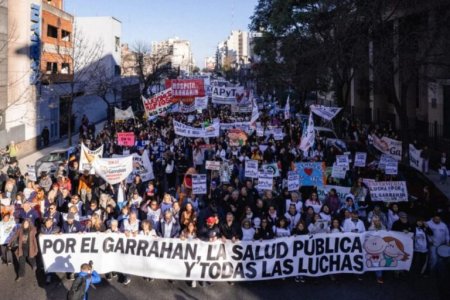
One speaker, Norma Lezana, will be speaking in Spanish, with Fede as our translator. Norma is a nutritionist and diabetes educator at El Garrahan Hospital in Buenos Aires. This public hospital is the premier hospital for complex pediatric care in South America. Norma is the General Secretary of the Association of Professional Workers and Technicians (APyT), the wall-to-wall union representing hospital workers. Last year the union led a massive strike that she’ll tell us more about.
Our second speaker is Maggie Zampieri a union colleague of mine. She was the secretary of our local union but currently is playing a more rank and file leadership role.
Can each of you tell us a little bit about your background, the work you do and how you got involved in union activities? Maggie, can you start us off?
Maggie: I’m a pediatric nurse by trade. That’s always what I’ve gravitated towards. My husband was a career student for a really long time, so we did a lot of bouncing around. I had several jobs as we followed his career. I’ve always gravitated towards where the fire is. I like hard jobs where there’s justice to be fought for and you can right a wrong.
That said, I did not grow up in a very left or very union friendly space. I had no interaction with unions at all until we finally landed at U of M, at which point I’d been a nurse for years. I started working there in 2017, right before we launched our campaign to prepare for the 2018 contract.
I was working on a unit where nurses were really unhappy, really short-staffed. They were not treated well by management and that caused them to not treat each other well. In a space like that problems kind of snowball. It was also a space that was ripe for organizing.
There were a handful of nurses on that unit that if they did anything right, it was, “Hi, welcome to 8A, you work here. There’s your locker, here’s your union card, fill it out. And one of the things we do as a union is wear red on Wednesdays.” That was just one of our organizing things.
I was stuck in adult land for a minute and wearing red head to toe to a ridiculous level was a way to be goofy and be a peds nurse. I really leaned into that, wore a lot of red and got a lot of red on a lot of other people and that was my first entry in getting active in the union. It was an easy way to get people involved. I felt like I was contributing and connecting us to the bigger picture.
I started paying attention to the union, but the 2018 campaign came and went. I didn’t take a leadership role. I was just sort of rabble rouser on my unit because making good trouble is fun. Went to the pickets, did the marches, all of that, but I finally escaped back to the pediatric world.
By 2020 a major schism developed within our union. Essentially some bad actors who had been in power for entirely too long wanted to make sure they could hold onto that power forever and duped a lot of people into thinking that what they were doing was right. While a lot of really good people got sucked into that, more good people saw through it. So that’s when I got pulled into a leadership space.
We all received an email on Christmas Day that just pissed enough of us off because don’t email me on Christmas day about your union nonsense. That made us pay attention. Then I ended up in a meeting Ted and a handful of other organizers to find out what the heck was going on.
I wasn’t super satisfied with the answers. So I went to a Facebook space that was moderated by someone who supported those bad actor leaders. When I asked a question that he didn’t want to answer he kicked me out of the group and that made me mad. I laced up my shoes and it was on.
A couple weeks later a friend sidled up to me on the unit and said, “Hey, would you be a union rep for just for two weeks until we get this sorted out?” We saved our union from a massive decertification campaign. And during that time I went from being just a casual organizer helper to deciding to run for office. I ended up as secretary.
The story is that people repeatedly invited me in and I just kept saying yes. I learned from the leaders around me and refused to lose even when it seemed really, really uphill. I’m not good at many things, but I am pretty good at organizing people. I found that niche and have leaned into it.
I’m not in an officer role anymore, that’s not any fun. But I did spend my entire day organizing turnout for the petition that we’ve got going right now and we’re 200 signatures richer for it. So here we are.
Norma: Thanks for the invitation to this meeting. I want to send my solidarity to the striking health workers and nurses.
I am a nutritionist. I studied at the University of Buenos Aires, then I specialized in pediatric nutrition and then in diabetes. I started working in 1998. I didn’t get involved immediately in union work, but I was a social activist, working around issues of poverty.
In 2009, legislation changed medical training, elevating doctors above all the other medical professionals. Although the struggle against this regressive regulation was unsuccessful, it led to the refounding of the union.
Until then, the administration of the hospital and the union leadership worked together. During that struggle there were big assemblies of workers discussing this so-called reform and other policies; from there we won the leadership and made it much more open and democratic.
In the meantime, I met and joined the MST, the political organization that I’m now a part of, and with their help we began to strengthen the union. With the last election I became the Secretary General. It’s a four-year term, and I’m in my last year.
When Milei came into office as president, he and his far-right government attempted to impose a drastic austerity adjustment against the hospital.
Ted: Maggie, what would you like people to know about what nurses are facing at the University of Michigan as we are up against the current round of contract negotiations?
Maggie: We represent about 7100 nurses. The hospital system is essentially multiple hospitals. There’s a building for pediatrics and the women’s hospital, there’s a building for other adults who aren’t having babies and a whole new building that they’ve opened around the corner, plus all of the clinics, some of which are in satellite spaces. It’s a pretty spread-out system with diverse needs across those spaces.
In our last contract we secured contractually enforceable nurse-to-patient staffing ratios for the first time. They were enforceable because there was a mechanism within the contract that cost the hospital a lot of money to break them. It became cheaper to staff us than to short staff us.
It was really embarrassing for them when we published that the University of Michigan just paid a quarter million dollars to its NICU nurses for routinely short staffing. That doesn’t play well publicly, so there’s a high incentive for them to do the right thing.
They would really like to see ratios dropped during this round of negotiations; they have come out hard against them. Since we ratified this contract three years ago they’ve been trying to poke holes in the ratio provision or slow down its implementation. They tried to wear us down but now they’ve proposing to weaken those ratios across the board.
More importantly in my mind, they’ve proposed what is essentially an elimination of the enforcement language. That’s what people are hyper-fixated on right now.
The last contract eliminated mandatory overtime. Before, management wouldn’t hire enough nurses. They would force nurses to work well beyond the time that we were contractually obligated to work and it was terrible.
There’s still the lingering shadow of being forced to stay past one’s shift in some of our procedural areas; they’re just calling it “completion of care.” For example, an Operating Room (OR) nurse can’t leave during a liver transplant. The answer is to hire more nurses.
The bargaining team is trying to shore up some of that language as management prepares their onslaught against the standing language. We need additional language and they’re attacking the language we already have! The overall feeling seems to be they’re going to give us nothing and try to take back what they already gave us.
We have passed several proposals around workplace safety. There’s an epidemic of violence against healthcare workers across the United States and very little recourse when that does happen and little support for nurses who are victims.
It sounds like management is refusing to engage with those proposals. They hired, for the first time ever, the third largest union-busting law firm in the United States to help them fight us. This demonstrates how management would rather spend their resources subjugating nurses than taking care of their employees.
Another hot-button issue is the attack on our access to time off. Last time around we beat it back. But the fact that we have to beat it back again shows us the space that we’re in. Our contract expires at the end of March, and we are working to activate our membership.
Previously our contracts expired in the summer but the date was moved forward with our last contract to March 31. The weather’s warm in June and now we may be picketing when it’s still very cold here. The weather is just part of the challenge since we’re also facing a national political administration that is not labor friendly.
We need to recognize that it is the workers who hold power — when we claim it.
Ted: Thanks. Norma, could you briefly recap the issues that led to the strike last year, the course of the strike itself and what you won?
Norma: In responding to Maggie’s comments, the issue of the patient-nurse ratio is also a central issue. When workers are overworked the quality of care suffers. It can lead to compromising the safety of patients when mistakes occur or emergencies happen.
In a children’s hospital, with very complex illnesses, we fight for calculating this ratio in a scientific way. But when using a cost-and-benefit analysis, nurses and other hospital staff are the first factor to be reduced. That’s why I understand fully what Meg is talking about.
Our struggle intensified in December of 2023 when the far-right Milei became president. The first thing he did was devaluate our currency by 118%, and therefore our salaries.
We had waged a significant struggle over salaries the year before and had won supplements that didn’t raise the base salary — but everything was wiped out. The rise in food and transportation costs led to an exodus of 300 professionals who could not accept the hospital salary.
As the country’s main pediatric hospital, this meant we had fewer workers, and given the economic crisis, more patients. We were all overworked. On top of weakening the entire health system and specifically pediatric care, there was a government plan to close the hospital that had operated for 38 years.
Huge assembly meetings of hospital workers took place, as our union methodically worked to unite all those who came out to defend the hospital. Our union brought together the sectors that are more militant with the more professional groups that don’t tend to be involved.
This unity opened other doors and we were able to hold town hall meetings that called on community support.
Maggie: We used that tool too. We called on unions beyond the health sector, families of the patients and the general public.
Norma: As the union we asked people for their solidarity because we needed to win. Human rights groups joined, and also the ISL. A leading member of the party dedicated himself full-time to this struggle. He worked with me, figuring out the day-to-day strategy given that hospital administrators were intransigent.
The administration brought many resources to defeat us. Their plan was to empty the hospital and therefore they offered no negotiations, just a strong anti-union campaign. Meg mentioned the UofM hospital hiring a union-busting firm, in our case the Milei government wants to cripple the unions, especially left unions.
Our task was to build unity in diversity, to build a broader unity with workers everywhere around two or three main demands against the austerity attack of the Milei government, which is very much like Trump’s. The party’s strategy was key to achieving unity in diversity and without any sectarianism. That is necessary to go up against a far-right enemy.
Ted: Thank you, Norma. Maggie, can you tell us about your efforts to build a more democratic union and strengthen the rank and file power of nurses at U of M?
Maggie: Probably the best story that illustrates that would be the formation of the reform caucus that Ted and I both belonged to. Historically our union had a career leader in place. She was president for 13 years and was never going to leave. She had managed to eliminate term limits and was going to hold on forever in that cushy space.
Having worked to elect someone new, you would think we would’ve had the sense to elect a different kind of leader — but we did not. We managed to pry a tyrant out of the hole, but we forgot to fill it in. Another tyrant fell into the hole because it was still tyrant-shaped. What we needed was change the culture of our union. With that we’d demand a different kind of leadership.
It took another three hard years to remove a person who became more authoritarian in the way she led and ultimately was overtly siding with management. She said we needed to give management six months to figure out how to implement the contract. And then after that six months, she still said we needed to give management space.
Since as union secretary my role was to recruit and train representatives, when the 40 reps we had began to step back from their job in frustration, they talked to me about it. Individually they felt disillusioned with the union but after our conversation they realized it was a systematic problem, and something we could change.
We got enough of them in the same room and began a campaign for internal reform. At our peak we had 50 active caucus members and forced the implementation of staffing ratios despite our leadership.
When the Emergency Room (ER) nurses spoke up about the terrible condition of the break room, we encouraged them to get that changed. They didn’t have to wait for a union leader to do it for them.
At first we were just organizing in all of these different corners. I really thought that might be enough to change the way we were all functioning. But as elections got closer, it became glaringly obvious that we were never going to get to where we needed to be if we had to fight against our own leadership as well as the hospital administration.
The union’s executive committee, which is also the bargaining team, is made up of 12 elected positions for a three-year term. Our caucus ran ten people who were active caucus members. They all 10 won. The other two officers had been supportive of the caucus demands.
The caucus was formed around this idea that good union leaders build power by giving it away. They take feedback and are always pulling in new leaders.
Before, we had a sleepy membership. If you never tell anybody what’s going on, they stop asking. And if they stop asking, they stop realizing they should care or that they should be engaged.
Now we put out a robust newsletter every month; it’s a ton of work. It means nurses way over here hear what’s happening way over there. They say, “They got it fixed. Maybe that’s something we could do too.” They’re hearing about other people’s wins and it’s contagious.
We’ve blown open the communication network within the hospital. Don’t get me wrong, we have a long way to go. But we ran candidates on a campaign platform of being accountable for the things they said they stood for. And I think by and large they’ve stood by that.
We have more reps now than what we have ever had in the history of our union. We established a system of communication team leaders (CTL), They are to develop relationships with less engaged rank and filers and the union reps.
We don’t want the typical pyramid union structure with the officers at the top and the unengaged rank can file at the bottom. We think of ours as a wheel with the people you’ve elected in the middle, holding it all together and dispersing information along spokes connecting them to the membership and reps.
The focus is always shifting because the need is ever changing, but nobody’s crushing anybody else. We’re holding each other together.
That model comes out of a lot of conversations, a lot of relationship building, and believing that it can be done — and inspiring other people to think it can be done. We just did it because not doing it really wasn’t an option.
Ted: Thanks. This next question comes from my own observations. I left Maggie’s unit, pediatric oncology, a year before Maggie started there. How have either of you faced particular challenges organizing among workers who have devoted their lives to pediatric care? For example, is there a tendency to accept demands from management that are concessions in the interest of better serving patients and their families? And if so, how have you countered that?
Norma: There’s so many things that we as health care workers have in common including the weight of responsibility we share.
When we are on active strike in El Garrahan, we clock in and we stay inside the hospital building. This is where we stay in permanent discussion. One concern is how do we care for the children who have problems while we are striking.
Being able to communicate to the public what is happening in the hospital is what turned our strike into a national issue. From the beginning of the campaign the MST advised us to publicize the concerns of all patients. This meant not only the problems they were having but what the hospital means to society. We had the support and unity of the patients and their families.
It’s very important to demand not just the need for a salary, but to link our working conditions to the needs of the entire society. That we achieved! National polls revealed 85% of the public approved of our action. That enabled us to win a 60% wage increase.
I want to highlight something that Maggie said. We have the practice of union officers permanently talking to members. The union is not just where elected officers take care of problems for the members but rather it takes the intelligence of all the workers to think through what the best strategies are, and what we should do.
When we’re on strike, nurses decide what are the minimum essential services that we maintain. Since we are meeting in the hospital’s main hall, if there is an emergency, someone runs off to take care of it.
It’s very important in the healthcare sector that we understand that we can’t win without the support of society. It’s a discussion that more sectarian organizations don’t consider.
For our struggles to win, we need to force the bosses to take up our demands. That permanent dialogue is crucial for involving workers feeling they’re not having things imposed on them but are part of what we decide to do.
In this strike we couldn’t take a step back. We had to be creative. We had to talk all the time with our coworkers and the patients’ families so everyone would know that if we didn’t win this struggle, we would lose the hospital. It wasn’t a struggle like any other.
Our strike became a national cause, with mobilizations from the farthest northern province of Argentina to Patagonia. It wasn’t about just our salary, but our ability to care for people.
The country learned during the pandemic that when the work of the healthcare sector gained value as we saved lives. If we’re overworked, if we have to go from one job to another, everyone’s health will suffer. That experience strengthened our struggle.
University of Michigan nurses marching through the hospital complex during 2018 strike. (Labor Notes)
Ted: Thanks. Can you share information, Maggie, about efforts by our union to build alliances with other unions, community organizations and social struggles in particular?
Maggie: In our last contract campaign, we received an unsolicited letter from a patient after we had authorized a strike vote. We maintained that either management had to bargain in good faith and give us contract, or we were considering walking out.
The patient wrote that he had sustained a head trauma and had been brought into the ER. Laid on a stretcher in a hallway, elbow to elbow with other overflow patients for hours on end, he was afraid to fall asleep. He understood that no one was ignoring him on purpose but that there simply weren’t enough nurses.
That’s what we’d been screaming from the rooftops. Having his letter was patient confirmation, and very helpful to us at that stage in the negotiation. Our contract is publicly available, so anyone can see what the nurse-to-patient should be.
There are legal ramifications about soliciting patient experiences, but when nurses help the community, they will respond to defend us. It’s not simply that hospital administrators are disrespectful of us, but that people understand that understaffing affects them if they’re in a bike accident and forced to lay eight hours in a flickering-light hallway hoping to walk again.
I think we are making progress in building coalition relationships with other unions. I spent a lot of time today speaking with the teachers’ union.
Teachers in our local school district are working without a contract for the first time in 29 years. They are picketing at the different schools in the district on rotating days this week. I’ll be joining them in the morning with my husband, my three kids and our homemade picket signs.
I know nurses will be reciprocated when it’s our turn to be on the line for whatever reason. There is an overlap between the two unions so it’s a natural alliance. Both are predominantly female professions and service professions. Each gets flack from some folks in the community who say “This is what you signed up for. How could you possibly walk out on pupils/patients?”
Because we work in a large hospital, there are a lot of unionized trades and construction workers. Historically we’ve tried to maintain a relationship. And we’re walking past them on the way to the hospital in the morning. They are particularly important to reach since if they don’t show up, the place grinds to a halt.
We have a lot of room to improve, but I think that coalition building is growing proportional to our internal democracy. Those two things go hand in hand. If we can’t activate our own membership, we don’t have the right to try and suck in help from another membership.
And as we near the date of our contract expiration, we go door to door to the businesses in town and ask if we can put up “We support Michigan nurses” signs.
Even in the current political reality, for the most part we’re able to harness some level of support. Many understand that if we can’t do our job, we can’t keep patients safe. Nurses can only run so fast.
About five months ago, ostensibly in anticipation of attacks by the Trump administration, the University of Michigan proactively cut their gender-affirming care program for adolescents. The program was eliminated for anyone under 19.
Ted: Maggie, how have the cuts to gender affirming care or the fear of Immigration and Customs Enforcement (ICE) impacted the populations you serve? Given that there are politically conservative nurses in our bargaining unit, has there been any change in perspective when policies are not just an abstraction but have a risk to the patients they are caring for?
Maggie: I so badly want the answer to that question to be yes, but the truth is just not that rosy. What I have observed is that the vocal people on both extremes of the spectrum have become more vocal.
People who already held hateful and exclusionary views seem to feel empowered to express those in a way that I don’t think they would have just a few years ago. On the flip side, people who believe in human rights are speaking louder.
What has been interesting is the people in the middle who hold their politics close to their chest, are speaking up. There’s really not a space for silence anymore.
The murder of Alex Pretti by ICE agents in Minneapolis did shift a number of healthcare workers. People are beginning to recognize that the system of immigration is broken and this isn’t the way to do it.
It probably goes without saying, but we do have patients where there is significant concern that they will not show up to appointments because they do not feel safe. And we can’t assure them otherwise. We’ve had patients leave care or move to other spaces for care. I think the fear of ICE is the prevalent one at this point.
Ann Arbor is a relatively affluent area. The risk isn’t as high here as I think it is in predominantly immigrant communities. But ICE is circling elementary schools in the town 20 minutes away, where my husband works.
Yes, I think we’re seeing people fearful of seeking medical care. And that will obviously impact outcomes, which is the whole point. The cruelty is the point.
Ted: In the United States the labor movement has yet to take meaningful steps toward building an independent expression of working-class politics. But in Argentina, the situation is somewhat different. Norma, could you tell us a little bit more about your political candidacy and the general political terrain in Argentina. How did the coalition that you’re part of fit into that?
Norma: Those of us in the Left Workers’ Front (FIT-U), especially in the MST, see the necessity that in addition to having militant and democratic unions, it’s also important to have a political alternative. In Argentina, the historic mass party has been the Peronists (originally followers of the 1940s and ‘50s populist leader Juan Peron —ed.).
Most workers today say they’re disillusioned with that party, especially with the Alberto Fernandez government. That led to Milei’s election as an alternative. Although in Argentina voting is mandatory, many workers didn’t vote in the election It was an historic abstention.
The debates we used to have about the crisis of capitalism leading to a far-right government is now a common discussion among workers. This presents the left in general with a huge opportunity to raise proposals.
Congress is discussing a labor “reform” that leads to almost slave-like conditions. If passed, it would eliminate almost all historical gains made by workers. To fight against this reform, we’re convinced that we need a unity far beyond the left. We have the responsibility of confronting these far-right reforms together.
What MST proposes is that we need to build something new from the left to merge with a chunk of those who are leaving Peronism, but not looking towards Milei or the right. From where we are standing, these debates are very important. In the hospital, for example, we talk to every unit, to every sector, in turn.
Being able to talk with workers not only about strikes, but the gains won over decades and are now at risk because of capitalism’s crisis. The challenge is to reach these people and present a positive and new political vision. If we only unite with our left forces, we’re not strong enough to defeat the labor reform. We need to unite with everyone who is willing to fight against this.
As for the Peronists, they’re saying there is nothing we can do, we have to wait until the next election. We disagree — we see the urgency of acting now as we see they are destroying and selling off our Argentinian, our Patagonian natural resources, our human rights, our lives. Everything is at stake.
I get up every morning thinking, what do I need to do today to be part of offering a alternative, a possibility for this world that we love so much? It is workers who make everything run, who make the hospitals run, we’re the only ones that can carry out this mission. I think we can do it.
Ted: Thank you. The last question, again for both of you, could our hospitals run effectively without management? What could this look like? Could it be a society without bosses?
Maggie: The stronger we become as a union, the more engaged that our membership becomes, the more we do the work of governing ourselves, the more obsolete middle management becomes. I would argue that we’re already approaching some level of middle management’s obsolescence.
The stronger our membership gets, the less utility there is for low level management. It’s something we will have to build and fight for. But given the greater social space we are in, that’s what immediately comes to mind.
The more that you empower nurses to govern ourselves, the more obsolete that kind of autocratic leadership structure becomes.
Nurses have long enjoyed the status of being the most trusted profession in America. Combine that with agreement across the political spectrum that our healthcare system is fundamentally broken. We may not all agree as to why or how, but you would be hard pressed to find an American who could, with a straight face, tell you it’s working well.
We are primed to respect decisions made by committees of nurses actually doing the work rather than a manager who hasn’t worn scrubs in 50 years. When nurses make decisions about our own workplace, we make decisions that positively affect patient care.
How many times has our union found itself trying to undo a dumb policy that management put in place ostensibly as an efficiency time saver, but that’s making everybody’s job harder and outcome worse?
Hospitals without bosses run by healthcare workers would be a functioning healthcare system. The closer we get to society actually wanting and recognizing that, the better off we’ll all be.
Norma: I agree entirely with Maggie. In moments of crisis we realize that it’s the workers who organize the day-to-day work in the hospitals.
I saw this during the pandemic. While the hospital administration didn’t know how to develop procedures, they talked to nurses and we already had a proposal for how to manage the situation.
Again, when we took over the hospital for this strike, we knew how to make it function with minimum guardrails. Throughout the whole conflict, there wasn’t any problem that workers couldn’t resolve.
We also had the support from families. We were able to reprogram what could be reprogrammed. We were able to maintain urgent care with minimum services.
It’s the workers of the hospital that know best how to run it. Of course, there are different ideas but we have the experience of working together. That’s where the health team comes together to figure out how best to care for the patient and involve the family in a discussion.
We apply that lesson to building a union that can work like it should. Working as a team is the same in both cases. Solidarity empathy, resolving things collectively is what makes things function. And workers are experts in how to do that, resolving problems.
For more on the solidarity campaign at Garrahan Hospital.
Source: Against the Current.