
 Version imprimable
The U.S. has practically from the beginning embargoed Cuba, attempted to assassinate its leader Fidel Castro on numerous occasions, and most recently attempted to debilitate Cuba by cutting off the country’s oil supply, all of which have taken a great toll on the Cuban people. Now it appears that Trump wants to end the rule of the Cuban Communist Party (CCP) and find a replacement for it that will open the country to foreign trade and investment, including from Cuban exiles.
Trump believes his January 3, 2026 operation in which the United States briefly invaded Venezuela and seized President Nicolás Maduro and his wife Cilia Flores, bringing them to New York for trial, was a tremendous success. Trump said at a press conference, “This was one of the most stunning, effective, and powerful displays of American military might and competence in American history.”
Trump may see that operation as a model for something similar in Cuba. Though Secretary of State Marco Rubio, who is of Cuban descent and spent part of his childhood in Miami, Florida, the bastion of Cuban exile conservatism, wants to see the CCP replaced with a liberal state and a capitalist economy and appears to prefer a negotiated settlement to a violent attempt to overthrow the government. The question is: Can he find a figure willing to deal with him and the U.S. government to make that transition, someone like Delcy Rodríguez, who replaced Maduro as president of Venezuela, and yielded to Trump, permitting U.S. companies to begin to take over the petroleum industry?
The danger is that if a resolution is not reached soon, without oil for light and heat in homes and hotels, and without energy to run the water system and the countries machines, the Cuban economy and government could fail leading to chaos, crime, and violence such as we see in Haiti. If the United States and Iran can reach an agreement that ends the war, Trump would then be free to initiate his next imperial adventure, whatever form his intervention in Cuba takes.
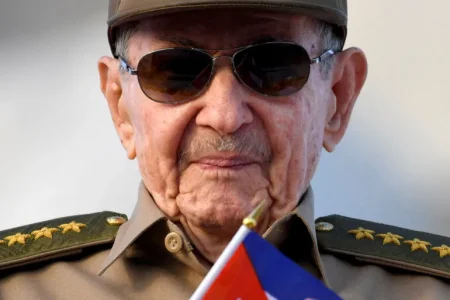
Trump and Rubio recently sent CIA director John Ratcliffe to Cuba were he met with the Cuban Minister of the Interior in Havana. He offered the country $100 million in aid, but Cuban President Miguel Diaz-Canel said that his government would prefer the United States to lift its blockade. Raúl Castro was present at the talks, even as the U.S. was preparing his indictment.
There have been only a few small protests against the recent U.S. interference in Cuba. While there are almost three million Cubans in the United States, half in Florida and others in Texas, California, and New Jersey. These immigrants came in waves since 1960s, there are few friends of the Cuban government among them. Many would support a U.S. intervention. The U.S. protests have been organized by small left groups that have supported the Cuban Communist government, and there is little support for them in American society. Recent polls show that only 15 to 25 percent of Americans would support U.S. military intervention. Trump would like a victory after his failure to win the war against Iran.
24 May 2026