
 Version imprimable
The issue came up again last week at the Tony Mazzocchi Centennial Conference held at Rutgers University Labor Center in New Jersey. Mazzocchi, a leader of the Oil, Chemical, and Atomic Workers and a central figure in the fight for legislation to protect workers’ health back in the 1960s and 70s, was the driving force in the attempt to organize a U.S. Labor Party back in 1996. Labor union leaders who had been part of that effort spoke on a panel to remember and celebrate Tony’s work that provided a forum for a discussion of working-class electoral strategies.
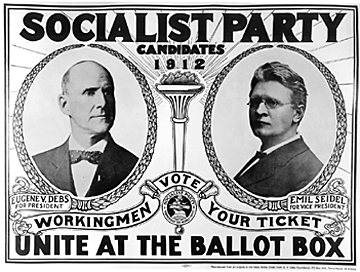
The United States has never had a successful labor party, a Socialist Party, or a Communist Party, that is one that was a serious contender for political power. The high point was reached by the Socialist Party when in 1912 Eugene V. Debs, its candidate for president received almost one million votes or 6% of all votes cast. The Communist Party’s high point came in 1932 when William Z. Foster received 103,307 votes for a mere 0.3% of the total. The Labor Party that Mazzocchi helped to found was created with the support of several major national unions and many regional and local unions. But the party’s leadership hesitated to run candidates against the Democrats in national elections, never ran a presidential candidate, fearing that a left party would weaken the Democrats and aid the Republicans. The party petered out with Mazzocchi’s death in 2002 and it died in 2007.
Today, as in the past, labor and left activists and organizations present two major strategies: the Democratic Socialist of America (DSA), the largest socialist group in the country with 100,000 members, which has rejected forming an independent socialist party and endorses and works for candidates in the Democratic Party and elects some such as congresswomen Alexandria Ocasio-Cortez and New York City Mayor Zohran Mamdani. Labor Notes staffer Jenny Brown spoke for that position at the conference, arguing that DSA candidates are movement activists who run as socialists. The Working Families Party does have its own ballot line, but it too supports Democrats. Les Leopold of the Labor Institute, a former associate of Mazzocchi, advocates carrying out education to win disaffected working-class voters of both major parties to the idea of a labor party.
The Green Party, which as an environmental-socialist platform, wins some local elections, but it has never received more than 0.7% of the vote for its presidential candidates. It is ignored by DSA, WFP, even by the far left.
Far from the progressive coasts, in the Republican state of Nebraska, Dan Osborn, a mechanic, a former union president, and the leader of an important strike, is running for the Senate as an independent—and he has a chance of winning. In a race for the state’s other Senate seat last year the Democrats decided to give him some financial assistance and he won 47% of the vote. Bernie Sanders, a democratic socialist and a political independent praised Osborn for his working-class campaign. Osborn has referred to the Senate as “a country club of millionaires that work for billionaires.” Clearly, he hopes to break into the club and shake it up.
One could say that Osborn is, on his own, testing the Labor Party idea, so far, a Labor Party of one. The question is, can the left, in search of a strategy, connect with working class candidates like Osborn, if there are more of them? Does our future lie there?
7 June 2026