
 Version imprimable
The day after his election, US President Donald Trump issued an executive order on 29 January 2025, “Celebrating America’s 250th Birthday”, and set up a political task force within the Department of War to organize, outside of all the committees composed of historians, a “unifying, patriotic, and family-friendly event" to celebrate the United States’ place in the world among “the powers of the earth… to which the laws of nature and of nature’s God entitle them”. The planned big concert will not take place, as the main artists contacted have refused to participate in a partisan event.
Trump wants to justify his current imperialist interventions, his discourse on the dangers facing white America by relying on the imaginary of conquest and colonial history. “Trump’s arguments and semantics call for a long-term reading, free of the most immediate strategic issues: it is a question of taking seriously, as a hypothesis, the filiation of which he claims [...] U.S. imperial practices [...] must be seen as the crux of an identity, expressing itself again today in a striking way – destabilizing the world and stunning Europeans.” [1]
This new form of US imperialism no longer claims to defend freedom and democracy, but affirms its desire of “restoring peace through strength for a new golden age of America”, as the Pentagon’s National Security Strategy published on 23 January 2026 says. This document, in which the word democracy does not appear once, shows that there are no longer permanent allies or enemies – only the law of the strongest and American interests count.
Trump wants to join in history the great presidents who have won or conquered land. It is no coincidence that his inaugural speech referred to President McKinley, who was at the initiative of building a U.S. colonial empire at the end of the 19th century, from the Philippines to Puerto Rico and Cuba, as well as to Theodore Roosevelt or Franklin Delano Roosevelt. To measure what is at stake, it is therefore essential to look back at the constitutive history of this country.
Celebrating the Independence of 1776... Or the conquest of 1492?
This celebration of the independence of July 4, 1776 is being prepared by public prayers and Bible readings organized with great pomp, which put forward a historical narrative centred on Christianity, the civilizing mission of the West on the American continent.
It began very early, without any particular ceremony, on 23 March 2026, with a political gesture that is far from trivial: the installation of a statue of Christopher Columbus near the White House. It was built from the fragments of a statue dismantled and thrown into the water in Baltimore during the 2020 mobilizations of the Black Lives Matter movement. Because since 2020, Christopher Columbus is no longer celebrated everywhere as a hero: states and cities have chosen to remove his statues from the public space, to no longer celebrate Columbus Day, to replace it with a day dedicated to Indigenous peoples, Indigenous Day. To combat this development, an article of the executive order for the 250th anniversary aims at “protecting American monuments from vandalism” and specifically cites the depredation of the Christopher Columbus memorial fountain.
The colonial conquest of land and the extermination of Native American populations began with the arrival of the first settlers in America, more than a century before independence. Convinced that they were a chosen people, the colonists appropriated the land of those whom they saw as savages incapable of cultivating it and which was therefore rightfully theirs. In the first colonies, in New England and Virginia, colonization took place in a bloodbath, which was added to devastating epidemics.
This exterminating conquest is celebrated in the United States during the Thanksgiving holiday, which celebrates the first harvest of the Mayflower colonists in 1621. This holiday totally obscures the genocide of the Amerindians and recounts a myth of poor Britons, religious dissidents in search of a place to practice their religion. In reality, this boat was chartered by London merchants to participate in colonization, to seek their fortune in the “new world”. Let us never forget that while the majority of these settlers were poor, not all of them were: there were migrants who arrived to make their fortunes and dominate from positions of economic strength in Britain.
How did the 13 colonies become the current USA?
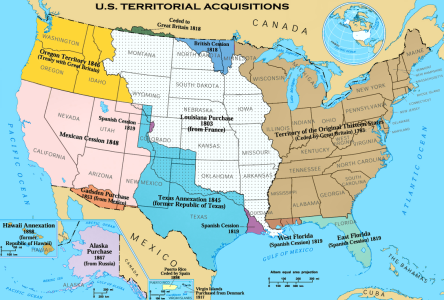
How did the 2.5 million white Anglo-Saxons (who exploited 500,000 enslaved people) who emancipated themselves from the British metropolis in 1776 became the leaders of the world’s leading power in less than two centuries? There is of course the conquest of the West erected into mythology, the genocide of the Amerindians, but the expansion was also to the detriment of the European imperialist powers present on the American continent.
Although populated by immigrants, the United States is the first nation in history to be freed from European tutelage, with one particularity: the notion of empire is consubstantial with its creation. The new country created is not the final goal, but the starting point for the construction of an empire that Thomas Jefferson calls the “Empire of Liberty,” a country in which territorial expansion is both necessary and natural. For example, as early as 1775, the United States tried to integrate Canada into its project and engaged in a war of conquest, which it lost. Thise extension continued through several channels.
Buying land
40% of the current territory of the United States was simply bought from foreign powers. Louisiana, a territory from New Orleans to the present-day Canadian border, representing 22% of the land area of the United States, was purchased from France in 1803. In 1867, it was Russia that agreed to sell Alaska, 18.7% of the United States’ land area. The last acquisition was that of the Virgin Islands, sold by Denmark in 1917.
But there have been other attempts to buy land that have failed, such as Texas in 1827, 1829 and so on. Greenland has also been the subject of multiple acquisition processes, in 1867, 1910, 1946, repeated in the 50s, recalled in 2019, so far without success. The first offer to purchase, in 1867, was part of an overall plan to bring the entire northern part of the continent into the United States. During the Second World War, the United States became the “protecting nation” of Greenland and obtained the right to build military bases there: during the Cold War, the Thule base in the Arctic was essential.
It was, and still is, a framework for the main objective, Canada, through the purchase of Alaska and Greenland. Trump is only taking up this objective in an attempt to make history by achieving it. Beyond the island’s mineral resources, he has made it a national security priority. As a result of global warming, traffic in the Arctic is steadily increasing, and Alaska, Canada and Greenland have a key strategic position for controlling the flow of trade and military control of these routes.
Several tripartite meetings involving the United States, Greenland and Denmark have been held since January 2026 during which the US government has presented three demands: the possibility of stationing its troops indefinitely (it has even begun to inspect sites likely to host American bases), a right of veto on investment agreements between Greenland and foreign countries and cooperation for the exploitation of the island’s resources. Trump’s envoy who arrived on 17 May is the same person who, upon his appointment, said he was honoured to serve to make Greenland part of the United States.
Annexations
In 1787, the United States adopted the Northwest Ordinance, which allowed its nationals who settled in a new territory outside its borders to then integrate it into the United States. This predatory economy was to be one of the levers of territorial expansion. It allowed the annexation of Mexican Texas. The Anglo-Saxon American settlers who settled there wanted to keep slavery on their plantations at a time when Mexico abolished it and imposed the emancipation of all slaves brought into the country, including those who escaped from neighbouring states such as Louisiana. The United States sought to buy Texas, but the Mexicans refused. The American colonists rebelled and declared themselves independent of Mexico after defeating the Mexican army, then asked for the annexation of Texas to the USA, which was obviously accepted with glee in 1845, giving an advantage to the slave states.
There were also “simple” annexations, such as those of Florida or lands conquered on the colonization front against the Native Americans in the West. They were adorned with motivations such as a divine mission, the expansion of Christian civilization, this “manifest destiny”, which would lead to genocide. Violence was at the heart of this conquest, in all its aspects, as illustrated by the seven land runs organized between 1889 and 1895 that made available to tens of thousands of white settlers, on a given day, the land stolen from the Native Americans: the best to the first! For example, in April 1889, 10,000 settlers settled around the area that is now Oklahoma City and created in one day the city that would become the capital of the state of Oklahoma.
Wars of conquest
In 1812, while the United Kingdom was at war in Europe against Napoleonic France, the United States invaded the English-speaking areas of Canada. This war of conquest, known as the “emancipation of Canada,” lasted three years but was a relative failure. And if, in 1846, the United Kingdom ceded three states, Idaho, Oregon and Washington, the main objective, Canada, remained British.
It is in line with this history that Trump has declared his desire to see Canada become the 51st state of the United States, using “economic force” if necessary. Beyond the declarations, there are meetings of the US administration with a secessionist movement in the Canadian province of Alberta that seeks to obtain its independence. This province is the fourth most populous in the country (about 4 million inhabitants) and produces 84% of Canada’s oil.
In the south, the integration of Texas into the United States in 1845 led to a war with Mexico in 1846, which the latter quickly lost. This was a great achievement for empire building. In 1848, Mexico was forced to cede nearly half of its territory, all the provinces west of Texas, New Mexico, Utah, Arizona, Nevada, California, and part of Colorado. In addition to all this, there was an expansion in the Pacific, in 1867 the annexation of the desert island of Midway, then in 1897 Hawaii. In half a century, through annexations, wars and purchases, the United States of the 13 original colonies had tripled its surface area, and in 1890 proclaimed the end of the colonization front.
White supremacism consubstantial with conquest
As soon as the American Civil War ended in 1865, the army invaded and controlled Native American territories, massacring and starving the population. Fifteen years later, all the surviving tribes were locked up in the reservations. More than 90% of the Native American population, estimated at 850,000 people when Christopher Columbus arrived, perished during the conquest, a veritable genocide: only 50,000 survivors remained at the time of the Wounded Knee massacre in 1890.
To populate and whiten these immense territories inhabited by Native Americans, Latinos and enslaved African descendants, a massive immigration of European populations was organised from the 1840s onwards, which would grow throughout the 19th century. Between 1819 and 1840, 750,000 immigrants arrived. Between 1840 and 1860, 4 million, and even 25 million between 1880 and 1920. From 1921 onwards, quotas were introduced favouring migration from Western and Northern Europe in order to maintain the hegemony of the white Protestant population in the face of the increase in the share of Catholic, Jewish and non-white minorities. Racial segregation, the official doctrine of “separate but equal,” was institutionalized in the United States from the end of the Civil War (Jim Crow laws from 1877) until the mobilizations of the 1960s.
Struggle against European imperialists central
The confrontation with the European powers is not new. This is the meaning of the Monroe Doctrine, as enunciated in 1823 in a message to Congress: “In the wars of the European powers in matters relating to themselves we have never taken any part, nor does it comport with our policy so to do. It is only when our rights are invaded or seriously menaced that we resent injuries or make preparation for our defense.… With the existing colonies or dependencies of any European power we have not interfered and shall not interfere. But with the governments who have declared their independence and maintained it, and whose independence we have, on great consideration and on just principles, acknowledged, we could not view any interposition for the purpose of oppressing them, or controlling in any other manner their destiny, by any European power in any other light than as the manifestation of an unfriendly disposition toward the United States.”
It was a time when the European powers began their colonial conquests in Africa and Asia. European creditors were threatening to intervene to recover their debts in Latin America. The United States thus asserted its hegemony over everything south of its territory, this time without territorial conquest. It would involve support for military dictatorships, various caudillos, and if necessary dozens of armed interventions in Venezuela, the Dominican Republic, Colombia, Guatemala, Cuba, Nicaragua, Honduras and Haiti.
From the Monroe Doctrine to the Roosevelt Corollary
When the United States had acquired a power that allowed it to build a military apparatus, to equip itself with bases elsewhere than on the American continent, it put forward another, lesser-known imperial theory, the “Roosevelt Corollary”, set out in a message to Congress in 1904. At this time, the United States was expanding outside the American continent. They annexed Hawaii in 1898, and set up the Pearl Harbor naval base there. They won a war against Spain that allowed them to annex Puerto Rico and occupy Cuba and the Philippines, countries in which they pursued a “classical” colonialist policy.
Theodore Roosevelt went further than Monroe, extending the “right”" for the United States to intervene beyond the American continent “until some method is devised by which there shall be a degree of international control over offending nations”. The United States thus arrogated to itself the right to decide whether a nation makes “good use” of its independence and under what conditions it can exercise an international police right: “Chronic wrongdoing, or an impotence which results in a general loosening of the ties of civilized society, may in America, as elsewhere, ultimately require intervention by some civilized nation, and in the Western Hemisphere the adherence of the United States to the Monroe Doctrine may force the United States, however reluctantly, in flagrant cases of such wrongdoing or impotence, to the exercise of an international police power”.
The National Security Strategy, a new imperial era
The current proponents of MAGA are in the imperial, racist and conquering lineage of the 19th century, of the Monroe and Roosevelt doctrines, to which they constantly refer. The plan of the US National Security Strategy published on 6 December 2025, presented as a “Trump corollary to the Monroe Doctrine”, is enlightening.
It reaffirmed the importance of remaining the strongest country economically and militarily and of “the restoration and reinvigoration of American spiritual and cultural health”, an America “that looks forward to a new golden age”. To do this, we must put an end to "American strategies since the end of the Cold War”: we must end America’s “willingness to shoulder forever global burdens” betting on globalism and so-called “free trade”” [which] have tied U.S. policy “to a network of international institutions, some of which are driven by outright anti-Americanism and many by a transnationalism that explicitly seeks to dissolve individual state sovereignty.” It pronounced the death warrant of the international institutions that emerged from the Second World War. The United States is equipping itself with the means to counter the rising power that is China, with all possible means, without any brakes.
China, referred to as “the other side of the world”, is the designated adversary. The United States “cannot allow any nation to become so dominant that it could threaten our interests. We will work with allies and partners to maintain global and regional balances of power to prevent the emergence of dominant adversaries. As the United States rejects the ill-fated concept of global domination for itself, we must prevent the global, and in some cases even regional, domination of others.”
This is about much more than US dominance over Latin America, it is about stopping foreign actors’ incursions into the US economy while maintaining “secure and reliable supply chains and access to critical materials”. The United States no longer wants to support the world order on its own, and therefore it will not be “equally attentive to all regions”, with a readjustment of its military presence according to its priorities.
Two regions are excluded. The Middle East, in which the US has a heavily armed colonialist military presence, a kind of gigantic American aircraft carrier that enforces imperial order in the area, Israel. It is enough “that the Strait of Hormuz remain open, that the Red Sea remain navigable, that the region not be an incubator or exporter of terror against American interests or the American homeland, and that Israel remain secure.” And on the other hand, Africa, in which it is enough to join forces with “capable, reliable states”.
In the Western Hemisphere, the US must be “preeminent” and expand its network, discouraging its members in various ways from collaborating with others. Europe, which remains “strategically and culturally vital for the United States [...], one of the pillars of the global economy” must therefore be vassalized, while financing its defence itself. It must adapt politically to the current US worldview to avoid a “civilizational erasure” (some countries eventually becoming “majority non-European”), aligning itself with “healthy nations”.
Two obsessions are present: mass immigration and the rejection of the “disastrous “climate change” and “Net Zero” ideologies that have so greatly harmed Europe, threaten the
United States, and subsidize our adversaries.”
Regarding Russia, which is almost absent from the document, one idea dominates, that of rejecting “NATO as a perpetually expanding alliance”. Both the United States and Russia have an interest in the destruction of all coordination between the European powers, and the destruction of their democratic model. Some to be able to vassalize them more easily, one by one, the other to take back part of the USSR’s zone of influence. As long as Putin’s Russia limits itself to this perspective, it is not perceived by the US as a competitor or a threat. This is what fundamentally explains their attitude to the Russian imperialist aggression against Ukraine.
Finally, the Indo-Pacific region, which accounts for nearly half of the world’s GDP, “is already and will continue to be among the next century’s key economic and geopolitical
battlegrounds” The document analyses Chinese advances, without explicitly mentioning the major Silk Road programme, the aim of which is to secure the movement of goods outside the traffic lanes totally controlled by the United States. It only insists on the need to “rebalance global trade relationships”.
It is in this part that the sound of boots is heard, the need to build “a military capable of denying aggression anywhere”, which is the usual way of the dominant to express their desire for an offensive. The question of Taiwan, because of its “dominance of semiconductor production” but also because it “splits Northeast and Southeast Asia into two distinct theaters. Given that one-third of global shipping passes annually through the South China Sea, this has major implications for the U.S. economy.” The message is very clear: hands off Taiwan, our strategic interests are at stake.
“If the doctrine is the basis of a singular conception of space, breaking with the European order, it is because the Western hemisphere has no precise delimitations. The doctrine can thus be seen as a process of despatialization of sovereignty, the latter no longer being indexed to a sovereign state territory within its borders. It is now the ‘rights and interests’ of the United States that delimit the space of its prerogatives.” [2]. This conquering ideology aims at the construction of a space, called the Western Hemisphere, in which U.S. capital and military have secure and unconditional access to the resources and markets that are necessary to strengthen it.
It is based on three pillars. An internal white supremacist policy of reconquest through the mass expulsion of immigrants. A marginalisation of Europe. An appropriation of new land, resources, wealth to be the strongest in the confrontation with China, by reviving the expansionist version of the spirit of the “border” to use the founding myth of the United States.
The American empire in crisis is all the more dangerous in its desire to move quickly to reconstitute its power in the face of China through dispossession and domination.
How to counter this imperial offensive?
We are at the beginning of this new imperial offensive by the United States. In order for it to move forward, it is necessary, from the point of view of the United States, that the world order that emerged from 1945 be abolished, that we return to the era of empires, of conquests, of the right of the strongest without any mask, with regard to everyone. The forms it will take will depend both on the reactions of the other empires involved, and mainly on China, and on popular reactions, particularly within the United States itself.
We must fight, denounce, mobilize against all these imperial machinations of the United States that seek to dominate and vassalize the entire Western Hemisphere, and reopen an era of empires on a global scale. The challenge is to achieve the existence of a vast popular movement of the exploited and oppressed masses against all imperialist aggressions, wherever they come from, here from the United States, there from Russia, from Israel, or from China. In this great confrontation that is being organized, we have only one compass, the right of peoples to self-determination, while remaining independent of the bourgeois governments of the different countries.
July 2026
Translated by International Viewpoint from Inprecor.