
 Version imprimable
After several years of seeming to be politically invincible, Trump has become increasingly unpopular including even in MAGA circles and is widely seen as a handicap for Republican candidates. Losing control over one or both houses of congress would represent a blow to Trump’s domestic and international agenda. A defeat for congressional Republicans will also be a sharp rebuke to Trump himself who has stepped up his efforts to use state power to prevent Democratic party victories through lies about election fraud and non-citizen immigrants voting, attempts to use the courts to limit voting in Democratic areas, and dark threats to send armed ICE agents and even the military to polling stations.
The elections are referred to as “midterm” in reference to the academic calendar and take place at the halfway point of the four-year presidential mandate for many, but not all offices at the federal and state levels as well as elections for state governors. Trump has had a Republican majority in both house of congress which has acted as a rubber stamp for his imperialist adventures and assault on democratic rights, political institutions, vulnerable communities, and the environment. But Trump has pursued his reactionary agenda largely through executive orders that have often overstepped congressional authority. Trump will very likely continue to try to sidestep congress, particularly if the Democrats become the majority party in both houses. The Supreme Court with its conservative majority has largely also acted as a rubberstamp for Trump but has nonetheless shown an independent streak in several important rulings such as on the question of birthright citizenship and on his attempts to intervene in the voting process.
Invincible No More
Trump’s slumping political fortunes are largely the predictable result of his own policies, particularly the high cost of living exacerbated by his tariff policies and the Iran war. His Republican allies have mostly sought to distance them from him. His insistence on weak candidates for Senate in South Carolina and Texas where Republicans have held those seats for decades, will likely be seen as major political gaffes in the event that Democrats prevail in those elections which could mean that the Republicans would lose their Senate majority. The billionaires behind Trump have been exasperated by the tariffs which have mostly harmed them, and some sectors such as agriculture and meatpacking, areas with large, mostly Mexican immigrant labor have come to resent the scope of Trump’s anti-immigrant campaign. Latinos, a population of which over 40% has voted Republican in recent national elections have recoiled at the violence and cruelty of the ICE terror campaign against immigrant Latino communities.
The anticipated victory of enough Democratics to take over the House of Representatives and possibly the Senate has nothing to do with the Democrats offering any progressive alternative to Trump’s policy. During Trump’s worst outrages from the deployment of violent ICE brigades in US cities and the deportations, to the kidnapping of Venezuelan President Nicolas Maduro and his wife Celie Flores and the looting of the Venezuela’s oil wealth, to the attack on trans people, to the war on Iran, no oppositional voices have been milder that those of the congressional Democratic party congressional leaders, Chuck Shumer, leader of the Democratic party delegation in the Senate, and Hakeem Jeffries, Democratic leader of the Democratic delegation in the House of Representatives. It was the Democratic party’s slide to right and its embrace of neo-liberal economic and social policies that help make Trump’s first victory in 2016 over Hillary Clinton possible. If the Democrats take the majority in the House of Representatives and much more so if they win the Senate majority and thus control both house of congress, they will be under immense pressure to undo Trump’s policy faster and more thoroughgoing than they would like.
The Big Tent
There is also a discussion within the Democratic Party and DSA on the relation between the two. Bernie Sanders favors a big tent party with a range of political and ideological currents which would include DSA. The reformist and electoralist currents in DSA are very interested in having a seat at the table. DSA-endorsed Francesca Hong, a Wisconsin state representative who ran and narrowly lost, in the Democratic Party primary for governor spoke in favor of a big tent Democratic party during a televised debate. Hong is now campaigning for David Crowley, who narrowly beat her in the gubernatorial Democratic primary with support from the Democratic party establishment. The conservative big money wing of the Democratic party is largely against giving the democratic socialists a place in the party although some enlightened centrists could very well see advantages in integrating an energetic electoralist oriented left wing which it could control better within the party than without. As gangsters in the Francis Ford Coppola film The Godfather reasoned, one should “keep your friends close, and your enemies even closer.” In any event, if all DSA-endorsed candidates for the House of Representatives win their elections, they would have a delegation of seven (there are currently 214 Democrats to 218 Republicans), far too small have much influence on party policy.
DSA at a Crossroads
Since its rapid growth beginning with Bernie Sanders’ campaign for the Democratic Party presidential nomination in 2016, DSA has not endorsed a candidate for President. Currently however, the more pro-Democratic party reformist wing in the DSA leadership seems to favor DSA endorsing a candidate for the 2028 presidential elections and it would be in the Democratic party, very possibly Alexandrea Ocasio-Cortez, AOC. Many on the revolutionary socialist left today also support the strategy of using the Democratic party ticket -the so-called “dirty break” with the Democratic party, as opposed to those who support a “clean break” with the Democrats in favor of independent political action. Revolutionary socialists who favor using the Democratic party ballot line see it as a short-term tactic on the road to building a left alternative or Labor party at some point in the future. But as Kim Moody recently put it, this “tactic become strategy.” Indeed, there are clearly widespread illusions among the largely inexperienced DSA membership about the possibility of transforming the capitalist-run Democratic party into a pro-working class, anti-capitalist party. For many DSA members, running in Democratic Party primaries is a strategy.
The Mamdani Experience
Zohran Mamdani’s victory for Mayor of New York city and the good possibilities that DSA endorsed candidates for mayor in Washington DC and Los Angeles could win in November, have put wind in the sails of the strategy of using the Democratic party ballot line to win primaries and then general elections. But a closer look at Mamdani’s experience in office reveals the contradictions and limitations of socialists running as Democratics with Democratic political and material resources.
The victory of Zohran Mamdani in the New York Democratic mayoral primary election which all but assured his victory in the general election has had a big impact on debates on the left and in DSA. In the primary Mamdani faced Andrew Cuomo, the former governor of New York state who was accused by several women of sexual harassment, which made Mamdani’s primary victory possible which in turn all but assured his victory in the general election given the strength of the Democrats and weakness of the Republicans in New York city politics. Mamdani appealed directly to working class New Yorkers with a program of rent control, free public transportation, and affordable childcare. Winning the Democratic Party primary gave Mamdani access to considerable political and material resources including the endorsement of centrist Democrat Governor of New York, Kathy Hochul.
But of course, this support came with strings attached. Hochul made it clear that Mamdani’s proposal to levy a billionaire’s tax on the great fortunes to pay for his programs was off the table. He has also felt politically constrained to retain the former police chief Jessica Tisch, a billionaire in her position even after NYC police aided ICE agents who recently killed a person during a violent operation. To these political constraints preventing Mamdani from acting consistently on behalf of working-class New Yorkers are added institutional constraints facing any mayor. Budgetary restraints prevented Mamdani from supporting the just demand of New York city’s paraprofessionals for a one-time ten-thousand-dollar bonus.
Independent Political Action
The Mamdani experience and the debates on the left regarding the use of the Democratic party ballot line is the most recent incarnation of the debate around the question of independent political action. The absence of a mass political party with some sort of institutional connection to the labor movement is a key aspect of American exceptionalism and an important barrier to the independent mobilization of the working class outside of the two main capitalist parties. Revolutionary socialists in the US have long considered the independent pollical organization of the working class and its allies as fundamental and necessary step to bring the working class out of its atomization and political subordination to the capitalist parties, towards anticapitalist class consciousness, action, and organization. The DSA today has the opportunity to help solve the question of independent working-class political action by educating its members and political audience on the class nature of the Democratic party and agitating on the need for a mass independent socialist or labor party.
However, reformist currents in the DSA leadership particularly the Groundwork and Socialist Majority caucuses have come out in favor of DSA endorsing a candidate for the 2028 presidential election, beginning with endorsing a candidate in the Democratic party primaries. They have launched a campaign to “draft” Alexandra Ocasio-Cortez (AOC) as candidate in the Democratic party primaries. Some revolutionary socialists like the Bread and Roses caucus in DSA also support an AOC candidacy in the Democratic primaries.
Post-election Period
The post-election period will present a new political terrain. If the Democrats win control of both houses of congress, they will be under enormous pressure to undo the damage Trump has done. Such pressure would likely push the Shumer-Jeffries congressional Democratic party establishment to go further than it would like on issues such as US support to Israel, tax cuts, transgender rights on which they have already shown themselves as unreliable allies, environmental deregulation, releasing the Epstein files, and much of the mostly neo-liberal agenda that Trump and his Republican congressional majority have enacted. Their inevitable hesitancy on these issues will further expose their true nature to those on the left who still harbor illusions on the progressive nature of the Democratic party. The post-election period will also signal the opening the campaigns for the 2028 presidential elections.
The coming period will also be a crossroads for DSA. Will it chart a course that will bring it and the energy of 135,000, mostly young members into the Democratic party where that energy will be dissipated? Or will it help create an independent political alternative for workers and the oppressed to fight Trump’s neo-fascist, imperialist, extractivist neo-liberal attacks and lay the groundwork for a mass labor party outside and in opposition to the two capitalist parties?
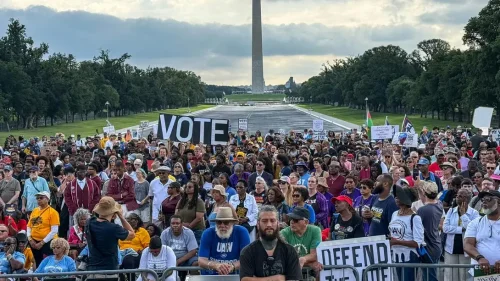
The post-election period will also hopefully signal the return of mass anti-Trump protests. With the exception of a recent massive “protect the vote” called by the pro-Democratic party, NGO-dominated No Kings! apparatus, the mass movement has been largely dormant during the last few months as social movement energy was diverted first to Democratic primary electoral activity, and over the last few months, to the general elections.
Milwaukee,
30 October 2026