
 Version imprimable
The attack followed weeks of brutal extra-judicial killings of crews on supposed drug running boats near the Venezuelan coast and the Pacific. Then, on January 9, in the streets of freezing Minneapolis, Minnesota, an ICE agent coldly murdered an unarmed white US citizen Renee Goode, a 37 year old mother of two involved in non-violent immigrant support work. The numerous video recordings of Good’s murder helped make her the best known of at least thirty two people killed by ICE agents.
Linking the two seemingly disparate cases is the increasing use of violence against people of color at home and abroad and their allies on the basis of fictious accusations of narcotics smuggling. The naming of Stephen Miller, the neo-fascist commandant in charge of Trump’s racist immigration policy as one of the top Trump government officials in charge of immigration policy strikingly underscores the connection between the assault on Venezuela and the ICE murders.
Within hours of the attack on Venezuela emergency protests were held in several cities ranging from a few hundred to two thousand in New York city.
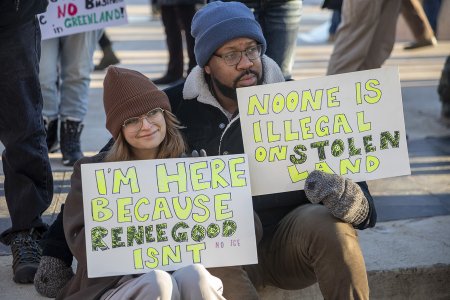
But it was the murder of Renee Goode that struck a nerve in the US population. Thousands of protests throughout the country were held to commemorate Good and demand the abolition of ICE. Polls show huge support for this demand. The government responded by accusing Good of hitting the ICE agent with her car, though videos clearly show that her car was moving away from the officer. The federal investigation into the shooting has excluded local Minneapolis officials and threatened an investigation into Goode’s widow’s ties with militant groups -activity protected by the US constitution. Jonathan Ross, the Christian nationalist ICE thug who murdered Good has not been charged and is not currently being investigated. The government responded by sending more ICE agents to Minneapolis and Trump threatened to invoke the rarely used nineteenth century Insurrection Act to send in regular military troops into the city. ICE is now claiming the right to conduct raids on private homes without a search warrant, a move that if generalized would mark a dangerous blow to democratic rights and a further step towards authoritarianism and neo-fascism.
There is a widespread sense that the city is occupied by a hostile force. Minneapolis’s Democratic mayor, Jacob Frey, and Democratic Governor Tim Waltz have used strong words to oppose ICE and demand it leave the city and state but have done little else. While vice-President JD Vance has blamed Frey and Waltz for obstructing ICE operations and the FBI has opened an “investigation” of both of them, Minnesota police are participating in repressing the protests.
ICE have been terrorizing cities and towns across the country for months now, but Trump has special hostility to Minnesota, a traditional liberal Democratic state with a rich history of labor struggle. Minneapolis, the state’s largest city is also home to a sizeable Somali population who has arrived in recent decades. One of them, Ilhan Omar is US representative of the state’s fifth district which covers most of Minneapolis. She is one of the four members of the “squad“ - four outspoken progressive women Democratic members of congress who Trump routinely attacks and threatens on social media. Trump has claimed that Ilhan, who is a US citizen “should be in prison” and deported.
Birth of a Social Movement
There were over 1,000 demonstrations held on January 10 to protest Good’s murder. Many, but not all, DSA chapters answered a call from the DSA national leadership to participate in the protests against the aggression against Venezuela.
The efforts to defend immigrants from ICE raids have all the markings of an authentic nascent social movement. Activists use classic tactics from the handbook of social protest - marches, rallies, the chanting of slogans, and creative original methods as well such as the blowing of whistles when ICE agents arrive in a neighborhood. Neighborhood organizations have been established throughout the country that organize shopping and transportation for immigrant families fearing ICE violence, arrest, and deportation.
These groups are made up of ordinary citizens, many of whom had not been involved in politics before seeing their neighbors and coworkers snatched by masked armed ICE officers. Rightwing journalists have been outraged at what they call “wine moms”-middle class suburban white women participating in neighborhood watch groups. In the case of Minneapolis, the center of current ICE protests, the network of support and mutual aid groups can be traced back to the George Floyd protests of 2020. High school students around the country have walked out of classrooms.
Groups from different parts of the country are beginning to relate to each other, sharing resources and tactics. For example, an ICE watch group on Chicago’s North Side, called Protect Rogers Park, helped train ICE watchers in Minneapolis. “Know your rights” cards can be seen in stores and restaurants in Mexican and other immigrant neighborhoods in many cities. Some schools in the city have chosen to close as a precaution against ICE raids. Tenant unions in LA and elsewhere have blended into the movement, further underscoring the deep implantation of the movement into working class lives and other struggles.
Such networks of mutual aid will connect with other existing movements laying the basis for larger and larger actions and strengthening the general anti-Trump movement. These are networks of working class solidarity that serve as a powerful resistance to Trump’s racist white Christian nationalism and give us a glimpse of the possibility of a democratic self-organized society.
Focus on Minneapolis, Minnesota
The video recordings of Good’s murder and footage showing ICE agents breaking down doors, arresting a Hmong refugee and leading him outside half dressed in the frigid temperature, and others showing the arrest of a five year old boy by armed masked ICE agents along, with footage of the heroic resistance of the people of Minneapolis, have put the spotlight on Minneapolis.
A day of protest, called by some a “general strike” took place there on Friday, January 23. Many small businesses closed to protest ICE presence, and although there were few actual strikes, unions such as the United Auto Workers (UAW), teachers unions, and even the usually conservative construction trade unions, as well local labor councils endorsed the protests and joined in the demand that ICE and other repressive forces leave. In spite of extreme cold, thousands marched outside and more rallied inside a down stadium. Others protested at the airport where ICE agents arrive in Minnesota, and from which arrested immigrants are deported. Over one hundred clergy people were arrested following a peaceful civil disobedience action at the airport. [1] Over two hundred and fifty actions in solidarity with the Minneapolis movement and its demands took place throughout the country.
21 January 2026, updated on 24 January 2026