
 Version imprimable
It is implementing increasingly repressive migration policies and congratulates itself on having stemmed the problem. The consequences: illegal police violence, systematic pushbacks [2]) and broken lives on the margins of Europe. While the Serbian movement is fighting against corruption and for political rights, how can we explain the fact that the issue of migration remains largely absent from its demands?
The migration issue, conspicuously absent from the Serbian student movement
In Belgrade, the massive student mobilisations against corruption, political repression and the authoritarianism of Vučić’s regime almost never include the migration issue. For many, the “problem” has been solved with the diversion of the Balkan route. The camps are far away, invisible, relegated to the margins of the city. However, the issue is not completely absent from the Serbian political scene: the Solidarnost movement, which we met, makes the defence of migrant workers a central point of its struggles, particularly during protests against the exploitation of Indian workers in industry and construction.
But this politicization remains strictly confined to workers living in Serbia. For most of them, the final destination is the Schengen area. These exiled people, stuck in camps, deprived of status and rights, remain outside the scope of mobilization and suffer the full brunt of violence, in total invisibility.
Illegal practices at the Serbian borders
The violence observed at the borders is neither accidental nor marginal. It is part of the security shift in European migration policies that has been in place since the 1990s and continues with the very recent European Pact on Migration and Asylum. Europe is outsourcing border control to EU candidate countries such as Serbia. [3] The gradual closure of the Balkan route and the implementation of European migration policies have transformed Serbia into a “buffer zone”, criminalizing irregular passage and strengthening border controls. [4]
On the ground, the consequences are immediate. Many associations have deserted the border area due to the dangerous conditions on the ground. Those that remain have withdrawn to Belgrade. They are trying, as best they can, to meet basic needs. For exiles, Serbia was supposed to be a stopover. It has become a prison, sometimes even a tomb. None of the following testimonies can truly convey the horror that is taking place at the borders.
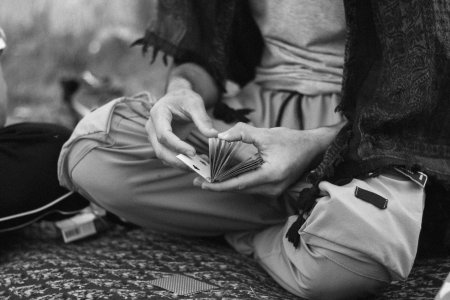
At the Obrenovac camp, on the outskirts of the capital, families wait. We are not allowed to enter, so we meet them outside. On a picnic blanket, there are card games and children’s drawings. We spend the afternoon drinking tea and playing cards. A young Moroccan man with a broken leg plays ball with the children. His injury and lack of medical care have put an end to his journey. He has been stuck there for eight years, with no prospects for the future. An Iranian couple has come to seek political asylum in Germany, where friends are waiting for them. They have raised the money needed to pay the smugglers: several thousand euros. Today, they are postponing their departure. The young woman explains: “It’s very difficult to see the person you love being abused by the police, but if we go back home, he will be killed.” They have already been subjected to several pushbacks, a practice deemed illegal under the 1951 Geneva Convention.
Outside the camps, people on the streets hope they are only passing through. They have been in Serbia for a few days and are trying to escape to Europe. A man arrives, his arm torn to shreds by dogs. Using his phone and Google Translate, he describes the man holding the leash: a Bulgarian police officer who must be working for Frontex. The agency is made up of police officers of all European nationalities who come to play manhunt at the borders. It is a cruel game with no rules, in which the same side always wins. At night, raids are organized to remove people in exile from their shelters. Taken to the police station, they pay the corrupt Serbian police to be released. Two fourteen-year-old boys have just crossed every border from Afghanistan without stopping, walking more than five thousand kilometres. They ask for shoes, as theirs are too worn out from the journey. The next day, after they have managed to cross into Hungary, one of them sends me a text message saying "Help". I never hear from him again.
Can a state be democratized without addressing its margins?
While Serbia zealously enforces repressive European policies, it fails to respect the democratic values demanded by the student movement. Similarly, although the European Union has finally called the Vučić government to order over its repression of the movement, it continues to use the country as a testing ground for illegal migration policies.
The silence of the Serbian social movement on migration is not an anomaly: it is the product of an active depoliticization of the subject. By treating migration as a technical and security issue, Europe is transforming borders into spaces of exception where anything goes. These practices, initially inflicted on the most marginalized, always end up spreading. Borders are heresy and those who defend them are criminals.
10 January 2026