
 Version imprimable
What is the situation in terms of press freedom in Serbia and how does the public media function?
In the face of threats to press freedom in Serbia, and in particular state pressure, a coalition has been created to demand and act for independent information. Press freedom in Serbia is in serious decline: threats, harassment and attacks are frequent, and institutional protection is increasingly unreliable. In 2025, NUNS recorded 371 cases of pressure, attacks and threats against journalists (including 113 physical attacks and 165 threats), and international monitoring platforms reflected the same trend, confirming that Serbia is among the riskiest environments for journalists in Europe. Officially, the media landscape is pluralistic, but in practice, political influence is exerted through a combination of mechanisms: pressure on key institutions and regulators, opacity of public spending and co-financing of projects, pressure via state-linked companies and advertising, and sustained campaigns to delegitimize critical reporting.
These pressures are amplified by a weakened, often barely functioning media market and precarious working conditions, which reinforce the media’s dependence on sources of funding that can easily become tools of influence. When incomes are unstable and labour rights are fragile, newsrooms become more vulnerable to “disciplinary” measures such as dismissals, reassignments or changes in internal rules. This is also evident in public service media, which fail to fulfil their public interest mission: journalists and editors who try to resist pressure or insist on professional standards are too often faced with disciplinary proceedings and other forms of retaliation, sending a chilling message to the entire profession.
Ownership pressures also remain significant on a larger scale, due to concentration, opaque relationships, and politically tinged business interests. As the market shrinks and ownership structures move closer to power centres, editors and journalists increasingly run into informal “red lines,” while key stories are downplayed, relativized, or pushed off the agenda.
A particularly alarming development is the return of the state, through state-owned enterprises, to media ownership. Telekom Srbija, a state-owned company, now owns or controls about 20 media outlets, and the impact on editorial policy has become increasingly visible since last year. Digital surveillance is a particularly dangerous new dimension. At the end of 2024, the first confirmed hacking of a journalist’s phone was documented, as well as at least three unsuccessful attempts to install spyware. The scale of the phenomenon is probably greater, but it is technically complex to prove such intrusions, and awareness of these risks is only beginning to develop in newsrooms.
Are there opposition or independent media? How do they work and what is their audience among the population (especially in which sectors)?
Yes, Serbia has independent and investigative media (including independent TV/cable channels, online newsrooms, weeklies and investigative centres). They typically operate through a combination of revenue from their audience (subscriptions/donations), commercial revenue where possible, and international support for projects, but this model is fragile in an environment where political and economic pressures often punish critical journalism.
Their audience is strongest among urban and politically engaged citizens, including students, professionals, civil society circles, and parts of the diaspora, while their reach is limited by a highly polarized news ecosystem and the dominance of pro-government tabloids and broadcasters in mass distribution.
According to the findings of the Reuters Institute Digital News Report 2025 for Serbia (presented on the country page), independent brands linked to United Media are among the most trustworthy: N1 (48% trust), Nova.rs (46%), TV Nova (44%), but also other independent media outlets such as the weekly Vreme (40% trust), while overall trust in “news in general” is only 27%.
Can you tell us about the Coalition for Press Freedom in Serbia? How did it come about and what are its demands?
The Media Freedom Coalition (Koalicijaza slobodu medija) is an informal coalition that brings together leading journalists’ and media organisations in Serbia to act jointly when media freedom is under threat and to coordinate advocacy for better conditions for journalism. The Coalition is composed of: the Media Association; the Online Media Association (AOM); the Association of Independent Journalists of Vojvodina (NDNV); the Association of Independent Journalists of Serbia (NUNS); the Association of Local and Independent Media “Lokal Pres” (professional association); the Slavko Ćuruvija Foundation; and the “Nezavisnost” section of the Culture, Arts and Media Workers’ Union (GS KUM Nezavisnost).
It was born in response to the increasing pressure on independent journalism, attacks and threats, weak or politicized institutional protection, and opaque “reform” processes that often exclude credible professional actors, as individual organizations usually cannot tackle systemic issues alone. The Coalition is organized democratically and independently of political parties, government agencies, ideologies and religious institutions. It operates throughout Serbia in accordance with European and international standards on freedom of expression and the right to information.
Its main demands and priorities are: strengthened protection for journalists and media workers and an end to impunity for attacks; joint responses to violations of journalists’ professional standards and rights; transparent and accountable use of public funds in the media sector, including the control of public funding and the prevention of political patronage; credible and independent regulation and strengthened self-regulation; transparent legislation with real participation of professional organisations; the protection of the editorial independence and pluralism of the media, including the fight against political and landlord pressures; and the creation of a fair, free and non-discriminatory media market, while supporting professionalism and high journalistic standards, in both traditional and digital environments.
What has been and is the relationship between the opposition/independent media and the student movement?
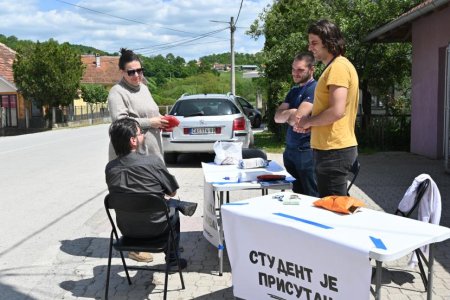
Independent media and investigative bodies have played a crucial role in documenting the protests and making student demands visible, especially when the pro-government mainstream media portrays the protests in a negative light or provides limited and/or biased coverage of them. Recent reports on student protests in Serbia highlight both the scale of the mobilization and the hostile environment surrounding it.
At the same time, the student movement relies heavily on direct communication (social media, live broadcasts, networks on the ground, and the creation of new media such as Blokada or Zoomer), partly because trust in the big broadcasters and tabloids is low. This creates a parallel public sphere where independent journalism becomes a key checker and amplifier, but also a target, as pressure and risks increase around coverage of protests.
10 January 2026