
 Version imprimable
Led by the SNS [2] since 2012, but participating in government since the 2000s, the ruling party is one of the main architects of the transition to neoliberalism and privatisation that followed the collapse of the Federal Republic of Yugoslavia.
The student mobilization that began in November 2024 was met with resistance from an authoritarian regime that controlled the country’s media, relied on the support of local parties representing national minorities, and employed entrenched corruption mechanisms. In a country where a significant portion of the workforce is employed directly or indirectly by the state, membership in President Aleksandar Vučić’s party and attendance at its rallies are mandatory for access to employment and housing, as well as for maintaining one’s position in the public sector.
Anti-regime protests have become a near-daily fact of life in Serbia since 2016, when masked men demolished buildings overnight in Belgrade’s Savamala district to clear ground for the “Belgrade Waterfront,” a flagship development project tightly linked to the ruling Serbian Progressive Party (SNS). That event symbolized the impunity and collusion between politics and business that now defines the system. [3].
Since then, waves of mobilization against the government have occurred periodically. In 2019, and again in 2023, students protested against electoral fraud. However, while Vučić called for early elections in 2023, he now refuses, faced with the tenacity of the student movement and the popular support it enjoys in the country. This reflects the regime’s fear of losing popularity, exacerbated by the deterioration of public services and the difficulties in envisioning a socio-economic future for Serbia. Ranked ninth in the world for population loss, Serbia faces a constant wave of emigration, also fueled by agreements signed with Germany that open the borders to unskilled workers and healthcare professionals. If a country that loses its youth is a country without a future, it is precisely this youth that has burst onto the political scene today to challenge this history written without them.
Chronology of a historic movement
On 1 November 2024, the collapse of the canopy at the train station in Novi Sad, the country’s second-largest city, killing 16 people—including children—sparked a wave of anger across the country and led to the first protests. This tragedy at a new station financed by foreign capital exposed the inequity of the government as much as its propaganda, centred on a Serbia driven by progress thanks to investors. It was clear to everyone that the corruption had been so pervasive that even the most basic safety standards had been disregarded.
The mobilization began in university centres, primarily in Novi Sad and Belgrade. Professors went on strike en masse, and students initiated blockades of their educationam establishments. In late November, the attack on students and professors by regime thugs at the Faculty of Dramatic Arts in Belgrade had the opposite of the intended effect. The resulting outrage signaled the spread of the mobilization to the majority of universities in the country. This time, students occupied their faculties. Unlike in the past, when Vučić had hoped the movement would fizzle out on its own, the failure of the repression signaled the beginning of an exceptional mobilization.
The student movement quickly built a platform of four demands which evolved very little during the first few months: a transparent investigation into the causes of the accident; the identification and prosecution of those who assaulted students and professors; the dropping of charges against detained protesters; and a 20 per cent increase in funding for public universities.
From then on, the student mobilization steadily grew, drawing in other segments of the population until the massive demonstrations of mid-March. Between 5 and 10 per cent of the Serbian population reportedly gathered in the streets of Belgrade that day. This also marked the beginning of a qualitative escalation in the regime’s repression: beatings of demonstrators, preventive and unjustified arrests. The government also apparently used a sound cannon, known as a “Long Range Acoustic Device”, that same day. The dissemination throughout the city of this sound, which produces intense pain, disorientation and hearing disturbances, created a wave of panic among the protesters.
Anja Ilić, an activist with the far-left party Marks21, characterizes this stage as follows: “The turning point came after the March 15th demonstration, a revelatory moment for both the mass movement and the regime. The mass of activists then saw firsthand that there was a limit that the students were not prepared to cross: direct and violent confrontation with the regime, even with hundreds of thousands of people in the streets. The regime, for its part, realized that certain "critical” forces within the movement, such as the organized working class and (former) military personnel, were not ready for a general strike or for a direct confrontation with the state authorities.” [4]
The demonstration of 15 March coincided with the peak of the mobilization, but did not signify the end of a movement that was profoundly shaking Serbian society. The students then made their first strategic shift by attempting to forge new alliances with other segments of society. In particular, they launched a call to organize local assemblies (zborovi) throughout the country. They also turned to the organized trade union movement , adopting one of the two main demands of the Serbian trade union movement: the restoration of an effective right to strike, and a labour code that reinstates strong social guarantees, a legacy of Yugoslav socialism. The five main confederations in the country then formed a common platform for 1 May 2025, when a joint demonstration was organized.
While May Day was a success, probably the biggest in decades, the convergence with the student movement fizzled out. Union demands remained part of the students’ repertoire, but the union movement neither organized strikes nor sought deeper ties with the student movement. Furthermore, in practice, the sectors of the workforce that actually participated were mainly limited to education, a sector of healthcare, and a few other categories such as delivery drivers and lawyers. The country’s working class did not participate as such.
Tarom Rukeci Milivojević, leader of the UGS Nezavisnost trade union and an anti-fascist activist committed to migrants’ rights, told us: “There is no strategic planning within the union regarding the movement, other than reforming the labour law system and legislation on strikes.” Another explanatory factor lies in the regime’s control over the working class, particularly in the public sector. As for the private sector, employer repression is fierce. Workers’ participation in the movement has thus primarily taken the form of civic action.
Even when the strike was real and widespread, as in education, other obstacles arose. Irenom Ristić, a university professor and union representative, recounts: “Looking back on the past few months, the strike was poorly coordinated with the students, and in many faculties, it was even delayed because students feared it would jeopardize the blockades, given the legal minimum work requirement. In the Faculty of Law, we obtained the full support of the plenary assembly, but we negotiated extensively with the students, for almost two or three weeks, until all the details were clear. This didn’t happen in all faculties. This lack of coordination and the fear that the strike would break the blockade, especially because of the exam period, resulted in a lengthy process. It seems to me that this hesitation allowed the government to achieve a significant result with a single decree: to deeply divide the teaching staff and students and to stifle any subsequent protest.” [5]
This failed, or rather incomplete, convergence was the corollary of a strategic reorientation of the student movement. The movement decided to create a student electoral list and confront the ruling party on an institutional level. We will return to this point later.
However, at the end of June, a surprise resurgence of the movement reignited the protests. Major road blockades took place on 28-29 June. Once again, the repression escalated. Natalya, an active student in the Philosophy department, told us: “The repression has increased significantly. Attacks against students by violent groups linked to the regime have multiplied. Arrests have become massive. We’ve also seen kidnappings of protesters.” (Interview with the 4th district delegation.) The partial blockades continued throughout the summer, accompanied by increasingly fierce repression. Criminals linked to the Serbian underworld were increasingly being called upon by the government, whether to attack protesters or protect the numerous SNS party offices... The teaching staff was suffering terrible repression: “At the beginning of the summer, principals who refused to participate in the repression of their employees were dismissed, and this situation continues. The fixed-term contracts of our colleagues who supported the demands of students and teachers have not been renewed.” [6]
After ten months of intense struggle, the momentum of the student movement finally waned in September 2025, under the blows of repression. In early November 2025, the commemorative demonstration for the Novi Sad accident was accompanied by numerous arrests.
Modes of action and political aspects of mobilization
The inventiveness shown by the student movement during this year of struggle is remarkable. It is worthwhile to revisit some of its aspects. First, the Sborovi , which can be translated as “Assemblies”. Initially emerging from assemblies organized in the occupied universities, starting on 15 March, students attempted to extend it beyond educational establishments. Natalya, a delegate in the “Sbor Unit” of her occupied university, describes the dynamic as follows: “The call was to gather and organize everywhere against the regime. To organize with ordinary people. The spirit was: we discuss and decide locally.” And the success was undeniable. Assemblies of various kinds sprang up in neighborhoods. Residents organized themselves using applications like Viber and met in public places, becoming visible throughout the city. In some neighborhoods, activists managed to identify up to 10 per cent of local residents as members of these groups. People met there primarily to discuss local issues and organize collective actions: these were, in a way, permanent action forums.
Natalya and her team identified 152 such groups across the country. However, they encountered difficulties obtaining a precise map as they moved further from Belgrade. This reflects the lack of coordination among local assemblies, a point frequently raised by our comrades on the ground. Another difficulty highlighted was that, except in education, the Sbors never managed to penetrate the confines of businesses and government offices, just as the movement struggled to gain traction among the working class and the lower classes, with Vučić primarily facing a crisis of legitimacy within the middle strata of the salaried workforce.
The Sbors also gradually died out. Natalya believes that to avoid this, it would have been necessary to “obtain legal recognition of the Sbors . For example, if 10 per cent of local voters ‘validate’ the creation of a Sbor, it would grant it real powers. If people feel that it can have a concrete impact, it would encourage wider participation.”
Another key strength of the movement was its ability to reach the entire country. They achieved this by organizing long marches across the country, reaching even the smallest villages. Vladimir describes it this way: “Literarily walking from town to town and village to village, they reached people directly, face to face – bypassing state-controlled media and its distorted portrayals. They also launched the initiative “A Student in Every Village,” refusing to remain confined to universities and instead bringing their message to remote communities that had long been politically abandoned.” [7]
During the resurgence of mobilization at the end of June 2025, some sectors of the movement also decided to launch a Social Front. The main objective was to bring together the most determined salaried and student sectors, and in particular, those most convinced of the need to refocus the movement on social demands. At the Front’s creation, workers from education, the postal service, agriculture, social work, the justice system, culture, and healthcare, among others, joined forces for this purpose. While the objectives of this Social Front are indeed to maintain a logic of political struggle against the regime through strikes and street mobilization, it does not wish to sever ties with the student list: “The Social Front offers its participants the opportunity to identify the main problems in their respective sectors and to propose solutions within the framework of the Minimum Programme. This document would allow the student list to best realize the electoral programme.” [8].
Lastly, an aspect as important as it was problematic deserves to be underlined: the persistence of anti-Kosovar racism, which was consistently expressed throughout the mobilization. From racist placards to the presence of the nationalist current within the movement, and including the participation of war veterans, Kosovo remains a dangerous taboo. All the activists and political parties we met acknowledge this. But they all also believe that, as things stand, opening up the subject would fracture the movement too deeply.
The electoral process: strategic issues
The political heterogeneity of the student movement undoubtedly served as a lever, insofar as it enabled mass mobilization. At the same time, it contributed to limiting its political reach. The difficulty in reaching an agreement with opposition political parties is merely one symptom of this. The weakness of Serbian civil society was already evident in its difficulty in exerting pressure on the government to counter the repression of the student movement. This is compounded by the weakness of political parties, discredited by the experience of coalition governments in the 2000s and 2010s, paying the price for the ruling party’s control of the media, and facing significant organizational obstacles. Their activist bases are reduced, hindering their capacity for mobilization and the establishment of consistent contact with the population. In this sense, the practice of marches adopted by students has been an important means of politicization: In general, students have proven capable of mobilizing some of the largest political gatherings the country has ever seen.
It is in this context that the movement decided to focus its activity on the electoral issue. “We believe that democracy is the only appropriate way to resolve a political crisis of this magnitude, and we therefore call on the population to support the electoral list in which the students who are blockading all higher education institutions in Serbia will place their trust, so that truth may prevail in the balance of justice ”. [9] The student movement thus presents itself as a unifying force for political change, relying on elections as an instrument to demonstrate the lack of legitimacy of the current regime and its political and economic power structure, because “when institutions systematically refuse to act in accordance with the law, elections remain the only means by which citizens can peacefully change the balance of power and enable the system to function.” [“Declare Victory”: Students to Canvass 89 Cities for Parliamentary Elections” Mašina 26 December 2025.]] By the end of December 2025, the students had collected the signatures in support of their list. The approach has no legal value, but is intended as a form of legitimation: far from conceiving elections as a political objective in itself, the movement sees them as a means of exerting pressure on the regime.
The electoral process does not, moreover, preclude other forms of democratic political organization and practice. The experiment of direct and deliberative democracy has not been abandoned, despite the limitations it currently faces: the difficulty of achieving mass support and the means of control and repression available to the regime. In this regard, a professor and trade unionist at the University of Belgrade, involved in the movement, supports the electoral approach based on the legitimacy conferred upon it by mass popular support: “Direct democracy is a noble and interesting idea, but in practice, in a pre-democratic and authoritarian society like ours, it simply doesn’t work. We quickly realized that it was easy to infiltrate even student assemblies, that a few vocal individuals could seize control of the discourse while the majority grew weary. Under such conditions, the regime can easily drag out the processes and gather information. (…) Direct democracy therefore did not fail because of certain criticisms, but because in a society like ours, it is a dangerous social experiment that requires radical changes that the people did not support. The people supported the fulfillment of the students’ demands within the framework of representative democracy as provided for in the Constitution.” [10]
Within the radical left, some see the electoral choice as the movement’s dead end, “The student list should constitute a compromise between liberal and nationalist currents and be structured around a program aimed at addressing the causes of citizens’ discontent, namely the Serbian people. In this respect, it will offer nothing that is not already present in the pre-election programs of the opposition parties since the introduction of multi-party politics.” [11]
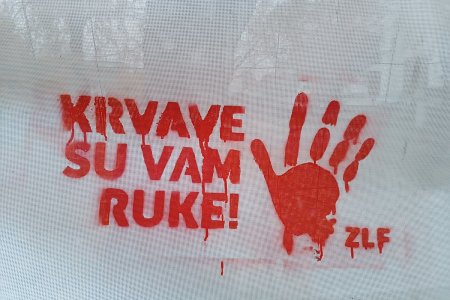
The Green Left Front (ZLF), a member of the European Green Party, identifies two areas of cooperation with the student movement: cooperation in controlling polling stations, as ballot stuffing and vote buying are widespread practices of the regime; and anticipating mass organization in case the opposition wins the elections and the government rejects the results.
Solidarnost (radical left-wing party, observer in the European Left) also emphasized the urgency of Vučić ‘s downfall as a political opening: “The programme the students are drafting will inevitably have flaws, just as their electoral list will be ideologically diverse. What matters most is that the movement itself does not fall silent. Progressive groups have already begun forming the Social Front — a loose network of organisations, trade unions, and parts of the student and activist base. The idea is that this front will serve as a lever of social struggle, pushing for justice and equality both in the streets and beyond the elections.[…] Serbia’s structural problems cannot be solved overnight. But regime change could at least create the conditions for democratic progress.
If the protests and their organisational backbone are crushed, repression will be brutal and the message clear: never try again. Yet if they endure, the door to a different future – more just, democratic, and humane – will remain open.”[ [Vladimir Simovic “From Grief to Resistance.”]]
It therefore seems necessary to avoid fracturing the unity of the movement: “Like many social movements before it, Serbia’s uprising is ideologically fluid — a broad camp encompassing everything from conservatives to radicals, from left to right. Yet for now, it remains the only living force capable of challenging Vučić’s authoritarian, neoliberal, and nationalist regime.” [12] The alliances forged by the student movement with different social groups, as well as with anti-extractive environmental struggles , make it “the movement remains an open and contested political space — one that should not be abandoned, but actively shaped. The task ahead is to organize and fight for a political articulation that places democracy, equality, and social justice at the centre of its struggle.” [Vladimir Simovic, “Serbia’s Student Movement is Still Going Strong”, 29 July 2025, Rosa Luxemburg Stiftung.]]
11 January 2025