
 Version imprimable
Inserted into the capitalist world economy, Serbia is in a typical position of a semi-peripheral country. Its strategic geographical position in the heart of the Balkans and at the gates of the European Union makes it a space of competition between multiple imperialist powers: the European Union, the United States, Russia, China, but also the Gulf monarchies or the United Kingdom and so on.
A peripheral colony
Serbia does not control its value chains or its production system. The massive privatizations carried out since the 1990s have liquidated the legacy of Yugoslav social property, transferring collective wealth to private, mostly foreign, capital.
In this framework, Serbia functions as a reservoir of cheap labour, a space for the extraction of value for big capital, and a captive market for imperialist investments. The absence of economic sovereignty is not an accident: it is the very condition for its subordinate integration into world capitalism.
From capitalist restoration to authoritarian recomposition
The capitalist transition, especially under Milošević, was accompanied by a social collapse: massive unemployment, explosion of inequality, widespread corruption, destruction of social protections. The liberal promise of a prosperous democracy was never kept, because it was based on an illusion: that of a “winning” peripheral capitalism.
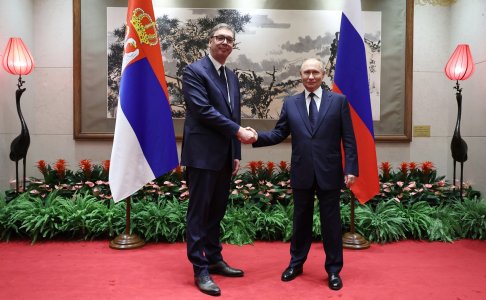
This impasse created the material conditions for the emergence of an authoritarian-neoliberal regime. Aleksandar Vučić, president since 2017, is not an anomaly, but the political product of this historical sequence. To speak of “regime” is essential here. Power is not limited to the government or the presidency: it extends to the media, the judiciary, the yellow unions, the police, the electoral processes, doctors and lawyers and so on. The Serbian Progressive Party (SNS) acts almost like a totalitarian party, organising a clientelist system where access to employment, social assistance or public resources is conditional on political loyalty.
Elections, mobilizations and regime crisis
Faced with this regime, major mobilizations have emerged, led in particular by young people, students and popular sectors. They have taken distinct forms depending on the territory, revealing differentiated social and political dynamics.
In Novi Sad, a university centre and a city historically integrated into the European economic circuits, the student movement is part of a direct challenge to authoritarianism, corruption and the destruction of public services. It expresses a generational politicization, rooted in democratic and social demands.
In Novi Pazar, the dynamic is of a different nature. Located in Sandžak, a historically marginalised region with a Bosnian Muslim majority, Novi Pazar carries a heavy memory: economic exclusion, political discrimination, symbolic and material violence inherited from the Yugoslav wars and Serbian state nationalism.
The mobilizations that are developing there today are not only the result of social protest, but of a process of historical reparation and political rapprochement. The fact that students and activists from Novi Sad and Novi Pazar are converging is a major political event: it breaks with decades of ethnic, religious and regional fragmentation maintained by the ruling elites. This convergence expresses a concrete questioning of nationalism as an instrument of class domination. It poses, in an embryonic but real way, the possibility of a transversal democratic and social self-determination, overcoming the identity divisions inherited from the Yugoslav dislocation.
The electoral contradiction and the crisis of the regime
Part of the opposition is betting on the electoral route to weaken or overthrow the regime. However, this strategy comes up against a structural contradiction. Even in the event of a popular majority hostile to the government, the control of the electoral process by the state apparatus makes any change of government highly unstable. Vote buying, economic pressure, fraud, control of the count: elections function more as a legitimation mechanism than as a real instrument of popular sovereignty.
The decisive question remains: what would happen if the regime rejected the verdict of the ballot box? This regime is in crisis, it can no longer ensure the stable reproduction of its power. Even an electoral defeat for Vučić would only mean the fall of a central figure, not the collapse of the regime. The state, the repressive apparatus, the economic structures and the international alliances would remain in place.
International showcase
The organization of Expo 2027 in Belgrade is another central element of the regime’s strategy. Presented as an opportunity for international attractiveness and “economic development”, the Expo is in fact part of an already proven logic of a profoundly opaque and authoritarian project. Like the Belgrade Waterfront, this type of mega investment is used as a pretext for a massive mobilisation of public funds, exceptional procedures and a de facto suspension of democratic control. Major urban projects are withdrawn from parliamentary and citizen debate, entrusted to opaque public-private partnerships, often linked to foreign capital and circles close to the regime.
This kind of project allows the channelling of public resources to private companies, a market without transparency, speculation and the consolidation of clientelist networks linking the regime with transnational capital and local actors. The regime tries to present itself as modern and social. And the consequences for the Serbian population are serious, as these kinds of projects lead to the eviction of working-class neighbourhoods and the destruction of public spaces. But also to the country’s indebtedness and consequently the precariousness of the Serbian working class.
The construction of the Novi Sad station to extend the New Silk Road is part of this same logic. A project that by nature is there to grow Chinese capital and expand into the European market. The collapse of the station canopy eventually killed 16 people and sparked a break with the corruption of the Vučić regime.
Balkans, imperialism and alternatives
The Serbian situation is part of a broader regional dynamic. The Balkans are a fragmented space, kept in permanent instability by competing imperialisms. Neither the European Union, nor Russia, nor China are proposing real emancipation: each is seeking to secure its economic and geopolitical interests.
An interesting alternative to explore would be a Balkan union, under these conditions of similar capitalist oppressions. An economic emancipation of Serbia could be viable in this way.
Serbia cannot declare overnight that it will no longer be the terrain of extractivism, money laundering and unequal trade. Because on the one hand it does not own the primary modes of production and on the other the external pressure on the country would be so hard that it would not last long. Capital has far too much to gain in Serbia: lithium, boron, its geographical position, its cheap labour.
Perspectives of struggle: beyond the change of political personnel
The central question is therefore not only “who governs”, but which class governs and for what interests. The fight against the Serbian regime cannot be limited to an electoral change. It poses the need for an independent popular organisation, capable of combining social, democratic and anti-imperialist struggles.
In a context of regime crisis, the ballot box can be a field of confrontation, but it is not enough. Real self-determination implies a break with imperialist dependence, capitalist clientelism and the repressive apparatus of the state.
What is at stake today in Serbia is a break with Vučić’s government, but the question remains open: will the mobilizations be able to move towards a real break with the regime and towards a rapprochement with the other struggles in the Balkans?