
 Version imprimable
Three centers of popular and working class resistance have emerged since Trump’s second election as president. The first is around the NGO dominated group -Indivisible-which organized the first two No Kings! Demonstrations in 2025 and has called for a third round of No Kings! demonstrations for March 28, 2026. There were around twenty-five million people in the streets around the country in the last demonstrations. The No Kings! demonstrations have been sites for the expression of anti-Trump sentiment on many fronts as seen by contingents and banners in the demonstrations including immigrant defense, Palestine solidarity (even if the official statements from Indivisible to do not mention Palestine/Gaza), the defense of LGBTQI+ communities, the environment, and of course general opposition to Trump’s march to authoritarianism.
The Anti-ICE Movement
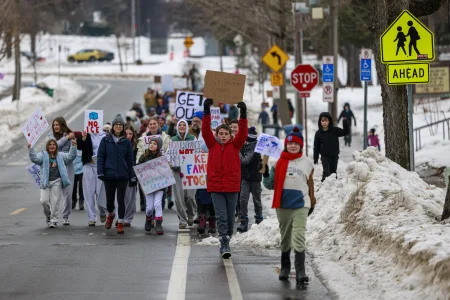
The second center of resistance to Trump is the anti-ICE movement. The resistance of the Minneapolis anti-ICE networks to the surge of over three thousand ICE agents has captured the imagination of anti-fascists and antiauthoritarians around the world. The murder of Renee Good, an immigrant rights activist and US citizen murdered by ICE agents in Minneapolis, not far from where George Floyd was murdered by a Minneapolis police office in 2020, and then of Alex Pretti, also a white US citizen a few days later set into process a vast protest movement that is shaking US politics. These mass demonstrations and the networks involved amount to the rise of a new mass social movement that displays all the features of a social movement. The first of these is its mass character. In addition to the massive street demonstrations, there has been mass participation in the solidarity networks. An astounding 25% to 50% of the local population in Minneapolis and St. Paul-next to Minneapolis have participated in the protests and networks of mutual aid.
The founding of new organizations is also a feature of a social movement. The anti-ICE movement has developed new organizations and drawn in existing organizations and networks of activists like tenant unions and networks established during the George Floyd protests of 2020. In addition to the networks themselves, coalitions of new and existing anti-ICE groups have developed such as in Chicago, where a city wide coalition of approximately 100 anti-ICE groups called the Immigrant Coalition for Immigrant and Refugee Rights (ICIRR) has been founded. Those groups have coordinated with the anti-ICE activists in Minneapolis in some cases through existing networks established by unions.
The anti-ICE movement is present not just in Minneapolis and places like Los Angeles and Chicago which have already had their ICE surges, but also in cities like Milwaukee, where there has so far not been a surge, but where an anti-ICE movement is developing in anticipation of a possible ICE surge.
The movement has involved an impressive level of organization and uses classic social movement tactics such as demonstrations and boycotts and novel variations on those. Neighborhood level Rapid Response networks have used Signal chats to link activists (most of whom are new to organizing) to arrange mutual defense work to bring meals to immigrants and other forms of assistance to keep immigrants safe from ICE patrols. ICE sitings are reported on the chats and activists rush to the scene to provide support and video document ICE activity. License plate numbers of ICE vehicles are circulated, and activists follow them in their vehicles. Whistles are blown by activists to alert others to ICE presence. The organization of activists following ICE vehicles in their cars recalls the flying squadrons used in the 1934 textile general strike and more famously the 1934 Minneapolis truck drivers’ strike.
Boycotts are being organized against the car rental company Enterprise and the Hilton hotel chain, which have rented vehicles to, and housed ICE agents. These are variations of “corporate campaigns” that have been used since the 1980s to put indirect pressure on companies by targeting their customers. High school and universities student walkouts against ICE raids have taken place throughout the country and more are being planned for May Day.
Scores of big unions like the Service Employees International Union (SEIU), the United Auto workers (UAW), and many local and national teachers unions such as the American Federation of Teachers (AFT) and the National Education Association (NEA), and the union federation the AFL-CIO itself have issued statements opposing ICE. In Minneapolis, these and other unions endorsed the January 23 and January 30 demonstrations.
May Day Strong
The third center of resistance is May Day Strong (MDS)- a network of left wing-led unions and union locals such as the Chicago Teacher’s Union (CTU), and militant locals of the Service Employees International Union (SEIU) in Minneapolis-has been organizing a day of action on May Day that involves a “general strike” school walkouts and boycotts. Three thousand people participated in a recent video meeting called by MDS to discuss May 1 actions which will involve work stoppages, school walkouts, and boycotts. May Day this year will probably not be a classic strike with walkouts called by unions because of US laws against political strikes and contract agreements. But agitation for a general strike will stimulate discussion on the question of labor action including mass strikes and the necessity of opposing legal restrictions on labor protest.
It is very possible that May Day actions will resemble in some ways the 2006 May Day “Day without Latinos” which involved mass demonstrations in cities with large Mexican and Latina/o populations like Los Angeles and Milwaukee and de facto strikes attended by workers who called in sick or just missed work to demonstrate.
The US far left and the Anti-Trump movement
Beyond local anti-ICE militancy in Minneapolis and elsewhere, and the No Kings! demonstrations far left groups have organized and participated in demonstrations against Trump’s attack on Venezuela and most recently, the attack on Iran, and in solidarity with the anti-ICE movement. Groups with campist orientations like the Party of Socialism and Liberation (PSL) and the Freedom Road Socialist Organization (FRSO) have taken the lead in organizing demonstrations, with organizations like the revolutionary socialist organization Solidarity and others participating as well.
So far, the largest organization on the US left, the Democratic Socialists of America (DSA) has focused more on electoral work than mass anti-war demonstrations and mass protests in general. But this is changing. Some DSA chapters participated in actions around Venezuela and ICE and there are indications that DSA will be active in opposing Trump’s war in the Middle East.
Prospects for Unifying the Anti-Trump movement
The social and political climate in the country today has created a huge space for resistance. Neither the anti-immigrant campaign nor the war on Iraq will make the Epstein affair go away or working people forget about the high cost of living, which will be exacerbated by the rising oil prices that will result as the entire Middle East is enveloped in war. Unlike the Venezuela operation the war on Iran promises to be an extended affair. Polls already show little support and much opposition to the attack. The war will also accelerate disaffection with Trump among the MAGA base and some elected Republican party officials who were promised an end to Iraq style military engagements.
The anti-ICE movement in Minneapolis and around the country has sunk deep roots into working class communities. These experiences will make indelible marks on the consciousness of millions, opening many of their minds to radical social and political analyses and programs.
The overwhelmingly working class composition of the Latina/o immigrant population in the US creates the basis for moving mass consciousness beyond defense of one’s neighbors as many involved in the anti-ICE movement see their activity, to more class conscious based understanding of anti-Trumpism. Socialists and class struggle oriented unionists will emphasize the class nature of Trump’s attack and the working class composition of the immigrant communities under attack.
Uniting the various strands of the loose anti-Trump coalition of mass No Kings! which reflect general and sectoral resistance to Trump and the anti-ICE movement under democratic working class leadership independent of the Democratic party would be a powerful step forward for the anti-Trump movement. But there are challenges. Indivisible is a top down affair with decisions made by the NGOs rather than a democratic movement, and its leaders openly display their pro-Democratic Party (DP) sympathies and intentions to use the demonstrations in support of the DP.
May Day Strong may be able to play the role of connecting the No Kings! demonstrations and its various progressive anti-Trump elements with the anti-ICE movement in a vast anti-Trump movement with unions and the working class in the lead. The organizers of the March 28 demonstrations see that action as building towards May Day which will facilitate unity. But after May Day, there will be a strong push by Indivisible to orient the movement to support the Democrats in the November 2026 midterm elections which would have a demobilizing effect on the movement.
The potential power of the three strands of anti-Trump resistance resides in its mass character, its use of classic and novel tactics from the handbook of social protest, its deep roots in the US working class and oppressed communities, and its independence from the Democratic Party. Given the stakes in next November’s “midterm” elections, keeping the anti-Trump movement independent will be a major task indeed.