
 Version imprimable
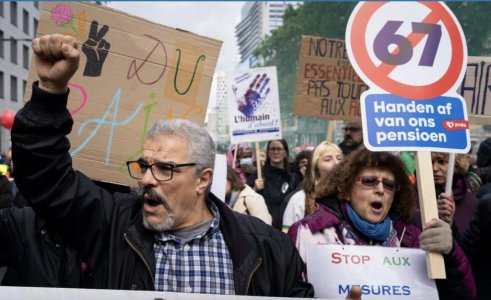
The social movement has been going on for a year and a half. The spaced-out nature of general strikes and large national demonstrations allows the unions to take a long-term perspective. Demonstrations, strikes and various demonstrations, sectoral or local, occupy the space between the major mobilizations. Thus, the demonstration on Tuesday, 12 May was preceded by a long strike in the Post Office, a strike in the prisons and the filing of a strike notice by the socialist police union (CGSP). Teachers and students have decided to continue the movement until the end of May in schools and the unions have agreed to cover the movement. The formation of the Mars Attacks! collective, a rank-and-file organisation that rejects “cheap negotiations and demands the withdrawal of all the reforms”, reflects the state of mind of the demonstrators and contributes to the radicalisation of the movement.
To avoid the trap of “sterile opposition”, the trade union common front has presented fiscal and parafiscal measures to increase revenues with a view to absorbing the public debt instead of the government’s plan. Moreover, while the unions and employers have not been able to reach an agreement for a long time, for the first time they have agreed on a common alternative proposal to the partial freeze on wage indexation. However, the whole thing is brushed aside with a wave of the hand. The government is determined to dismantle everything that makes up society: social security, pensions and labour law.
What conclusions can be drawn from these long-term trade union actions? When it was formed, the government coalition promised radical reforms that were supposed to clean up the state’s debt by reducing social spending and reducing taxes on employment that were supposed to improve purchasing power without increasing tax revenues. Apart from an emblematic unemployment reform that has massively excluded from benefits the long-term unemployed, whose burden is now borne by social assistance and results in an increase in poverty, the outcome of the government’s action seem, in relation to its expectations, particularly disappointing.
If the balance sheet is not commensurate with the government’s hopes, that of the social movement, however massive and determined, seems very low. Some measures have certainly been marginally implemented and the vote on the law programme, which includes a partial freeze on wage indexation and an increase in excise duties on gas, has been postponed. However, it will be voted on in the coming days. More importantly, the pension reform, the flagship measure of the government program, which will result in a major deterioration in the condition of workers and particularly of women workers, has been further delayed. But for how long? Especially since the government is already announcing austerity measures in the preparation of the 2027 budget. To deal with this, the trade union common front has demonstrated its capacity for long-term mobilisation but suffers from a lack of political perspective.
The bulldozer reforms, the brutality of the methods and the contempt, even denial, of the social movement have not, throughout these 15 months, been enough to stifle the mobilization. Faced with the government’s desire to deny any legitimacy to the mobilization and even to social dialogue, the movement is now at a turning point. Can he be satisfied with the continuation of the actions undertaken? Should the actions be reoriented or toughened? Between the organizations and within them, opinion are far from unanimous, even if the movement continues in a common front. Nevertheless, in the autumn, in the face of the adoption of the worst measures of social regression that the country has known, we can expect a hot beginning to the social year.
17 May 2026
Translated by International Viewpoint from A l’Encontre.