
 Version imprimable
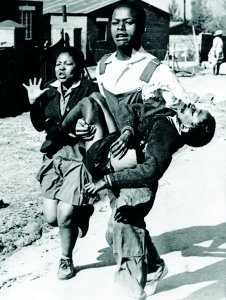
Short for South Western Townships, Soweto is known for the riots of June 1976, immortalised by Sam Nzima’s photograph showing a man carrying the body of a 12-year-old boy, Hector Pieterson, who had been killed by the police. Walking beside him is a young girl, his sister, her face etched with grief. This image has become the symbol of the brutal repression meted out against peaceful demonstrators.
Bantu Education
The protests were triggered by a circular making the use of Afrikaans compulsory in schools – a language associated with racist oppressors. But beyond this measure, South Africa’s black youth were confronted with a deeply unequal education system. The government allocated 644 rands to each white pupil, compared with just 42 rands per black pupil.
Such inequality was not justified solely on economic grounds. Dr Verwoerd, the proponent of Bantu education, explained his policy in these terms: “The natives (Black people) must learn from an early age that equality with Europeans (White people) is not for them.” Education was thus an instrument designed to reinforce apartheid.
The limited progress observed over the years in the schooling of young Black people resulted mainly from pressure exerted by employers, who needed a more skilled workforce.
The revolt
In secondary schools there was an organisation, the Student Christian Movements (SCMs), which was officially apolitical but largely infiltrated by activists from the South African Students’ Movement (SASM), linked to the Black Consciousness movement. These activists carried out significant organisational and awareness-raising work.
They first set up an Action Committee, which later became the Soweto Students’ Representative Council (SSRC). These activists played a decisive role in triggering the protests.
Hundreds of young people left their schools to join a demonstration. Without warning, the police opened fire. Numerous eyewitness accounts report teenagers being shot dead whilst they were fleeing.
The Soweto uprising spread across the country, drawing in large sections of the population. Everywhere, the authorities responded with ruthless repression. The army was deployed and the police did not hesitate to fire on township residents in order to sow terror.
The Turning Point
The Soweto uprising marked a genuine turning point in the struggle against apartheid. Following the Sharpeville massacre in 1960, the leaders of the main nationalist organisations, the ANC and the Pan Africanist Congress (PAC), had been imprisoned or forced into exile. The regime seemed unshakeable at the time.
However, the authorities were forced to back down by abandoning their reform imposing the use of Afrikaans in schools. Above all, a new generation of activists had emerged. They were to considerably strengthen the anti-apartheid organisations, whether trade union or political.
On the international stage, the brutality of the South African regime sparked major solidarity movements which helped to shift the balance of power within the country. Following the Soweto riots, more and more South Africans became convinced that apartheid was no longer inevitable and that it would eventually come to an end.
23 June 2026
Translated by International Viewpoint from l’Anticapitaliste.