
 Version imprimable
Approximately 5,000 separate actions tool place throughout the country (for report of May Day actions around the country, see the Solidarity webzine “May Day Strong 2026: A Brief Roundup”).Although the size of the actions in terms of participants fell short of the expectations of many, the dynamics surrounding the May Day demonstrations involve encouraging signs for the development of the US labor left and an independent mass working class-led anti-Trump movement.
Over the past year, three centers of resistance to Trump’s war have emerged. These are the No Kings! demonstrations of which there have been three massive demonstrations, the most recent being last March 28. No Kings! is a top-down organization led by NGO leaders with deep ties to the Democratic party. The second center of resistance was the heroic anti-ICE mobilizations most notably in Minneapolis [see below for a specifc report], Minnesota, and finally the union-led May Day Strong coalition.
There was considerable enthusiasm in radical circles in the months and weeks before May 1. MDS video planning meetings attracted as many as three thousand participants including high ranking union officials from large teachers’ unions not known for militancy like Randi Weingarten of the American Federation of Teachers (AFT), a teachers’ union of 1.8 million members. The other large teachers’ union, the nearly three-million-member National Education Association (NEA) is also part of MDS. High school students from the Sunrise movement reported on their organizing for May Day school walkouts as did organizers planning boycotts of businesses like Enterprise car rental and Hilton hotels that have rented vehicles to and housed ICE agents.
The size of the actions fell short of the hopes of the organizers. The street demonstrations were far smaller than the No Kings! demonstrations, but as big or perhaps a bit larger than most May Day demonstrations over the last few years. 10,000 marched in New York city on May Day as opposed to 50,000 at the No Kings! demonstration on March 28. Around 2,000 rallied in Milwaukee on May Day, while several tens of thousands of attended the No Kings! march.
Encouraging Trends
The modest size of the actions and the fact that many unions endorsed the actions, but few mobilized their members into large union contingents or called on their members to strike, could be interpreted as the failure of the working class and its organizations to take the lead in the anti-Trump movement represented by the No Kings! and Anti-ICE movements. But a closer look at the overall dynamics of May Day, MDS and the history of labor political action in the US, suggests encouraging trends for the development of a mass militant labor response to Trump’s ultra-reactionary assault on immigrants, LGBGQT+ people, the environment, democratic rights, and ever-increasing imperialist military assaults.
The coalition issued three demands: “1) Tax the Rich: Our families, not their fortunes, come first. 2) No ICE. No war. No private army serving authoritarian power. 3) Expand democracy, not corporate power. Hands off our vote.” These were class-struggle-based demands putting opposition to ICE and therefore defense of immigrants and defense of democratic rights at the fore at a time when both are under serious attack.
The May Day street demonstrations, though much smaller than the No Kings! demonstrations, reflected the same broad front of organizations and issues. Anti-ICE banners, pro-Palestinian signs, anti-fascist banners, defense of, democratic rights, and some union contingents such as the Service Employees International Union (SEIU), many teachers’ unions and even a traditionally conservative construction workers union was at the head of New York city march. Socialist groups like DSA, the Party of Socialism and Liberation (PSL), the Freedom Road Socialist organization (FRSO), Solidarity, Socialist Alternative, and others had visible presences with banners and contingents.
Significantly, the May Day demonstration in Minneapolis, a city of 370,000 (500,00-600,00 including its “twin city” St. Paul) became the center of ICE resistance last winter, drew 10,000 marchers – similar in size to the demonstration in the New York city, a city of eight million. This suggests that the anti-ICE movement has created a general dynamic of mobilization that is meshing with the general opposition movement to Trump. Furthermore, the anti-ICE mobilization in Minneapolis on March 23, saw an estimated full quarter of the population take the day off, an impressive de facto strike that MDS certainly found inspiring and suggests great potential for future mass political strike action.
Teacher Strikes and Student Walkouts
Although there were not mass labor strikes, at least twenty school districts cancelled classes in New York city following their teachers’ announcement that they weren’t available for work because they would be attending the May Day “Kids Over Corporations” march.
In Wisconsin, after seventy percent of the teachers in Madison and Milwaukee declared their intention to take the day off, the school administration canceled classes. Even in the conservative anti-union state of North Carolina the Board of Education, in its biggest city, Charlotte, voted to call off school on May 1 due to the number of staff absences expected that day. The North Carolina teachers’ union mobilized teachers from around the state to march on the legislature, demanding higher taxes on corporations for more school funding.
Chicago teachers and their union, the Chicago Teaches Union (CTU), convinced the school district to make May 1 an official day of civic education, arranging field trips for students to learn about civil rights, resulting in a de facto student, teacher, and staff walk out with great educational value for Chicago’s largely working class and people of color population. This became especially relevant in the face of the Supreme Court’s decision to eviscerate the 1965 Voting Rights Act which was designed to ensure Black political representation.
May Day and Labor Day
Until the last few years May Day demonstrations were mostly organized and usually attended by far-left socialist groups with little if any union endorsement. Though May Day as an international working-class holiday has its roots in the Chicago Haymarket affair of 1886 and the struggle for eight hour day, US unions have traditionally celebrated Labor Day, which occurs at the end of the summer, an official holiday that serves to depoliticize the working-class holiday. In fact, in the 1950s President Dwight Eisenhower issued an order that May Day be officially declared as “loyalty day” which Trump reissued during his first term. So, May Day as a union-sponsored day of political protest is a relatively recent development and many unions and sectors of the working class have yet to embrace it as a working-class holiday of social and political protest.
Propaganda for Mass Strikes
The slogans of the demonstration- “No Work, No School, No Shopping” were novel, intending to send a broad and powerful message of mobilization and resistance. Mass participation in the no work part-essentially a call for mass strikes or as some saw it, a general strike- was unlikely given this stage of the US class struggle and structural barriers such as union contracts that prohibit strikes during the duration of contracts, and reactionary legislation like the 1947 Taft Hartley act that outlaws secondary or solidarity strikes. But raising the slogan for this year’s May Day action introduces the idea to a much broader layer of the unionized and ununionized working class. It will serve to help revive and amplify the call issued by Sean Fain, president of the United Auto Workers (UAW) for a general strike in 2028 to demand a national health care system, though Fain has done nothing to advance the strike. Nevertheless, many workers in some areas called in sick, or otherwise did not work, but these were not coordinated by the unions. The “No School” portion saw student walkouts throughout the country. The preparations, publicity and the mobilization themselves amplify the labor left.
The MDS coalition overlaps with other centers of radical labor organization such as the networks connected to the Labor Notes newsletter and biannual conferences. The leading role played by teachers’ union and the Chicago Teachers Union in particular, reflects both its militant leadership and membership and its nexus between militant unionism and defense of immigrant students and families threatened by ICE terror and puts it in the vanguard of the militant wing of the US labor movement and the general anti-Trump movement.
The US May Day actions may be the last mass nationwide demonstrations for the next few months. The high stakes November “midterm” elections will certainly see much militant organizing energy diverted towards electoral campaigning for Democratic party candidates. But the groundwork laid in the last months of organizing and propaganda and the development of new networks and organizations augurs well for the development of a radical working class led anti-Trump movement and the growth of a militant labor left in the US.
20 May 2026
“No Kings” In Twin Cities
ST. PAUL, MINNESOTA — Millions of Americans took to the streets Saturday, March 28 to protest the Trump administration and its assault on democracy, in likely the most massive turnout of demonstrations on a single day in U.S. history.
Organizers of the No Kings protests estimated that 8,000,000 people demonstrated. Protests took place in 3300 cities and towns across the nation, according to organizers from Indivisible, one of the groups sponsoring the action. They also reported 38 international protests.
Twin Cities was seen as the flagship demonstration because of the horror inflicted on the state by U.S. Immigration and Customs Enforcement (ICE) agents, whose thuggish behavior, abduction of thousands of immigrants in Minnesota, and murder of two ICE observers, Renee Nicole Good and Alex Pretti, outraged the nation.
Their killings and a massive grassroots resistance that included courageous efforts by ordinary Minnesota citizens to defend immigrants, captivated Americans across the United States and forced the Trump Administration to withdraw a large portion of the 3000 ICE agents it had sent into the state. (Hundreds of agents remain, however, less visible but still conducting abductions.)
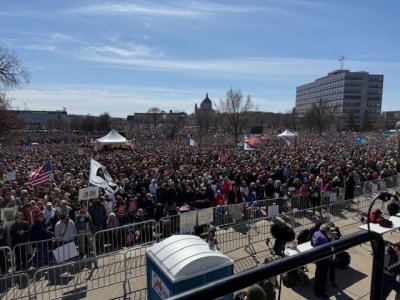
The Minnesota State Patrol estimated Saturday’s crowd that filled the vast lawns in front of the State Capitol in St. Paul at 100,000, while protest organizers put the figure at 200,000. Either way, it was huge. Speakers at the rally included U.S. Sen. Bernie Sanders of Vermont, Minnesota Gov. Tim Walz and actress Jane Fonda, and musicians Joan Baez and Bruce Springsteen, who sang “Streets of Minneapolis,” a song that he wrote, honoring the memories of Good and Pretti.
“This past winter, federal troops brought death and terror to the streets of Minneapolis,” Springsteen said in his introduction to the song. “Well, they picked the wrong city. The power and the solidarity of Minneapolis, of Minnesota, was an inspiration to the entire country. Your strength and commitment told us this is still America and this reactionary nightmare, these invasions of American cities will not stand.”
Across the Country
No Kings actions on Saturday stretched from Kotzebue, Alaska in the Arctic Circle (there were about 25 protests in Alaska) to Bangor, Maine (there were 50 demonstrations in Maine). In Minnesota, 90 separate demonstrations were scheduled, according to the No Kings website.
“This sign is too small to list all the reasons I’m here,” read one Minnesota protest placard, carried by Corinne Bedford, 40, of Minneapolis, who works as a financial advisor. “I’m here for my daughter,” she said. “We need to do better on so many fronts.”
Meghan O’Connor, 18, a freshman at the University of Minnesota, held a sign that read, “Only you can prevent fascists.”
Why had she come to the demonstration? “I’m sick of this administration trampling on my rights,” she said. Her friend Eva Stavrou, also 18 and a student at the University, carried her own sign that read. “This isn’t about politics, it’s about humanity.”
Opposition to President Trump’s war on Iran played a major role in increasing the size of the protests.
“I’m here because my city is under attack,” said Wayne Nealis, 73, a retired toolmaker and writer, who held up a sign at the St. Paul rally that read “Prosecute the killers of Renee and Alex.”
He added, “I’m here because I’m opposed to the war on Iran and here to support the Palestinian people.”
Murders with Impunity
Rally speakers repeatedly referred to the shooting deaths of the two Minneapolis residents, Good, 37, a poet and mother of three, and Pretti, also 37, an intensive care nurse for the U.S. Department of Veterans Affairs.
Both were acting as nonviolent observers of ICE and were killed by ICE and border patrol agents in separate incidents in January.
No agents have been charged, and the U.S. Justice Department has refused to turn over evidentiary materials to the Minnesota Bureau of Criminal Apprehension and the Hennepin County Attorney’s office, which are investigating the shootings to determine whether to prosecute the agents.
Minnesota Attorney General Keith Ellison and Hennepin County Attorney Mary Moriarty announced earlier in the week that he has filed suit to force the federal government to turn over the materials.
Ellison also addressed the rally. “Justice is not optional,” he said. “Accountability is coming.”
Nekima Levy-Armstrong, an attorney and past president of the Minneapolis NAACP, celebrated how Minnesotans refused to capitulate to the ICE assault. “They underestimated us,” she told the St. Paul rally. “We told them, ‘Hell no, we won’t go.’”
Levy-Armstrong is among 39 protesters facing federal charges for disrupting a St. Paul church service where one of the pastors also leads a local ICE field office. U.S. Attorney General Pam Bondi ordered the arrests.
Also charged were two independent journalists, Don Lemon and Georgia Forte, who were covering the January demonstration. It’s part of the federal government’s attempt to muzzle journalists.
Labor Turns Out
Labor unions are playing a big role in organizing the No Kings protests, having seen many of their own immigrant members abducted by ICE.
Speakers at the St. Paul rally included Liz Shuler, president of the AFL-CIO, Randi Weingarten, president of the American Federation of Teachers, and April Verrett, president of the Service Employees International Union.
“Over and over this year we’ve seen this administration try to divide us, as working people,” said Shuler. “Whether we were born here, whether we were blue collar, white collar, gay, straight, trans, Black, white, Latino.”
Senator Sanders saved his strongest words and drew a vociferous, positive response for his comments, criticizing the war on Iran. The war, said Sanders, was begun by Trump and “his partner, Benjamin Netanyahu,” and is unconstitutional and a violation of international law
He ticked off the war’s consequences so far: 13 U.S. soldiers dead, hundreds wounded, nearly 2000 Iranian civilians killed and wounded, 498 schools bombed by American and Israeli missiles, more than 1000 Lebanese killed and one million displaced, which is 15 percent of Lebanon’s population.
In Israel, Sanders said 20 people had been killed and 5000 wounded, and on the West Bank, “Israeli vigilantes are burning down homes and killing Palestinians.”
“At a time when gas prices are soaring,” said Sanders, “when many Americans cannot afford the basic necessities of life, it is estimated that this war has already cost a trillion dollars. At a time when the American people are politically divided, there is one issue that is bringing us together. Conservatives, moderates and progressives are speaking out in unison, ‘End this war.’”
Repeated chants of “End this war,” echoed across the crowd.
“It’s a good feeling being here among like-minded people” said Rodney Massey, 59, an IT worker from Minneapolis, who is Black. He wore a sign on his back that said, “Staying silent in times of injustice is privilege.”
His daughter Kassia Massey, 33, a host at a Minneapolis nightclub, was beside him. She came, she said, to oppose “the racism, the fascism” and felt good to be at an event where, “Everybody, together, is trying to make change.”
Source: Against the Current.