
 Version imprimable
“The G7 brings together the governments of seven of the world’s richest countries each year to discuss the economy and geopolitics. Since 1975, the United States, France, the United Kingdom, Germany, Italy, Canada and Japan have come together to organize the capitalist leadership of the world – joined in 1997 by Russia, now excluded following the annexation of Crimea in 2014.”
This is how the Call for Mobilisation of the International Coalition NOG7, made up of more than 40 left wing organisations, currently mainly from the Lake Geneva region, begins.
A restricted club at the service of the powerful and multinationals
The G7 is a “forum” created in 1975 in the form of an “informal” meeting of Western industrial powers. The G7 embodies the international order that emerged from the Second World War, with the United States as its pivot. At its peak, it accounted for more than two-thirds of the world’s gross domestic product. Although its economic weight has now declined, its members continue to concentrate a large part of the planet’s technological, military and financial capital. The G7 has no democratic legitimacy, but that does not prevent it from considering itself a permanent world government of multinationals, finance capital and military complexes.
The G7 plays an active role in the imposition of neoliberal policies in the South and the North, and in the grabbing of resources from the peoples of the South. It advocates the reduction of public spending, the reduction of the state to the sole function of social control and increased militarization.
To impose these policies, it relies on the international financial institutions, such as the International Monetary Fund, and the World Bank, and later the World Trade Organization, in which the members of the G7 have the majority of the capital and therefore determine the decisions.
The G7 has a dual function: the reproduction of the world economic order for the interests of the great powers and the control and plundering of the dominated countries, mainly through debt. The G7 is ruthlessly pursuing its policy despite the scale of the ecological and social disasters that accompany it.
The G7 today
We live in a world characterized by growing inequalities: social and economic, political, ecological, geopolitical inequalities, the most significant manifestation of which is the neocolonial domination of the countries of the Global South. Added to this is the permanent war of the United States to keep its hegemony, the Israeli genocide in Gaza, the Russian invasion of Ukraine and so on.
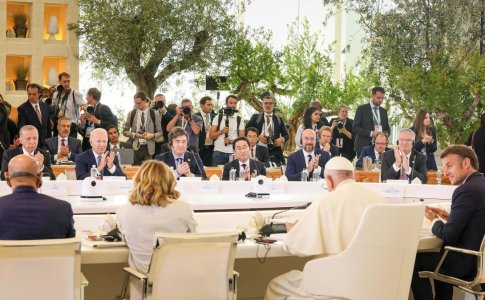
The meeting that will take place in June on the shores of Lake Geneva will take place in a particular geopolitical and economic context, different from previous summits. Tensions and conflicts of interest within the G7, often masked by a façade of unity, have increased to the point that the traditional “family photo” will no longer be able to hide them. We are going through a period of profound change on an international scale, marked by the rise of the reactionary far right – in government in several countries, starting with the United States – the intensification of inter-imperialist contradictions and attempts to break the old global balances.
There are opposing interests between the members of the G7, particularly on the war in Ukraine and its continuation; the military intervention of the United States and Israel in Iran and the geopolitical consequences for the region and the economic consequences for the rest of the rich countries; the expansionist ambitions of the Trump administration, even targeting countries in the European Union; the confrontation with China, the main competitor to the hegemony of the United States and so on. We are witnessing the restructuring of the world-system at the international level and inter-imperialist struggles, which are reflected in a rise in militarism and warmongering, as well as in new extractivist dynamics aimed at preserving or expanding new spheres of influence.
Adopting an anti-capitalist perspective on the G7 is not simply denouncing its one-off decisions, but analysing the system it embodies and reproduces, the very nature of this global institution. A small core of heads of state who represent the privileged people of the planet cannot arrogate to themselves the monopoly of deciding for us.
In the face of this, ecosocialist and anti-capitalist alternatives exist, and we will debate them at our counter-summit in Geneva on 13 and 14 June.
Building internationalist resistance
At the initiative of the Feminist Strike, anti-fascist sectors and an autonomous centre (le Silure) in Geneva, a broad coalition, including trade unions, BDS, Solidar, the NPA-L’Anticapitaliste and the CADTM, was formed to denounce the role of the G7 in the world disorder and to build a major mobilisation, notably on 13 and 14 June 2026. The official summit will take place from 15 to 17 June, in Evian, on the French side, near Geneva.
As the French authorities have banned all demonstrations on their territory, the mobilization will take place in Switzerland, in a restricted and controlled setting. The federal government will deploy more than 2,000 soldiers and the police of the neighbouring cantons will reinforce their Geneva colleagues. They want to close the borders and restrict free movement. The authorities are trying to create an atmosphere of fear by saying that the “rioters” are back, 23 years later. On the other side of the border, no room is available for the counter-G7, by order of the prefecture, and on the Geneva side, no public space is granted to us. No municipality, even those on the left, wants to make land available for the camp for the moment.
On 14 June, a colourful feminist demonstration
In Switzerland, 14 June is a central date in the fight for equal pay and the recognition of women’s visible and invisible work. It corresponds to the anniversary of the first women’s strike in Switzerland, on 14 June 1991. Organised ten years after equality was enshrined in the Constitution, it brought together more than 500,000 women, around the slogan: “Women, arms crossed, the country is losing its footing”. This day contributed to the adoption of the Equality Act in 1996. Another massive feminist strike took place on June 14, 2019, denouncing the persistence of inequalities.
Today, the Feminist Strike in Switzerland is one of the main drivers of social mobilizations against patriarchy, racism and fascism. The demonstration against the G7 on June 14, in the afternoon, will take on the purple colours of this anger.
A relatively radical appeal was drawn up, giving a large place to the struggle against fascism. Other axes are also put forward: the struggle against imperialism, the denunciation of new forms of postcolonial domination, as well as extractivism and the use of debt as an instrument of domination.
We plan to organize more than a dozen conferences, workshops and plenary sessions, starting on the evening of Thursday, June 11. Several themes will be addressed: the role of the feminist strike, ecofascism, solidarity with Palestine, the new world order, extractivism, how to fight fascism and so on. Concerts and artistic activities are also planned. And, of course, a demonstration will take place on Sunday 14 June, in the afternoon.
A different political context compared to 2003
The Swiss media compare the current mobilization to that of 2003, against the G8 in Evian. However, the context is profoundly different. In 2003, the anti-globalization movement was at its peak, driven by several years of massive mobilizations on an international scale. Today, the dynamics are different, even if certain struggles, notably solidarity with the Palestinian people and the feminist strike, remain central. In twenty years, the repression and criminalization of social movements have intensified, reducing the spaces for protest.
For the moment, we do not know if the activities planned in Geneva, as well as the demonstration on 14 June, will be allowed. Despite this, the mobilization is being organized. In the meantime, a broad coalition has been formed in France and an Appeal has been launched. We are working together and calling for mobilizations together.
The Geneva appeal concludes with an invitation to join the mobilization in Geneva: “For internationalism and solidarity between peoples, against colonialism and deadly migration policies, let’s organize resistance! For solidarity between workers in all countries and against dispossession, let’s demonstrate together against the G7!”
We are waiting for you!
24 April 2026
Translated by International Viewpoint.