
 Version imprimable
We propose to review these recent events and retrace their chronology. More fundamentally, we want to show that the current mobilization goes far beyond the defence of the environment: it reveals the major tensions that still run through contemporary Albania around questions of territorial sovereignty and the broader right of the population to self-determination.
To understand these conflicts and potential breaking points, it is necessary to examine their causes—including the convergence of interests between foreign investors, oligarchs, local landowners, and politicians, which leads to a progressive commodification of territory. In other words, we intend to highlight the capitalist, neoliberal and imperialist nature of the combined mechanisms that lead to the democratic denial against which the Albanian people are currently rising.
Chronology of the opposition movement
It all began on 15 March 2024, when Jared Kushner, Donald Trump’s son-in-law, published computer-generated images on his Instagram account presenting several luxury tourism projects in Albania. On 16 January 2025, Reuters revealed that Edi Rama, Albania’s prime minister, had reached an agreement estimated at $1.4 billion with Atlantic Incubation Partners LLC, an affiliate of Affinity Partners, to develop a vast hotel complex on the island of Sazan.
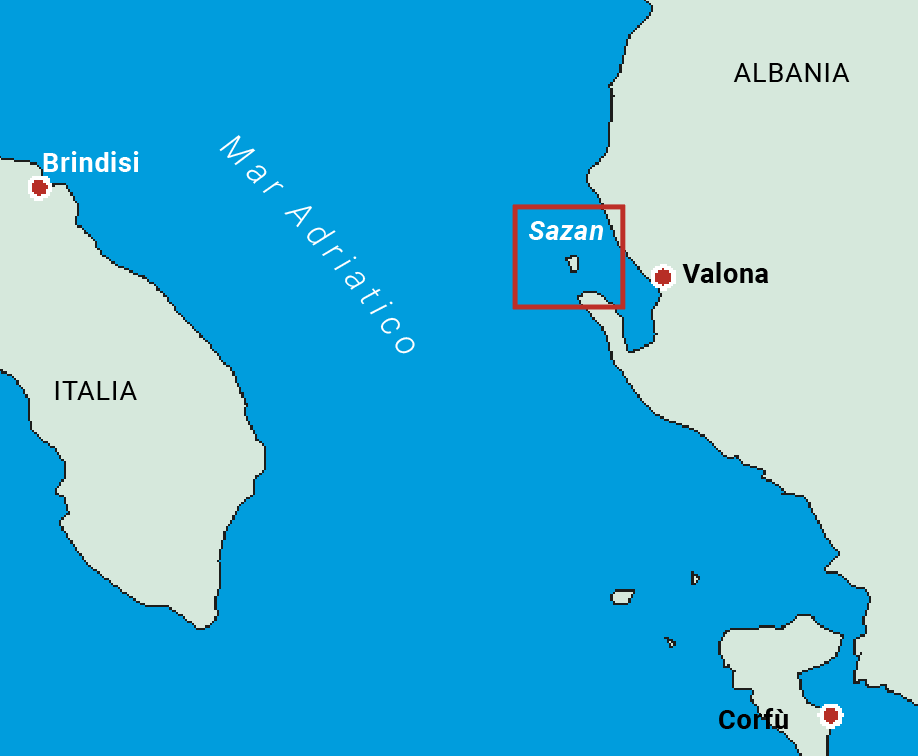
Located at the entrance to Vlorë Bay, Sazan is the largest island in Albania. Long closed to the public, it served as a strategic military base under the regime of Enver Hoxha. After the fall of the latter, Sazan’s prolonged isolation helped preserve its remarkable landscapes and biodiversity, as urbanization transformed much of the Albanian coastline as early as the 1990s.
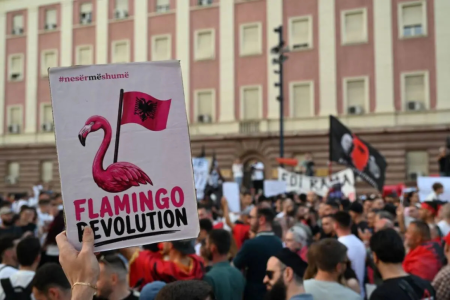
While the revelations about Sazan have acted as a catalyst, they are not the only ones to fuel widespread opposition. On the coast of Vlorë, in the Zvërnec and Narta region, another large-scale tourism project is taking shape. This includes the construction of thousand villas, apartments and hotels as well as tourist infrastructure on several hundred hectares located near one of the most important ecosystems in Albania. In the area, hundreds of distinct species of birds have been observed, some of which settle there to winter — for example, the pink flamingo. The latter has become both the symbol of the ecological richness of the site and its fragility in the face of tourist projects, so much so that it has been adopted as an emblem of the protest movement. The term "Flamingo Revolution" (Revolucioni i flamingove) has thus gradually taken hold among the demonstrators to designate the mobilization.
At the end of April 2026, the first works began in the area of Pishë Poro and Portonovo. Bulldozers entered the site, which was previously accessible to the public, while fences and barbed wire were installed. On 23 May, residents and environmental activists gathered for the first time near Narta Lagoon to protest against the fences erected around Pishë Poro beach.
A week later, on 30 May, a new demonstration took place near the Portonovo construction site. Clashes then broke out between demonstrators and private security agents in charge of protecting the future construction site. Images of these incidents circulated quickly on social networks, causing a wave of indignation across the country.
In the days that followed, thousands of people took to the streets of Tirana and several major cities in Albania to demand the abandonment of current projects, to demand stronger legal protection of the territory, and to call for the resignation of prime minister Rama.
Barbed wire revives old memories
While opponents of the Zvërnec and Sazan projects denounce the destruction of protected natural areas and the privatisation of the coastline, the anger that has been expressed in recent weeks is not limited to environmental concerns alone. To understand the cause of the protest and its extent, it is necessary to sketch the history of the Albanian people. For more than a century, the question of their self-determination has been at the centre of their concerns: whether as a popular project or as a project of local elites, it has been negotiated or even repeatedly denied, which has profoundly influenced political consciousness and national historiography.
In 1913, at the London Conference, the major European powers recognised Albania’s independence and drew the country’s borders. A significant part of the Albanian population remained outside the new state. Kosovo was assigned to Serbia, while other territories were attached to Montenegro or Greece. Independence was thus born of a political paradox: that of a state finally recognized by influential nations, but deprived of a significant part of the population it was supposed to gather.
In addition, this newly independent Albanian state was then placed under the authority of a foreign prince, Wilhelm of Wied, appointed by the European powers in 1914. This tutelage continued during the twentieth century, with the predominantly Albanian territories continuing to be subject to multiple influences and forms of external domination: military occupations, interventions by the great powers, political or economic tutelage and so on.
Of course, the tourism projects of Zvërnec and Sazan differ significantly from these historical sequences. But the images of barbed wire, private militias and beaches closed to the public revive a collective memory maintained by a deeply rooted historiography. Indeed, in the Albanian national narrative, the motif of a small people resilient in the face of centuries of foreign domination is central; the identity of Albanians has thus survived the Roman, Byzantine, and Ottoman empires, the Balkan wars, the fascist and Nazi occupations of the twentieth century, and, more recently, the policies of ethnic cleansing carried out in Kosovo.
Recent events add to this long-running narrative. For a part of public opinion, the fundamental question of the political destiny of Albanians is once again being asked, in a new form: who decides the future of the territory? Until the fall of the colonial empires and the entry into neo-colonialism, foreign domination was manifested — and partly exercised — by arms.
Today, imperialism is taking the less visible routes of markets, investment, major private infrastructure projects and agreements between governments and big business. The mechanisms have certainly changed, but recent events reveal on the one hand the discernment of a population in the face of this reconfiguration of imperialist domination, and on the other hand its fear of losing its right to self-determination. For many protesters, barbed wire is not just a sign of beach closure; They revive a collective trauma, passed down from generation to generation, which is still painful.
In this regard, it should be added that the current mobilizations in Albania do not follow a single political line. There are very heterogeneous orientations and sensibilities: ecologists, left-wing activists, citizens with no particular political affiliation, but also nationalists from more traditional movements. This diversity can be explained precisely by the historical, symbolic charge that the question of territory has in Albanian consciousness and historiography. Albanian nationalism is not an imperialist nationalism, but a nationalism of resistance, anti-colonial struggle and self-determination. Its origin does not diminish its political contradictions, nor the violence it may have engendered. However, this ideological relationship to the nation makes it possible to understand why the defence of a lagoon, an island or a beach can today mobilise far beyond ecologist circles – an adhesion that may be surprising from the point of view of Western Europe.
A logic of neoliberal dispossession
However, the planned projects for Zvërnec and Sazan are not isolated projects. Since the fall of the Stalinist regime, part of the country’s coastline, agricultural land and natural resources have gradually been ceded to private interests. These decisions were taken without real popular consultation, often for the benefit of a minority of local or foreign investors. The neoliberal dynamic has accelerated under the government of Edi Rama, who has made attracting foreign investment and tourism development one of the pillars of his economic strategy. For its supporters, this policy is a means of modernising the country and promoting its European integration. In practice, it has mainly resulted in an increased concentration of wealth in the hands of a minority, in the strengthening of the political power of Albanian oligarchs, and in the gradual transformation of the territory into a commodity auctioned off for the benefit of the wealthiest investors.
The development policy designed by Rama has gradually become a reality over the past few years. Since the adoption of the Strategic Investment Act in 2015, several million square meters of public or semi-public land have been made available to private investors. According to a survey by Citizens.al, nearly 5.8 million square meters had already been allocated to strategic investors in 2023, a significant portion of which was on the coast. More recently, the Albanian government presented a portfolio of 83 priority projects related to tourism and infrastructure development aimed at attracting foreign capital. This data shows that the tourism industry is not a side project of the government. On the contrary, it represents one of the pillars of the economic model that has been in place for several years. Indeed, tourism would represent about 26% of GDP, including its indirect benefits. For the demonstrators, the Zvërnec barbed wire is not simply a democratic denial, but is the tangible expression of an entire development model, fundamentally based on the privatization of the public domain.
It should also be pointed out that, even when it is not sold off to private capital, Albanian territory is a resource that is willingly abandoned in exchange for any economic reward, even if indirect. In 2023, Edi Rama and Giorgia Meloni, Italy’s far-right prime minister, reached an agreement for the construction of a refugee camp in Gjadër, near the coast in the north of the country. For the Meloni government, it is a question of relocating the processing of refugee applications outside the national territory, at a lower cost; for Rama, the aim is to present the Albanian government as a reliable partner in the management of the migration crisis, with a view to facilitating the process of integration into the EU. He expects such integration to have major economic benefits: boosted exports, foreign investment made more fluid by the legal framework, economic aid and so on.
Like the plans for Zvërnec and Sazan, this project claims to indirectly strengthen the country’s economic development, in defiance of any democratic decision-making process on the management of the territory: the Albanian people have never been able to express their opinion on this dehumanising policy that transforms their land into an open-air prison of Frontex – the European Border and Coast Guard Agency.
This logic is not new. For more than twenty years, Albania has been importing waste sporadically, mainly from Italy, while it is already facing real difficulties in managing its own waste. This is evidenced by the many open-air landfills that dot its territory. Before his first term, Rama had promised to put an end to the public-private agreements responsible for the phenomenon. He then changed his mind; the situation was only regularized in 2022, after an investigation was conducted and several individuals and public entities were indicted for corruption.
More recently, the government has introduced a particularly advantageous tax regime to attract European pensioners, particularly Italians, who are exempt from tax on their pensions when they move to the country. Their number has grown from a few hundred to nearly 3,000 in just a few years. The logic remains the same: Albanian territory is being sold off to foreign states, in this case EU members, whose political favour is to be gained.
Who sells Albania?
Kushner and Affinity Partners did not arrive in a virgin Albania; the ground had already been prepared for them. In fact, it would be too simple to summarize the challenge facing Albania to an opposition between foreign capital and national interests. Today’s major tourism projects are not isolated phenomena, but are the result of an older process during which the territory was gradually monopolized by a nebula of local actors: businessmen, speculators, dubious intermediaries, figures close to the government and the nouveau riche who appeared in the chaos of the privatizations of the 1990s.
The project covers an estimated area of 437 hectares. Of these, 251 hectares are affected by construction, and are mainly owned by two major landowners: Redi Struga, who owns 120 hectares through his companies (South Adriatic Development and Smart Construction Invest), as well as Arthur Shehu, a resident of Florida, who owns 110 hectares. Similarly, several investigations point to the role that Shefqet Kastrati — one of Albania’s most powerful oligarchs, head of the Kastrati group — allegedly played in the conduct of negotiations related to the projects.
This nebula of interests makes it possible both to facilitate the contribution of foreign capital and to conceal the responsibility of the main players in the operation. The question of land ownership is nevertheless quite central. Who owns the territory for the Zvërnec and Sazan tourism projects? A few private owners, international investment funds, or the relevant local authorities? The current controversy therefore goes beyond the question of the direct nuisance caused by the real estate project. It concerns issues of sovereignty, democracy, and the management of the country’s common wealth.
What future for the mobilization and for Albania?
The Zvërnec and Sazan affair reveals the convergence of interests between Albanian economic elites, a neoliberal political power, and international investors in search of new spaces for the valorisation of capital. Local oligarchs provide the land, governments change laws and create favourable conditions for the planned projects, while foreign capital provides the necessary financing for the land development of the territory. In this system, citizens lose all control over part of their land without ever being consulted and the environment becomes a simple resource, an asset whose value is measured by its ability to generate profit.
Lenin wrote that imperialism is the highest stage of capitalism. More than a century later, the barbed wire in Albania offers a particularly concrete illustration of this. It is no longer armies that threaten Albania, but capital that buys sections of its coastline at low prices. Violence has not disappeared; it is now exercised in other forms, more subtle, discreet, diffuse — those of a mode of development imposed by foreign capital at the expense of the Albanian people.
The demonstrations of recent weeks, however, show that this violence is contested and rejected. Despite the speeches exalting the development and the influence of the economic interests at stake, thousands of Albanians have seen the forces at work behind the barbed wire and the issues that the situation raises. They have not only identified an ecocidal tourism project, but also a tangible manifestation of a denial of sovereignty, democracy and control of the territory.
In an international context that keeps repeating that there is no alternative to the demands of capital, markets and investors, the Albanian demonstrators propose another narrative: no development can be considered legitimate when it is built against the will of the populations concerned. Behind the defence of a lagoon, a beach or an island, it is ultimately the right of peoples to decide their own future that is at stake. The challenge now lies in the political materialization of this struggle: in a country without a real radical left front against Rama’s Socialist Party, how can these popular demands be directed towards a real anti-capitalist and anti-imperialist policy? Albanians will tell us.
18 June 2026
Translated by International Viewpoint from Marx21.ch.