
 Version imprimable
In Madrid, the criminal government of Ayuso [1] and her cronies have tried to shift the crisis onto the central government by forcing the declaration of a Level 3 alert, which compels the Ministry of the Interior to take command. The objective of this manoeuvre is clear: to place the blame on the Sánchez government and immediately begin accusing them of a lack of resources.
As so often happens, Ayuso plays at taking the initiative, launching insults and forcing her political rivals to go on the defensive against the avalanche of media outlets that the right wing showers with public money and that are eager to point the finger at the supposedly progressive central government. However, we cannot be swayed by the escalating rhetoric of Madrid’s ruling class or by the contrived responses of Sánchez’s government, which continues to engage in climate posturing without taking real action. The best proof of the irrelevance of its transition policies is the disappearance of the minister and vice president of the government who should be in charge of these actions.
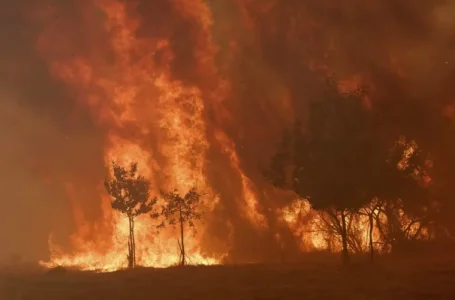
The powers to deal with this issue belong to the regional government, and this is not a matter of legal discussion, but of facts and means: it is the regional government that has the resources, the budget and the knowledge of the territory; Ayuso and her team are responsible for the fact that the Madrid region is burning.
This does not absolve the central government of guilt: its green progressivism is completely incapable of taking control of key sectors, including land use, and has turned the fight against climate change into a puppet show where the usual suspects win. Real estate and commercial interests are undeniably paramount, and the supposed policy of ecological transition is merely a veneer that blesses electric cars and rejects a rational and democratic use of land.
Let’s not fool ourselves: climate change has progressed too far, and wildfires are now a part of our reality. Some of them, like those ravaging the southwest of the region or the recent fire that consumed thousands of hectares, have reached levels that are beyond human control. The real resources, beyond the rhetoric of many, cannot contain the firepower that the flames have reached in a context of climate chaos and a constant rise in temperatures.
But things can still be done: actions can be taken on the land, a construction moratorium can be imposed and companies that profit from tourist housing can be expelled while demanding new constructions, soil and forest conservation can be intensified and private vehicle travel can be legally reduced. The working conditions of forest firefighters, who are under-resourced and subject to a seasonal system that makes them precarious instead of providing a stable and well-equipped workforce to combat the fires that are now a part of our lives, can be improved. Tragsa [2] and other similar companies can be removed; these are organisations with public capital that are dedicated to creating precarious work instead of hiring with guarantees and rights.
The climate emergency is permanent, but the response to the fires currently ravaging the region must be immediate and massive, utilising all available operational and management resources. The focus must shift in the opposite direction from current policies: socially and politically sanctioning those who trivialise climate change and prosecuting those responsible for ecocidal policies.
It is possible, of course, to expropriate unused land in private hands and give it a social use to avoid the abandonment that awaits only for speculative use and that, meanwhile, leaves the land as cannon fodder for fires. Control of economic activity, expropriation, and collective management are the recipes for a common policy that truly tackles the problem of the land and provides collective solutions to the imminent challenges of climate change. An active policy is needed that unites the popular and working classes to give substance and strength to an antagonistic political project that challenges the dominant common sense in favour of a common political project.
2 August 2026
Translated and annotated by David Fagan for International Viewpoint.