
 Version imprimable
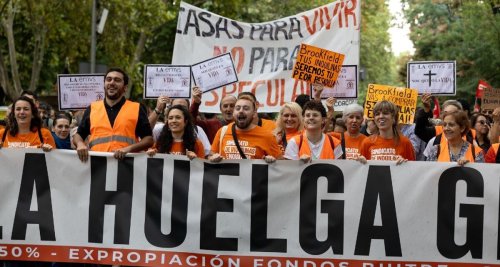
This statement by one of the spokespersons for the Tenants’ Union—the organisation that stood by Maricarmen in her fight against eviction right up to the very end—vividly conveys the shock caused by her death on October 7 among a broad and diverse majority of society, extending even beyond the borders of Spain. The cruelty and the malice—fuelled by falsehoods—directed at her by both the vulture fund and the reactionary political, judicial, and media bloc have been completely exposed, leaving no room for excuses. The rage and indignation that have been evident in the protests against the eviction since September 23rd have now reached unprecedented levels, providing even more impetus for a movement that is growing stronger by the day—as demonstrated by the encampments and new acts of solidarity across the country with the person who has become a symbol of the movement. In all of them—as was written from the Sol encampment—“Maricarmen has been and will be a symbol and an example for all of us, for the protest for decent housing, and for continuing to organise for our rights. She has been the spark that ignited this fire of unstoppable struggle.”
This harsh and sad news came after Pedro Sánchez’s decision to call a general election for November 29, convinced that the social outcry over housing might offer him the best possible opportunity to remobilise the left-wing electorate and counter the prediction—shared by virtually all polls—of an absolute majority victory for the PP-Vox coalition. [2] It also coincides with the support of virtually all national and regional trade unions for the Tenants’ Union initiative to call a general strike, scheduled for November 11.
Sánchez’s final decision to call early elections had become virtually inevitable following Junts’ [3] rejection of the initial housing decree and with no hope whatsoever that the proposed general budget would secure a parliamentary majority. Sánchez also had to take into account that he was unlikely to face a better set of circumstances in the coming months, given that inflation continues to rise (currently 4.9%) and legal harassment (the Zapatero and Leire Díez cases) [4] as well as issues involving family members, shows no signs of ending. That is why he chose to announce the call for elections with a speech in which he once again employed anti-elite rhetoric and boasted of some of his moderate social measures or of favourable economic growth figures even though these continue to contrast with the deteriorating material living conditions (especially regarding wages, housing, and prices, not to mention healthcare and education) of the majority of the working class.
Furthermore, Sánchez has opted to have the Council of Ministers re-approve—with some modifications—the two decrees [5] that were previously rejected by Congress, aiming to secure approval for at least the first one in the Diputación Permanente (Permanent Deputation or DP [6]) within a month. In doing so, he seeks to demonstrate that he remains responsive to the pressure exerted by the housing movement, attempting to position himself as its ally against the PP, Vox, Junts, and the conservative Unión del Pueblo Navarro (Navarrese People’s Union or UPN).
However, staging a comeback like the one in July 2023 will not be so easy this time; the task would be far more daunting now, as the advance of the right—particularly Vox—appears difficult to reverse. Compounding this is the fact that disillusionment with the PSOE-Sumar [7] coalition government has grown substantially among many working-class people, driven by numerous policies—or unfulfilled promises—regarding issues such as housing and the failure to repeal the "Gag Law" over the course of its eight years in office.
The PP and Vox were quick to respond to the snap election call—despite their initial bewilderment—since, prior to the Maricarmen eviction incident, the Ceuta crisis had offered them a more favourable landscape for their racist campaign and their electoral prospects. [8] Alberto Núñez Feijóo, head of the PP and leader of the Spanish opposition, has nevertheless expressed his satisfaction, as he sees himself—"at last"—as the future head of government. Even so, he does not appear entirely convinced, for he has once again resorted to the threat of electoral fraud, following the lead of Isabel Díaz Ayuso (President of the Community of Madrid and the PP) and Vox as loyal vassals of Trumpism. That said, the PP leader is barely heard speaking about policy proposals—beyond wanting to repeal any progressive measures enacted under Sanchismo and his obsession with sick leave—or doing anything other than trumpeting slogans like “PSOE or democracy” or “Spain against the PSOE.”
But, once again, it is former Prime Minister Aznar who has spoken most plainly, attributing profound significance to the November 29 elections. He goes so far as to argue that these are the most important elections since the Transition, as the future of the "Regime of ’78"—with the monarchy at its helm—is supposedly at stake...
As for Vox, its proclaimed pillars of "national priority, deregulation, and remigration" leave no doubt about its intentions should it come to power: to impose a policy that is racist, aporophobic, sexist, climate-change-denying, and ultraliberal—a stance now confirmed regarding a key issue, the pension counter-reform already announced by that sinister figure, MP José Figaredo, of Vox—the very man who called for the hunting of migrants in Ceuta. So, what awaits us if these parties come to power—amid the rise of the reactionary international, as we are currently seeing in Germany and Brazil—is a genuine counter-reform on the political, social, and cultural fronts.
Meanwhile, the call for elections has caught the national-level forces to the left of the PSOE—which have governed alongside that party—in the midst of a dispute. The conflict centers on who will lead the Sumar coalition—now being renamed the Frente Amplio (Broad Front)—and the question of whether or not to reach an agreement with Podemos. As polls predict, the potential electorate for that political space has shrunk significantly over the past eight years; the total vote share would likely be higher if they ran separately—to the benefit of the PSOE or of voter abstention. Occupying other political spaces are the regionalist left-wing parties (such as EH Bildu in the Basque Country; Bloque Nacionalista Galego, the Galician National Bloc; Esquerra Republicana de Catalunya, Republican Left of Catalonia; Coalició Compromís in Valencia; Chunta Aragonesista, Aragonese Union; and Adelante Andalucía, Forward Andalusia)—which possess genuine territorial roots—and will run under their own banners. It remains to be seen what platform and rhetoric they will adopt, in order to assess whether they reflect a desire to shift political direction following the varying degrees of subordination to the PSOE they have maintained until now. Separate cases are those of Adelante Andalucía—a proponent of anti-capitalist Andalusianism—and the Candidatura d’Unitat Popular (Popular Unity Candidacy or CUP) in Catalonia, whose national leadership has decided not to run, although this decision must still be ratified in an internal referendum.
On the other hand, what is also becoming apparent in these mobilisations is the emergence of a new generation of social and political activists who—alongside significant segments of earlier generations—are articulating a new process of radicalisation that urgently demands a left-wing movement committed to a clean break from, and independence from, the still-hegemonic socio-liberalism. [9]
Prepare and Organise the General Strike
In any case, preparing for the General Strike on November 11 requires the greatest possible unity of action among the organising bodies to establish neighbourhood, workplace, and campus committees across the country—as has already been proposed by the Tenants’ Union and various other trade union, feminist, environmental, and social organisations. It must be—as was successfully proposed for the feminist General Strike of March 8, 2018—"a strike involving labour, care work, consumers, and students," although its impact in factories was limited at the time, since the major unions called only for partial, two-hour work stoppages.
Therefore, there are sufficient grounds to believe that the agreement reached regarding this call to action will pave the way for a virtually total work stoppage—an unprecedented scenario on the eve of an election campaign. Moreover, this process is unfolding against the backdrop of a likely "hot autumn" across Europe—a phenomenon not seen in a long time, as we are already witnessing in France and Belgium.
Obviously, there are various currents and strategies within that bloc; therefore, efforts must be made to avoid any instrumentalisation for electoral gain. Instead, this call to action should be grounded in shared objectives that—while rooted in demands for decent housing, fair wages, and fair prices—go further to target a form of capitalism that is rent-seeking, speculative, and predatory.
This mobilisation cannot remain indifferent to the threat posed by an electoral victory for the right—a threat that must be confronted with our full collective strength. Yet, this must be done while asserting the movement’s autonomy and its readiness to keep fighting regardless of who holds power, at any level, both before and after November 29. This is all the more true given that primary authority over housing lies with the autonomous communities and municipalities—mostly governed by the PP, and in many cases in coalition with Vox.
We are entering a decisive few weeks in which the reactionary bloc, business associations, and rent-seeking lobbies—emboldened by the blackmailing power they demonstrated against Junts—will not hesitate to use every possible dirty tactic to prevent the General Strike from becoming a success capable of shifting the current balance of power.
10 October 2026
Translated and annotated by David Fagan for International Viewpoint from Viento Sur.