
 Version imprimable
Regardless of any ethical-political values a strike might hold in a given situation, there is something inherently valuable about it—transcending the specific circumstances that frame it: its nature as an interruption to the mechanical course of things.
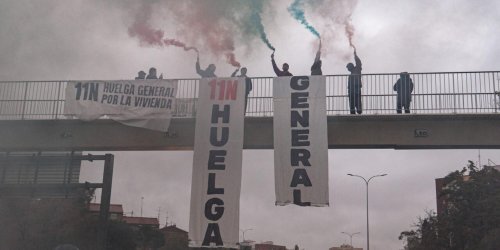
Indeed, this is what unfolded during this day of disruption to the established order—an event that may have reached as many as 5 million people and which, this time, can truly be considered historic, as described by its primary organiser, the Confederation of Tenants’ Unions. For, beyond the inequalities between different territories (with percentages (that, according to the unions, have ranged from 84% in Catalonia and 75% in Andalusia and Aragon, down to 41% in Extremadura,or a near-total standstill in the Basque Country [1]) and between productive and reproductive sectors - what has unfolded over the course of that day and the days preceding it is a process of bottom-up self-constitution: the emergence of a new socio-political subject that has developed an awareness of its own collective strength—a strength capable of challenging “all governments,” which are denounced as complicit with both rent-seeking interests and the employer class.
A process that, in the days leading up to the strike, took the form of largely unified efforts—through strike committees in many neighbourhoods and workplaces of all kinds, as well as countless information pickets held in the early hours and throughout the day of the strike—resulting in a widespread work stoppage across key sectors such as shipbuilding, ports, heavy industry, and transport, as well as in areas already engaged in struggle (such as education) and others that often receive less visibility, such as hotel housekeeping and the care sector.
The day’s mobilisations culminated in large-scale, predominantly unified demonstrations held in the afternoon across the country—this despite persistent rain in most cities and towns. The diverse slogans and chants, voiced in a cheerful and festive atmosphere, confirmed a trend that had already begun to emerge: a new process of repoliticisation and radicalisation taking root among broad segments of the general public—a movement that stands in direct opposition to the rise of the far right, while remaining openly critical of the progressive coalition government.
A general strike—unprecedented in our collective history—that had as its primary objective the demand for the right to decent housing, to which other demands have since been added (such as fair wages, pensions, and quality public services), alongside various proposals put forward by the myriad social movements that have joined this day of mobilisation.
Its success has been unquestionable, especially when one considers the growing hostility that the reactionary bloc—comprising political, economic, and media elements—has directed against it, with the President of the Community of Madrid, Isabel Díaz Ayuso, at the forefront. But also—despite Prime Minister Pedro Sánchez’s stated “respect” for the legitimacy of the General Strike—there was brutal police repression (including the use of pepper spray) against picketers at many workplaces and during demonstrations, such as those in Seville and Madrid (the largest, involving hundreds of thousands of people). This took place under the command of Minister of the Interior García-Marlaska, whose history of complicity in human rights violations goes back a long way.
This is a mobilisation that, for the first time, also featured the housing movement and a new generation as key protagonists; it was marked by the greatest unity of action ever achieved among the diverse trade union and political organisations of the working class—ranging from the old consensus-oriented unions to more militant ones, both within the stateless nations [1] and across the state as a whole—and saw an intergenerational level of participation far greater than what we have witnessed on similar occasions in the past.
In short, it was a day that brought together a wide array of struggles and collectives linked to various social, cultural, and other organisations—each contributing its own specific demands and perspectives. The feminist movement placed a special emphasis on care work, building upon the experience of the 2018 General Strike; the environmental movement focused on consumer boycotts and the fight against the climate emergency; and the anti-racist movement reminded us that “there can be no General Strike without migrant and racialised working-class people, and class solidarity cannot be built without grassroots anti-racist organising.”
This political, social, and ideological plurality explains why there have been such lively debates within many of the forums that have emerged throughout this process—debates not without their tensions, precisely because this convergence is something entirely new. Ultimately, what has become clear is the increasingly robust emergence of an alternative form of trade unionism—one rooted in confrontation and the building of popular power—that seeks to transcend the framework of "consensus-based" unionism and the "lesser-evil" politics that have prevailed until now.
It’s only the beginning - the struggle continues
The outcome of the general elections on November 29th will largely determine the landscape in which this new cycle of struggles continues—a cycle that encompasses a legitimate contest for hegemony among the various currents that have emerged throughout this process. This task need not be incompatible with the pursuit of the broadest possible unity in action against a reactionary bloc which, regardless of the election results, will continue to hold power in the majority of the autonomous communities and municipalities. Or, alternatively—though this seems less likely at the moment—we could see a return to a government dominated by the social-democratic Partido Socialista Obrero Español ( Spanish Socialist Workers Party or PSOE), which, as the last two legislative terms have clearly demonstrated, has sufficiently exposed the limits and contradictions of its policies—and not just regarding housing. One need only recall the persistence of a “gag law” that continues to be used to curtail the right to protest and to strike, as we have witnessed in recent days.
In this context, it becomes increasingly necessary to advance the construction of an eco-socialist, transformative left—one that defends the sovereignty of peoples—following the path already indicated by Adelante Andalucía (with its highly likely presence in the new parliament to emerge from the November 29th elections) [2] and which is beginning to take shape elsewhere, such as through the Liberar Madrid [3] initiative ahead of next May’s municipal and regional elections.
In any case, as the organising groups have already announced, November 11th is intended to serve as a starting point for new initiatives—initiatives that, fortunately, will unfold amidst a period of heightened social unrest across Europe, particularly in neighbouring or nearby countries such as France, Italy and Portugal. [4]] Perhaps this will pave the way for a significant scaling up of mobilisation efforts—an objective already pursued by a recent meeting in Paris, which brought together various European housing movements and has called for further mobilisations on November 20th, 21st, and 22nd.
12 November 2026
Translated by David Fagan for International Viewpoint from Viento Sur.