
 Version imprimable
This struggle ushered in a new cycle of confidence for the popular movement.
The government, which holds a minority in parliament, put labour issues on hold and sought to change the subject. It ensured that the PS abstained on the draft state budget, on the one hand, and, on the other, reached an agreement with the far right on a new rental law which, in practice, virtually eliminates any rights for tenants.
A two-month delay in paying rent can lead to eviction. There is no longer a cap on deposits for renting a property. The number of months’ rent a tenant must pay in advance when signing a tenancy agreement has been increased to three. The 2 per cent cap on rent increases has been removed. With this proposal, the rental market – which is used by those unable to buy a home – becomes even more cut-throat, in the eurozone country where house prices have risen the most, where only 2 per cent of housing is social housing, where the rent per square metre has doubled over the last five years, where, on average, people spend 50 per cent of their income on rent for legally registered tenancies alone (that is to say, it is even worse if we take the informal market into account), and where the poverty rate rises from around 15 per cent to 27 per cent when housing costs are factored in.
The rising cost of living, including fuel prices, and the approval (albeit without a final vote yet) of the tenancy law have created the conditions for a new cycle of protests.
On 10 October, a coalition of various groups and associations, called ‘Não Dá Mais’ (‘We Can’t Take It Anymore’), organised demonstrations against the rising cost of living in five cities, attended by several thousand people. In the city of Porto, which has the greatest impact in the north of the country, this demonstration coincided with two other protests – in support of Palestine and to safeguard an old market (the Bulhão), which is highly symbolic for the city – and was followed by a call, inspired by events in Spain and the wave of outrage over Maricarmen’s death, to set up a tent camp at the end of the rally, occupying the square where it had taken place.
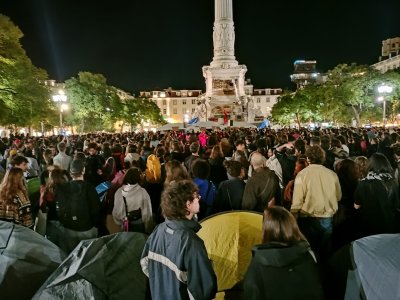
On the first night, around 30 tents were pitched and remained in place. On the second night, there were more than 50. The camp was going to be cleared by the council at the end of the second night. The activists used social media to call for a new demonstration at the same location, with the aim of deciding, at an open-air public assembly, whether to resume the sit-in. On that same day, the Mayor declared that he would be “absolutely uncompromising” if the square were to be occupied with tents again. But not even that deterred the organisers of the camp, who set it up once more, with more people and more support.
At 3 am, with no journalists left in the square, the Government and the City Council, acting in concert, ordered a brutal police charge against a few dozen peaceful activists who had spent the night in that square. Curiously, this was on the very same day that, 20 years ago, a movement had begun to occupy the municipal theatre located in the same square.
The mobile phone videos shocked public opinion and the city. That very same day, thousands of people flocked to the square in outrage, in a massive demonstration that also made its way to the entrance of the city hall. Not only did the movement explode, but it also began to spark reactions in other cities and a huge wave of solidarity.
Not even the attempts by the Government and some commentators to stigmatise and blame the activists for having ‘provoked the police’ had any effect.
For the past ten days, the square has been constantly filled with thousands of people in the late afternoon and evening, with cultural events and workshops, whilst the organisers manage the day-to-day running of catering, security and cleaning. A new camp also sprang up in Lisbon last weekend, and in Coimbra. At the trade union demonstration called by the CGTP (Portugal’s largest trade union confederation) against the rising cost of living on the 17th, trade union organisations and the ‘campers’ converged, forming a crowd of diverse ages and social backgrounds, which returned to the square in Porto. That same evening, the Porto camp was re-established with thousands of people, and several hundred spending the night there. A new cycle of protests has begun and will reach its next major national milestone on 14 November with a national demonstration.
At present, it is impossible to predict how the movement will develop. The issue of housing, however, is already at the centre of public debate, even as the government attempts to refocus the debate on ‘violence’ or the legitimacy of occupying a public space with tents. Progress has been made, notably during the demonstrations on 17 October, in developing a convergence between the housing protests and the trade union mobilisations. The political parties are under pressure to provide answers regarding the housing crisis, and the far right is already beginning to backtrack on its commitments regarding the new tenancy law, which may thus be defeated by popular mobilisation, as happened with the Government’s labour reform package. There is also discussion as to what effect the Spanish general strike will have on the timetable and repertoire of struggles in Portugal. Undoubtedly, the inertia has been shaken off and we are facing a new cycle of collective action, with significant youth participation, which is already fostering a new collective consciousness and may have lasting effects on the reorganisation of the popular movement and the balance of power in the country.
20 October 2026
Translated by International Viewpoint.