
 Version imprimable
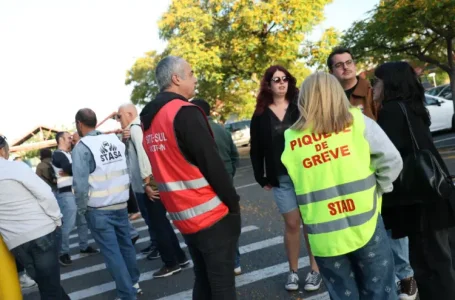
The general strike called for this Wednesday by the CGTP, with the support of eight UGT unions and many independent ones, began with a high level of participation, particularly in the transport, health, and education sectors.
“It’s turning out to be a major general strike; the data we have from last night shows workers are determined to treat today as a major day of struggle,” said the CGTP’s General Secretary in the morning outside one of the striking schools in Lisbon.
Based on the data he had gathered so far, Tiago Oliveira told reporters that “hospitals are operating with minimal services; in rubbish collection, participation was 100% in most districts; the ports of Setúbal and Sines are closed; and there is strong participation in public transport—including the Lisbon Metro, Transtejo, Soflusa, and CP—as well as in the aviation sector. And in industry, we have a large number of companies with 100% participation or with production halted.”
For the CGTP leader, “the scale of today’s action shows that workers are fully aware of what the labour package entails,” a bill presented “with the stamp of the 21st century.”
Tiago Oliveira does not expect the government to change course, as “it has been arrogant and overbearing in the way it has handled the whole process,” and the prime minister’s statements about the general strike the day before, “show a lack of humility and awareness of reality”. And that is why “it will be the workers who will defeat the labour package”.
In Lisbon, the unions announced early in the morning 100% support at the São José and São Francisco Xavier Hospitals, as well as at the São João Hospital in Porto and in Coimbra, and 90% at the Santa Maria Hospital.
CP trains are operating a minimum service, as are the other major public transport companies where strike action has been called. In the aviation sector, unions report 500 cancelled flights.
In Porto, Fenprof Secretary-General Francisco Gonçalves said that most schools in the city were expected to close. The proposed labour package brings additional difficulties for those working in education, and the union leader strongly opposes the implementation of individual time banks, which “would be an absolute disaster for teachers’ already deregulated personal lives.”
After joining strike picket lines the previous day at Vidralva in Marinha Grande and at the Lisbon Metro, José Manuel Pureza began the day with workers at Autoeuropa.
“Turnout is very high, and since Autoeuropa is such an important workplace, this gives us reason for hope,” the Bloco coordinator told reporters, emphasising that “what is at stake is decisive for putting an end to this proposal, which must be defeated politically in Parliament”.
Pureza added that this general strike “is a very important day and a source of great hope for those who believe that their lives and wages do not have to get worse and that their working hours do not have to increase.”
3 June, 2026
Translated by Iain Bruce for International Viewpoint from Esquerda.net.