
 Version imprimable
On the one hand, a public institution conceived as a pillar of social justice and democracy; on the other, a system that is gradually aligned with the logic of the market, profitability and individual responsibility.
On the morning of Thursday, 4 June 2026, a mobilization of exceptional magnitude materialized this divide. Thousands of people – teachers, pupils, students, parents, education and social sector actors – converged on the capital, Brussels. Their objective was clear: to express a massive rejection of the policies implemented by a government perceived as increasingly authoritarian and deaf to the demands on the ground.
This day did not emerge from nowhere. It was the culmination of 18 months of growing tensions, major mobilizations and an accumulation of reforms experienced as a systemic attack on public education.
A government accused of undemocratic behaviour
Since coming to power, about a year and a half before the events of June 2026, the government of the Wallonia-Brussels Federation has embarked on a series of reforms aimed at thoroughly restructuring the education system. Very quickly, relations with teachers and their representative organisations deteriorated.
The criticisms converge: lack of consultation, decisions imposed without real negotiation, and a clear contempt for the actors on the ground. The unions denounce a top-down logic in which the professional expertise of teachers is systematically marginalised. The emerging collectives speak of an assumed political will to circumvent social resistance.
This tension reached a climax with the adoption of a central text: “decree-programme 2”. In order to ensure its adoption, the government has resorted to exceptional parliamentary procedures. On two occasions, the established rules were circumvented in order to reduce debate to a minimum and prevent the opposition from fully playing its role.
For the opposition parties and a large part of civil society, these decisions constitute genuine breaks with democracy. The vote of 4 June 2026 therefore appears not only as a legislative moment, but also as a revelation of broader institutional drifts.
“Decree-programme 2”: a systemic reform with cumulative effects
At the heart of the protest is the very content of “Decree-programme 2”. Presented as a measure of budgetary rationalization, this text introduces a series of profound transformations in the education system.
Among the most emblematic measures is the increase in the workload in higher secondary education, which goes from 20 to 22 weekly periods, without a salary increase. For teachers, this change is not a simple technical adjustment: it implies an intensification of work without improving pedagogical conditions, in a context already marked by overload and burnout.
The text also provides for a significant restriction of rights related to sick leave and absences without a medical certificate. End-of-career arrangements are being tightened, limiting the possibilities for the most experienced teachers to gradually reduce their workload.
At the same time, social measures were abolished. In particular, the budgets devoted to the free distribution of meals in institutions with a precarious public have been repealed. This decision is particularly outrageous, as it directly affects the most vulnerable students.
In higher education, the reform provides for a substantial increase in tuition fees (from €835 to €1,194 per year in universities – an increase of more than 40%; and up to five times higher in some institutions). This measure is combined with an extension of student work (they are allowed to work more hours) and a lowering of the age of access to this work (from 16 to 15 years old), creating a paradoxical situation: students have to work more to finance studies that have become more expensive, at the risk of compromising their academic success.
Other provisions complete this picture: the abolition of free art academies for children under 12 years old, the questioning of previous reforms aimed at strengthening the equality of the system, and the lack of salary recognition for the extension of studies (from 3 to 4 years) for future teachers.
Taken in isolation, each of these points could be the subject of a specific debate. Together, they are designing a structural transformation: a school that is less accessible, more unequal, and based more on individual resources than on collective solidarity.
Austerity as part of a broader framework
Educational reforms do not unfold in a vacuum. They are part of a broader set of policies adopted at the national level. These include the “double index jump”, which reduces the purchasing power of employees by suspending the automatic indexation of salaries to inflation, as well as the tightening of the conditions of access to sick leave and end-of-career arrangements.
The introduction of “negative bonus” pension mechanisms affecting the future retirement of part-time workers further reinforces this feeling of precariousness. For teachers, these measures come on top of sectoral reforms, producing a particularly severe cumulative effect.
In this context, the protest quickly went beyond the framework of education. It joins broader concerns about the future of public services, the deterioration of working conditions and the rise of inequalities.
The birth of an unprecedented social movement
The movement was not born on 4 June 2026. Its roots go back to the autumn of 2024, when the first cost-saving measures affected state schools. From October 2024, local mobilizations emerged. They remained initially limited, but laid the foundations for a dynamic that would gradually expand. Teachers then expressed their concern about the deterioration of working conditions and the questioning of certain recent advances.
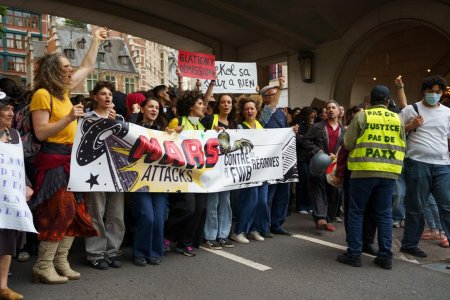
A turning point took place after the 2026 spring holidays. On 12 May 2026, a large demonstration against the federal government — often referred to as the “Arizona government” — helped to unite previously dispersed anger. In this context, several general meetings at schools, particularly in Liège, decided to launch renewable strikes. In Brussels, schools organised to strengthen their coordination and their capacity for action. It was at this pivotal moment that the “Mars attacks” collective emerged, an inter-school coordination that played a central role in the structuring of the movement.
The eruption of collectives
One of the most striking features of this mobilization is the emergence of autonomous collectives. Alongside the unions, a new generation of actors is organizing. Among the most visible are “École en lutte [School in Struggle]” and “Université en colère [Angry University]”, which respectively bring together primary and secondary school teachers, and higher education actors. These collectives seek to revitalize a social movement that is considered too institutionalized and sometimes disconnected from the realities on the ground.
The “Mars attacks” coordination plays a particularly decisive role. It organizes inter-school assemblies, coordinates actions and helps produce alternative information to what activists perceive as misleading government communication.
Quickly, other initiatives emerged: “Parents attack” and “Élèves attack [Students attack]”. These collectives extend the mobilization to the entire educational community, transforming a professional protest into a societal movement.
Self-organization and grassroots democracy
From May 2026, the movement entered a phase of intensification. Inter-school general assemblies (GAs) are organized in several large cities. These General Assemblies become places for collective deliberation and decision-making. They discuss the renewal of strikes, the organization of pickets, student evaluation methods, and communication strategies.
This dynamic of self-organization is one of the most innovative aspects of the movement. It reflects a mistrust of traditional structures, but also a desire to regain control of decisions. For many participants, this experience gives a political meaning to the teaching profession and to collective commitment.
4 June 2026: a massive demonstration under high tension
On Thursday, 4 June 2026, the mobilization reached its peak. In the morning, processions from all over the country converged on the Parliament district. About five thousand teachers, joined by pupils, students and trade unionists, were faced with a police force of unusual size. Roadblocks, anti-riot units, massive presence of officers: everything indicated an anticipation of a high level of conflict.
Very quickly, the situation became tense. Clashes broke out near the FWB Parliament. Several witnesses report particularly violent interventions by the police. Teachers are trying to protect their students, most of whom are minors. Young people aged 14 to 15, often present for their first demonstration, were at the heart of a brutal police repression. The trap technique — consisting of encircling demonstrators to arrest or even repress them — was used. It was denounced by many organizations as a problematic, even illegal practice.
Repression and targeting of young people
Tensions did not end on 4 June. In the following days, on 5-6 June 2026, so-called “preventive” control and arrest operations multiplied, concentrated in particular around transit areas, such as the central station. Several testimonies mention stops targeting young people — in particular, black teenagers and teenagers of North African origin.
These practices fuel a sense of injustice and reinforce the political dimension of the movement. The issue of police violence and institutional discrimination is now at the heart of the mobilization.
An immediate response: the appeal of 8 June 2026
Faced with these events, the reaction was swift. On Monday 8 June 2026, a joint call was launched by school and university collectives, teachers’ unions and youth associations, for a broad and peaceful demonstration against all forms of violence against young people. It marked a convergence between the different components of the movement and underlines its ability to reorganise itself quickly.
A movement that is spreading
Beyond the one-off demonstrations, the movement is a long-term one. The strikes continue. The general assemblies continue to meet. Rotating events are organized in different cities. A new deadline has been set: 16 June 2026, a major interprofessional demonstration in Namur, the capital of the Walloon region. This event marks a possible expansion of the movement to other sectors.
Demands that are being structured
If, at first, the mobilization was built around the rejection of the reforms, it is gradually evolving towards a formulation of positive demands. These include reducing class sizes, increasing teaching resources, recognizing teachers’ pedagogical freedom, and harmonizing salary scales. More broadly, the movement defends a conception of school as a space of equality, emancipation and the fight against discrimination.
International reach
The “chalk revolution”, as the movement has been called, is not an isolated case. It is part of an international dynamic in which many countries are experiencing similar mobilizations. Everywhere, teachers, students and parents are mobilizing against policies perceived as attempts to commodify education. The issues are similar: access to education, working conditions, funding of public services. In this sense, the movement observed in June 2026 can be interpreted as a warning signal, but also as a laboratory for new forms of mobilization.
A struggle that has only just begun
Despite the adoption of “Decree-programme 2” at dawn on 5 June, the movement shows no signs of running out of steam. On the contrary, it seems to be entering a new phase. The mobilization has already produced effects: it has highlighted issues that are often invisible and has made it possible to build unprecedented alliances.
It remains to be seen whether this dynamic will be able to influence political choices. One thing is certain: the question of the future of public education is now being asked centrally.
And, well beyond the borders of Belgium, it challenges all societies confronted with the same fundamental question: how can we defend (and expand) the right to education and public and democratic schooling?
11 June 2026
Translated by International Viewpoint.