
 Version imprimable
On the other hand, no major protest movement had been observed so far in 2026, although the situation has not improved at all. On the contrary, the interruptions in the water supply have even increased, testifying to a form of normalization of this phenomenon that has been going on for more than five years in these regions. In the summer of 2026, several northern governorates were also affected, with no short- or long-term solution being provided.
The return of mobilizations
The July heatwave, combined with water cuts of more than a week in many cities and rural areas, prompted residents to protest and block roads. Many have lost some of their herds due to the extreme drought, while monthly spending on water trucking has risen sharply.
Some examples of protest movements:
– 25 June 2026: Demonstration and blockade of the road between Nefza and Ushtata (Beja governorate).
– 13 July 2026: demonstration at the Mellag bridge, on the road linking Jendouba to Kef.
– 21 July 2026: protest in the Cap Bon region (Ennachaâ and El Karmania areas, delegation of El Haouaria).
At the same time, rotating power cuts were put in place during the month of July 2026 to protect the national electricity grid from a total collapse (“blackout”), as consumption exceeded production capacities. These cuts have sparked great anger among citizens, causing significant economic damage as well as the halt of many professional activities.
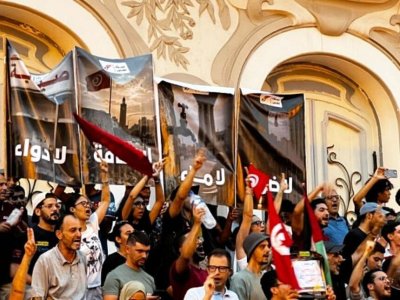
The celebrations of Republic Day, 25 July 2026, thus turned into a demonstration expressing the rejection of the existing regime. The authorities estimated the number of protesters at around 5,000 people. It should be noted, however, that this estimate is difficult to verify, as the Ministry of the Interior has installed, since the revolution, numerous filter barriers in the streets of Tunis in order to prevent large gatherings.
Therefore, several questions arise: what are the root causes of the water and electricity crises? Are the agreements concluded with the International Monetary Fund responsible for this situation?
Tunisia has experienced two periods marked by a strong influence of the International Monetary Fund on its economic and development policies. The first dates back to 1986, when, following the economic crisis and the fall in oil and phosphate prices, the country adopted a vast economic reform programme, a structural adjustment programme.
The second phase began in 2013, after the revolution, when Tunisia entered a new cycle of debt accompanied by reform programs related to financial and economic difficulties. This evolution has gradually made the IMF the central player in the orientation of the country’s economic and development policies. Successive governments have thus given priority to the implementation of projects benefiting from IMF approval or financing.
The causes of the water crisis
Tunisia is located in an area with a predominantly semi-arid and arid climate. Its Mediterranean-type rainfall pattern exposes all regions of the region to the most torrential rainfall on average every four years, affecting one or two regions each year. It is for this reason that old buildings are generally located on heights, sheltered from flooding.
Since independence, the Tunisian state has based its water policy on these climatic characteristics in order to guarantee the country’s water needs. Between 1956 and 1989, a vast programme of construction of dams and hill lakes made it possible to build up an important hydraulic network, thus promoting the development of industry and modern export-oriented agriculture.
However, since their commissioning, these structures have never been the subject of complete cleaning or sediment removal operations. The few interventions carried out were limited to one-off maintenance work or the repair of certain equipment, without any overall treatment of the siltation. From the beginning of the 2000s, however, the need for the desilting of the dams and hill lakes became urgent. However, the high cost of these operations, as well as the allocation of public resources to other priorities, considered more favourable to the interests of private capital, led successive governments to postpone this work.
This policy has led to a loss of more than 20% of the storage capacity of Tunisian dams (This official figure is nevertheless subject to caution: field observations suggest that this loss could be significantly greater, although it varies according to the location, age and characteristics of each dam). In addition, the lack of abundant rainfall each year accentuates this situation. During torrential rainfall episodes, a significant part of the storage capacity is already occupied by accumulated sediments, which greatly reduces the volume of water that can be retained. A considerable proportion of flood waters are wasted and discharged directly into the sea without being exploited.
Before and after the 2011 revolution, successive governments have not changed this policy, despite the accumulation of studies recommending the desilting of existing dams and the increase of their storage capacity.
The IMF’s policy is quite different: it supports seawater desalination, a solution that does not meet the country’s basic needs, is very expensive and offers very low returns (this technique is only necessary on the island of Kerkennah). This has led to a catastrophic crisis in water supplies in all central governorates: Kairouan, Sousse, Monastir and Mahdia, where in some areas the water supply to dams has been cut off to farmers, while in others the flow has been reduced.
This has led to the loss of a large part of the agricultural crops in the last five years and has led many farmers to bankruptcy, often forcing them to sell their land (it should be noted that most of these areas suffer from a problem of high salinity of groundwater, which makes some farmers totally dependent on water from dams)
The causes of the electricity crisis
The electricity crisis has similar characteristics to the water crisis. Thus, electricity consumption has gradually increased over the years as a result of the development of Tunisian society. On the other hand, the production capacity of the Tunisian Electricity and Gas Company (STEG) has not kept up with this change in demand.
On the contrary, four natural gas-fired power plant projects, proposed between 2015 and 2020, have been frozen. The same applies to the nuclear power plant project, first presented in 2010 and reintroduced in 2015, which has never gone beyond the proposal stage.
Faced with this situation, the authorities have favoured the use of electricity imports from Algeria during periods of high consumption, gradually abandoning the logic of energy self-sufficiency. This orientation has been denounced several times by the union of officers of the Tunisian Electricity and Gas Company.
From 2017 onwards, successive governments have made the development of solar energy their main focus of energy policy, in particular in order to meet the expectations of international donors, as the IMF has supported the financing of these projects.
The influx of these financings has attracted the interest of many foreign and local companies, transforming the renewable energy sector into a particularly lucrative market. This is mainly based on the partial assembly of photovoltaic panels as well as the import of essential electronic equipment and high-voltage lithium batteries.
To better understand this development, it should be recalled that two 10 MW photovoltaic power plants were authorised in Tozeur in 2017 and 2018, before coming into service in 2021. On the other hand, in the private sector, five generation licenses, representing capacities between 50 and 200 MW, were granted in 2018 without any of these projects having entered the production phase. Similarly, six other licences, with a capacity of between 50 and 800 MW, were issued in 2022, none of which have yet reached the production stage.
Despite the importance of the energy transition policy and the reduction of pollution that it brings to the environment, what is being put in place in Tunisia constitutes pushing the Tunisian state towards increasing indebtedness and dependence on the IMF, which has become the official decision-making body and the real determinant of the Tunisian state’s development policy.
In addition, these projects were handed over to the private sector as a gift to generate more profits, despite the fact that the National Company had applied to be awarded these projects; However, this request was rejected and its role was limited to purchasing the energy produced by these plants and extending a grid to the desert in order to connect the plants (the company lost more than $15 million in extending the grid to one of the private plants, when the project developer abandoned the latter). These policies systematically aim to bankrupt the National Electricity and Gas Company in order to place it under the tutelage of international financial bodies.
In addition, repeated power cuts during the exceptional heat wave caused considerable economic losses. The poultry sector was particularly affected, with the death of tons of poultry, while large quantities of food stored in shops were destroyed. In addition, there has been an increase in deaths among the elderly or those suffering from chronic diseases, accentuating the population’s discontent and fuelling a climate of high social tension. This situation illustrates the failure of the policies carried out so far and revives the debate on the need for a change of regime.
The deterioration of the situation in Tunisia is mainly the result of a combination of two factors. The first is the influence of the International Monetary Fund on development policies, which reflects a new form of colonialism and economic domination. The second is the role of private capital, both domestic and foreign, which relies on public funds to make quick and guaranteed profits.
This mixture of unlimited capitalist greed has made the economic and social situation unbearable for the people. This is why we are witnessing waves of legal and illegal emigration.
The Tunisian model not only reflects the inability of liberal politics, or even traditional capitalism, to find concrete solutions, but has become a reactionary force that opposes progress and freedom.
After a succession of economic crises and failures of public services, the streets have risen up again, which refers to the resumption of the momentum of the revolutionary process in the long term. That is why the socialist and progressive forces must unite and close ranks in order to seize power in the revolutionary explosion.
31 July 2026
Translated by International Viewpoint from Inprecor.