
 Version imprimable
Forest fires are raging in Algeria, Morocco, Tunisia and Syria. The number of deaths due to fires continues to rise in Algeria. In addition, there were fires in residential buildings in Algeria (an orphanage: 11 dead and nineteen injured), in the West Bank, fires in warehouses (Dekawane, Lebanon), shops (Misrata, Libya), electricity stations (Samawa, Iraq) and fires due to attacks during conflicts (Sudan, Kuwait, Bahrain). Water is scarce everywhere, and this year is marked by massive power outages (Iraq, Tunisia, Yemen, Libya) which in turn lead to water supply problems, particularly in Tunisia. In Libya, the authorities have announced the closure of wells in the Great Artificial River, due to the lack of power, which augurs well for water supply problems.
Daily struggles
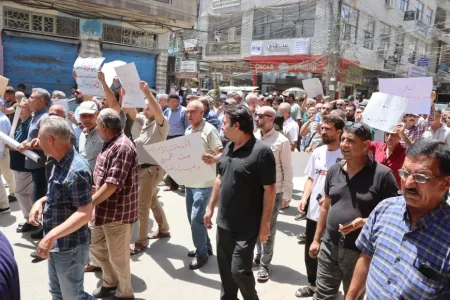
From Mauritania to Yemen, via Morocco, Iraq, Gaza, Syria or Libya, the people of the region are in the streets, demanding drinking or irrigation water, or electricity. Each year, this movement is accentuated as summer approaches, but this year it has taken a step ahead and gained momentum.
The struggles for water and electricity are led by the people, by neighbourhood, by city or village. From sit-ins to demonstrations, from blocked roads to the investment of public buildings, people are demonstrating where they live, with the exception of the marches of tens of kilometres by Moroccan populations from isolated localities to larger cities, or the rallies before the presidential palace in Nouakchott in Mauritania. Religious processions turn into demonstrations in Iraq. Roads were blocked because of their importance: the Route of Hope in Mauritania, the road leading from Egypt to Sudan. [1] These demonstrations are generally peaceful, but have turned into clashes in Iraq where the security forces have used weapons and injured many demonstrators, leading in turn to new protests forcing the authorities to release those arrested.
These struggles are not long-lasting, but are repeated as the days go by. There are attempts to organize (in Qamechli in Syria, in Kut in Iraq). Struggles for water are supported by the FTDES in Tunisia or the AMDH in Morocco, and are sometimes initiated by political parties in Mauritania.
The mattress revolution
Yemeni men spent nights on floor mats in the streets demanding electricity6 in several districts of the governorate of Aden or Lahij and for several days in a row in June7, breaking with these mass sit-ins, with, on the one hand, their tradition of confrontation with the authorities in the past years, and with the unprecedented mobilization of Yemeni women in 2025. [2] This method, also imposed by the heat wave, has spread to Iraq where a group of men has just repeated the experiment, again to demand electricity.
The protesters
Because the nocturnal demonstrations only involve men, who make up all the demonstrators in Iraq or Libya (in these two countries day and night), in Iraq, a mother of children broke this state of affairs by setting fire to a roadblock on a road alone to demand her share of electricity.
Everywhere else, women demonstrate during the day and often lead water struggles. And some of the demonstrations are only female, in Morocco or Tunisia. Everywhere else, diversity reigns. And often children are on the front line, as in Gaza.
Demands for water and electricity are sometimes coupled (Tunisia), or combined with others: standard of living or an end to the increase in fuel prices (Syria), payment of wage arrears (Yemen), corruption (Iraq), dismissal of officials (Iraq).
It is very rare for such struggles to start in the workplace. This was the case in Egypt where workers at the Al Raqaba solar power plant project (Aswan governorate) demonstrated at their workplace following the death of a worker and the discomfort of other colleagues, due to heat stress (48° in the shade), to demand suitable working conditions (water, toilets, medical clinic) and salary increases. Workers at the Ortho-Group textile company in Beni Hassen, Tunisia, protested in the streets against the power cut.
The lack of water and electricity is dragging other social categories into the protests: florists in Morocco, entrepreneurs in Syria, restaurateurs, industrialists.
Shortages of water and electricity for years have led to the emergence of new professions: private electricity suppliers or water deliverers by tanker trucks. However, the latter rose up in 2026, the former because of the interruption of fuel delivery (Syria), the latter because of fuel prices (Jordan).
“The future is not a question of luck or weather”
Fifteen years after the outbreak of the revolutionary process, it is not uncommon to hear familiar slogans: “The people want... water... electricity”. Demonstrators in Syria carry placards signed “Thouar 2011”, or “the revolutionaries of 2011”, or claim to be part of the revolution.
Faced with these daily mobilizations for almost two months, the authorities have had no adequate response, while some administrations have had to close, such as those in the city of Tripoli (Libya) because of the lack of electricity.
The populations have only been entitled to silence, closed doors, or punctual responses (such as sending tanker trucks) or promises to warn the populations in advance of future breakdowns! These measures are intended to temporarily calm the discontent, to gain time rather than to anticipate the future, not to mention the conspiracy theory dear to the Tunisian president, who has come out of silence to accuse “plotters lurking in the heart of the state” of sabotage rather than admit the dilapidation of the networks or structural failures. Tunisian MPs have asked questions about the repercussions in terms of deaths and deterioration of the state of health of patients due to the cessation of medical equipment in hospitals or at home. Others ask about the status of water desalination projects. But emergency measures are absent, as the demonstrators in Tunis on 25 July understood well, taking up the slogans of 2011, “Get out” and “Freedom, Dignity”.
In conclusion, this enlightened statement by Ikram Ben Said: “A blackout is exactly what a nation looks like when it stops planning its own future with its own people [...] The future is not a matter of luck or weather. It is about what we will build while waiting, deliberately, together, with our eyes open”. [3]
26 July 2026
Translated by International Viewpoint from Inprecor.