
 Version imprimable
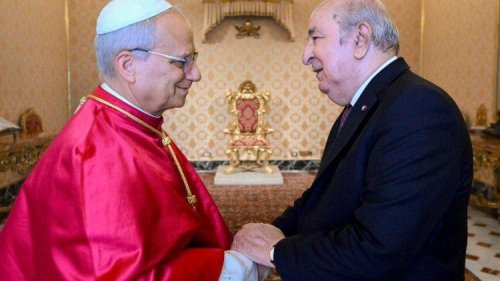
First, this visit undeniably serves the government of president Abdelmadjid Tebboune and army chief Saïd Chengriha. Diplomatically mistreated by its southern neighbours, under pressure from Morocco in a political and economic alliance with Zionism, France and Donald Trump on the Western Sahara issue, relegated to the waiting list by the BRICS and finding itself at odds with the Middle East in crisis, Tebboune’s presidency has engaged in a laborious regional campaign to reposition itself in this political and diplomatic chessboard and polish its image.
In this register, the war waged against Iran and its immediate consequences on the Strait of Hormuz benefits Algeria in the short term. It allows Tebboune to take good care of his image, to sell his energy to a Europe in search of immediate resources. From this point of view, the Pope, who unwittingly carries a “message of peace and dialogue”, gives him an unexpected media boost.
But this message of peace and dialogue with the Christian world does not hide the real American and Western pro-imperialist turn of official Algeria. This “Christian West” is concretely capitalist Europe and imperialist America in the midst of a warlike redeployment to keep its domination and hegemony battered by the emergence of other economic powers and other imperialist forces. Despite Pope Leo’s little polemic with Donald Trump, emphasising its autonomy and its opposition, the Catholic Church remains historically, culturally and politically the best ideological support for this imperialist West.
From this point of view, this announced “dialogue” concretely means, in Tebboune’s message, a call to establish one’s place in this universe. For, in its contemporary post-colonial formation, with its non-aligned anti-imperialist dimension, Algeria has always distanced itself from this Church as an institution. This distance has even taken on anti-Christian and anti-Jewish identity whispers in the rhetoric of the sermons of Islamist imams or even those of mosques under government control.
This cultural and religious dialogue with the Church therefore has another meaning. It reinforces the regime’s alignment with the theses of the neo-liberal, capitalist and imperialist West, epitomised by Melonia’s Italy, with which Algeria already has agreements well underway.
Founding myths, to each their own myths...
In this dialogue with religions there is also a dialogue announced with history, our history. There is in this visit of the Pope a flaw that opens up in the founding myth and the national narrative of the Algerian nation! We discover (or officially admit) that it all began long before the famous battle between Elkahina and Okba benou nafeaâ in the 7th century. Our ancestors of the current Souk Ahras (Tagast in ancient Berber), in other words the Amazigh Chaoui of today, have contributed to shaping the history of human thought and not least: Christianity! great human and religious thought alongside the other monotheistic religions that have shaped human history, Judaism and Islam. Much later, another great thinker from this region called the Maghreb, Ibn Khaldoun, also contributed to shaping human thought.
By recalling this truth, we break with the neo-colonialist ideology that presents today’s Algeria as a people without history, even a history of the eternal colonized!!
It is a necessity to emphasize this aspect, not for the glory of our ancestors, but for our self-esteem and to teach our children to build this self-esteem.
Self-esteem is a person’s overall judgment of self-worth. It directly influences mental health, self-confidence, and the ability to cope with challenges. Good self-esteem allows you to accept your strengths and weaknesses, while low self-esteem can lead to anxiety.
Yes we can!
Our fathers and mothers, grandfathers and grandmothers did it by taking up arms in 1954. Others before them pointed out this historical depth in 1949! They were expelled from the Algerian People’s Party (PPA), accused of being “Berber-Marxists”. The youngest recalled it in April 1980. They were imprisoned! It took the visit of the Pope to make a great qualitative leap in the reading of our history.
But the story does not stop at the greatness of Saint Augustine the Chaoui. It is also shaped by his opponents: the Donatists. Donatism is a schism that divided the Church, a dissident doctrine of Christianity born in North Africa, for three and a half centuries. It is a school of thought that takes its name from Donatus the Great who was Numidian, in other words one of the ancestors of the Algerians (not only the Algerians, but also the Tunisians, because they too had Numidian ancestors. There were no borders like today). The centres of Donatism were Cirta (Constantine) and Carthage.
More than a theological quarrel over the purity of the sacraments, this Berber movement constituted a social and political resistance against Roman rule and the official Catholic Church. Donatism is widely considered to be a resistance of the local Berber populations, especially the rural poor (Circumcellions), against the Roman administration and the urban elite.
Between the first (Saint Augustine) and the second (Saint Donatus), (Western) history and archaeology chose the first: It is the established conventional order, and this risked disturbing a pre-established scientific order.
We also had our “Spartacus”! Be that as it may, Augustine is African. Donatus is too. They are the fathers of the thought that has most structured the Christian West.
But beyond the myths, the message of religious tolerance that accompanied this visit should not hide the need to recall one of the fundamentals of the modern world: the freedom of conscience that is trampled on in our country.
Translated by International Viewpoint.