
 Version imprimable
This article, written from a Swiss perspective – the country is considered the “water tower” of Europe – sheds light on the hidden developments behind the increase in extreme weather events and the resulting disasters, what promotes them and what to expect in the future.
The reshaping of the Swiss landscape since the 19th century
In Switzerland, as in all other industrialized countries, humans have completely reshaped the landscapes over the last two centuries, urbanized them and developed agricultural exploitation.
The links and repercussions of these changes on the hydrological regime are less obvious: until the end of the twentieth century, the guiding principle was to drain as much as possible. The draining of marshy areas aimed to create land for agriculture and urbanization. Thus, few agricultural lands on the Swiss Plateau lack a drainage network [2]. Rivers and streams were also straightened to evacuate water more quickly, prevent flooding, and create arable land. Furthermore, the paving of green spaces in urban areas, combined with the sewage system, has led to faster drainage of all rainwater.
The extent of the drainage ditch network in Swiss forests is, however, less well known. These ditches were created with the idea that dry forest areas could be better utilized for intensive forestry. Approximately 95 per cent of Switzerland’s wet forests have thus been drained over the last few centuries [3]. Whether the drainage of forest areas has actually led to greater productivity in forest cultivation remains a subject of debate. Nevertheless, the forests have been drained, cleared, and often replaced with monocultures of fast-growing spruce.
Therefore, there is practically no landscape in Switzerland, below the tree line, that has not been reshaped by human activity since the nineteenth century.
Alteration of the natural adaptive capacity of landscapes
Landscape reshaping has profound consequences for the hydrological regime. In the event of heavy rainfall, the rapid flow of water in the downstream flow leads to higher flood peaks, as water from the entire catchment area [4] accumulates more quickly in the valley. Conversely, this means that less water is retained and, consequently, the entire system dries out more rapidly. Our landscape is therefore less resilient to both flood peaks and drought.
This also has significant biological repercussions, as all local animal and plant species have adapted to the initial natural conditions and often struggle to adapt to the altered landscape. The arrival of non-native animal and plant species (neozoans and invasive alien species, collectively known as "neobiota") creates a worrying situation of competition. This competition favours the spread of neobiota , as some plants and animals from other parts of the world are better able to establish themselves in the now dominant conditions and outcompete the previously native species.
Not all invasive spreads of neobiotic organisms are linked to changes in conditions, as some neobiotic organisms could very well have adapted to the conditions that prevailed previously. However, this results in conditions more favourable to the emergence of neobiotic organisms . Resilience decreases. This situation is exacerbated by the establishment of monocultures such as spruce plantations on the Swiss Plateau, mimosa or eucalyptus plantations introduced to the Iberian Peninsula, or North American conifers in Scotland.
Monocultures are far more vulnerable to disruptions in the natural balance because species that would be resistant to emerging phenomena are lacking (or present in insufficient numbers). This can result in vulnerability to fungal infestations or pests, as well as low resilience to floods, drought, forest fires, or storms.
Human-induced landscape transformation has exacerbated the effects of drought and flooding. Even without considering climate catastrophe, it is clear that natural disasters are never solely attributable to meteorological phenomena.
Climate change in Switzerland
Discussions about water must be framed within the context of climate change. On the one hand, Switzerland certainly benefits from a privileged position, possessing greater resources and infrastructure than elsewhere to cope with the climate crisis. Examples include costly flood protection projects, more adapted urban planning (soil de-sealing, higher tree density, optimized building layout to allow for better nighttime cooling, etc.), and the implementation of technical solutions to address heat waves (air conditioning, building insulation, etc.).
Switzerland, however, is located in a region particularly vulnerable to climate change. Statistics from 2025 clearly show that warming in Switzerland is approximately twice the global average [5]. The resulting increase and intensification of floods and droughts affect a territory whose capacity to mitigate these phenomena has been significantly reduced.
Flood protection therefore faces a challenge that is already well-known. However, Switzerland is currently ill-prepared for the growing danger posed by droughts.
The current approach to flood protection and its limitations
Current state principles regarding flood protection measures differ in many respects from those implemented in the past [6]. Instead of seeking to evacuate water as quickly as possible, increasing importance is now given to more comprehensive considerations. The so-called "natural" function of a watercourse close to its natural state is favoured: retaining water and reducing the energy of the current through turbulence and flow diversity. The idea of total protection has been abandoned. Much more attention is paid to what happens in the event of an "overload." In other words, what happens if the flow rate exceeds forecasts or if parts of the protection system fail? Thus, at least in principle, the most robust solution possible is systematically sought, one capable of responding flexibly to exceptional events or overloads [7].
The challenge posed by the sheer number of flood protection programmes required is addressed in two ways. First, a prioritization process is implemented so that flood protection measures are placed where the potential damage is greatest. Second, state regulations govern the implementation of flood protection through various construction projects. A classic example is the requirement to incorporate flood protection measures when constructing new buildings in flood-prone areas.
As a rule, the planning phase of flood prevention projects lasts between five and ten years. Effective flood protection systems require considerable space and have implications for land ownership. This constraint is often offset by generous compensation. However, the fact that the entire watershed of the watercourses should be redesigned to properly mitigate flood peaks is largely overlooked. Such interference with private property is, however, inconceivable in a capitalist system.
Despite significant adaptations in approach, flood protection remains essentially a treatment of the symptoms. Because many streams have been narrowed, a huge number of rivers have been straightened, and, above all, because of profit-driven real estate development and flawed land-use planning, many buildings have been constructed within potentially floodable areas.Flood protection is an intergenerational challenge that requires rethinking and redesigning the entire landscape.
Drought management
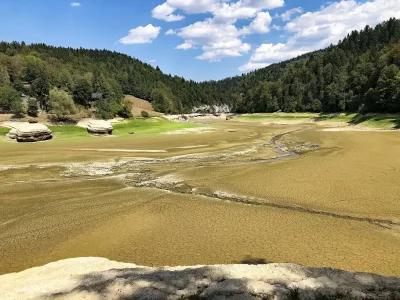
Measures to reduce the effects of droughts require either storing water during rainy periods or shifting water flows during dry periods.
The canton of Zurich, for example, often solves water supply problems during shortages by drawing water from Lake Zurich. Due to its size, the lake is less vulnerable to prolonged droughts. This requires an extensive network of large water pipelines and allows the canton to largely meet the drinking water needs of many localities during periods of drought.
In Switzerland, reservoirs are generally used for electricity generation. In principle, this form of water storage could also be considered to mitigate periods of drought, as is the case in many other countries. It goes without saying that the losses in electricity production—in Switzerland, the majority of energy companies are owned by the cantons and municipalities but operate according to private sector principles—would be strongly contested by their owners. However, dam projects always have significant environmental impacts [8]
The central problem, therefore, lies in the struggle for the remaining available water during periods of drought. This results in a situation of competition between the supply of drinking water to the population, the private use of water by the wealthy (for example, for swimming pools), the irrigation of agricultural land, the water needs for industrial production, the cooling water for nuclear power plants, etc.
This leads to a situation where, in capitalist society, ecological impacts take a back seat during times of crisis: to maintain economic productivity, the environment is sacrificed, which only exacerbates the problem in the long term. Thus, during the hot and dry summer of 2026, bourgeois circles are calling for the capture of previously untapped springs in the Swiss Alps to combat water scarcity. However, this pristine natural environment surrounding the springs is one of the rarest and most important to preserve in Switzerland, as almost all springs are tapped (well over 90 per cent of the springs on the Swiss Plateau are tapped or altered). These environments are home to rare and endangered species that have adapted to the specific conditions of groundwater flow.
Just as with flood events, the effects of droughts impact a landscape whose resilience has been weakened over centuries. The irrigation of drained farmland clearly illustrates that our water management practices are unsustainable.
The “sponge city” as a solution?
In recent years, the concept of the sponge city has gained increasing popularity. In cities, this principle seems to have worked remarkably well. It involves retaining water, promoting infiltration, mitigating peak flows, and, particularly through evapotranspiration from trees, achieving a local reduction in temperature.
But if the sponge city principle already seems like a drop in the ocean, the same is even more true for the sponge landscape concept. The principles are sound and important, and they run counter to historical drainage practices. The idea is to retain water, allow it to infiltrate, and replenish the water table. This helps mitigate runoff peaks, reduce soil erosion on farmland, and promote biodiversity. Overall, this approach improves landscape resilience. Replenishing groundwater is particularly important because groundwater flows much more slowly and is significantly colder than in surface watercourses. Thus, during periods of heat and drought, it can, with a certain time lag, bring fresh water to downstream surface watercourses, thereby improving both water availability and temperature during droughts.
The challenge lies in implementation. The only easily achievable measures are small-scale, do not significantly affect other areas, and therefore do not conflict with conventional agricultural and forestry production. They thus primarily concern state-owned land. However, for the system to truly function and produce measurable effects, large-scale measures and interventions on private land are necessary. We are therefore once again faced with the historic and long-term task of landscape reshaping.
Role of the capitalist mode of production
Not all water-related problems are attributable to the capitalist mode of production. For example, land drainage began even before the advent of capitalism. However, it is the capitalist mode of production that has accelerated widespread land desiccation. The optimization of food production, which aims not for maximum yield per unit area but for maximum yield relative to the effort expended, has led to the situation mentioned above, in which there is practically no agricultural land without a drainage network on the Swiss Plateau. The drainage of forested areas also dates back to the twentieth century, often in the form of job creation programmes during and after the World Wars. The capitalist logic of optimization is therefore omnipresent in this process of landscape transformation.
This logic hinders the restoration of a more resilient landscape. Conventional agribusiness is incompatible with a sponge-like landscape. The long-term effects of water retention manifest over periods far too long to be of interest to this profit-driven, capitalist production. Sustainable water management is incompatible with a system that prioritizes profit over human well-being and environmental preservation.
Conclusions for our activism
Landscape transformation must be an essential component of an ecosocialist alternative to the capitalist catastrophe. Without it, society is far too vulnerable to natural disasters. Within a capitalist system, it cannot be implemented on the scale necessary to protect all of society—and not just the wealthy. At the same time, this transformation involves combining a multitude of elements and mechanisms that cannot be implemented overnight. A complete overhaul of agricultural production, for example, is necessary: it must be freed from the profit motive and, therefore, will require more labour.
Given the time lag between the triggers and their effects on climate change, this observation leads us to an extremely interesting question for determining the priorities of our political intervention: we are currently experiencing the consequences of phenomena that, in some cases, were triggered decades ago. The capitalist system is incapable of solving these problems; on the contrary, it is responsible for a large part of the dramatic consequences generated by these new catastrophic weather conditions [9]. This is why we must move beyond the capitalist system and develop an ecosocialist alternative.
But it’s been a long time since "five minutes to midnight." We are faced with this unpleasant reality: the necessary global revolution is not imminent. The example of the necessary reorganization of the landscape also clearly shows that, even if a global revolution had already taken place, we could not prevent all disasters. The scale of the tasks required to address natural hazards is simply too great.
Our role is not limited to defending the need for an ecosocialist revolution and proposing credible ways to achieve a socialist break with capitalism.
We must also prepare for the fact that the effects of climate change will become apparent and can no longer be entirely avoided. This should lead to a modest but significant shift in our argument: solidarity and mutual aid in the face of disasters are becoming increasingly important if we want to minimize the effects of the coming climate cataclysm. We are in a position to promote this perspective because it is in solidarity-based resistance that we simultaneously discover the seeds of an alternative society. Left-wing organizations must form the framework upon which a solidarity-based approach to the crises to come can be built.
28 August 2026
Translated by International Viewpoint from Inprecor. Original publication Sozialismus.ch