
 Version imprimable
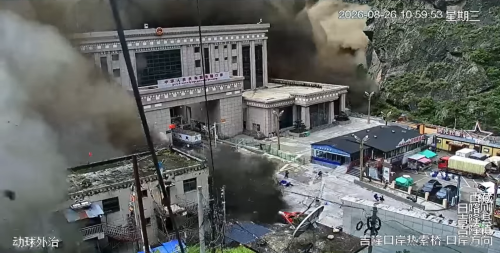
Such a disaster is not absolutely new in the history of Lang Tang. An earthquake in 2015 with a Richter scale reading of 7.8 had been recorded, with ice and rock falls from the same mountain as a result of which the langtang village was covered by the rocks and nearly 300 people had died. But there is a significant difference between the two events . The 7.8 Richter scale earthquake of 2015 had a direct cause while in 2026 we have found no evidence of such a tectonic trigger. Rather a part of the mountain broke and initially that avalanche was wrongly considered to be an earthquake.
But here the very word natural is facing a question. Glaciers have broken in the Himalayas in the past and glacier flash floods are not new. What is new is social economic system within which these natural processes are occurring. The mountains of Nepal have lost almost a third of their ice in the last 3 decades. In the recent decade the pace of glacier melting has increased by almost 65% compared to the past. Due to global warming ice is melting, the permafrost is weakening, the freeze thaw cycle is changing and as a result the ice and the solid soil that used to hold together the stones of the mountains are losing their stability. Scientists have not yet said that the particular glacier collapse of 26th August is solely or primarily due to climate change. But the situation in which the possibility and acuteness of such disasters are increasing, one can hardly doubt their relationship with the global warming that has been created by humans.
This is where an Ecosocialist analysis must start. The widely used notion that the climate crisis is “man made” is inadequate and consequently false. All humans do not burn fossil fuel equally, all societies have not emitted carbon equally and all classes do not make the same kind of profit out of this destruction. It is the internal compulsions of capitalist production — the permanent accumulation, production and expansion of the market, the use of nature as free or cheap inputs have brought us into continuous direct conflict with the boundaries of life. Nepal is a country that is historically responsible only to a very small extent for global warming, yet it is the peoples of the Nepal hills who are paying with their lives for the rich industrialised countries and the large carbon dependent economies. This is the class and imperialist marker of climate injustice. This is where the question of climate change comes in but with caution. It is not yet firmly established that this particular avalanche was caused by climate change. In the cases of rock and ice avalanche geology, slope geometry, glacier dynamics, water, permafrost and many local factors work together.
An in-depth analysis of a specific incident might require months and even years. The 2021 crisis in Uttarakhand’s Chamoli has not been directly attributed to climate change although it has been warned that global warming increases the possibility of such events. So ecosocialist criticism does not need to go beyond the findings of science. But the facts which are definite are deadly enough. From 1940 the summer temperature of this Langtang Lirung area has been rising by 0.29 degrees Celsius every decade. In 1996 to 2025 the average temperature was almost one degree more than that between 1961 to 1990. Between 2022 and 2025 four summers have been recorded as being among the five warmest summers in the last 86 years. July 2026 was the second warmest July in 86 years and the first 3 weeks of August showed the average temperature going above all previous August records. It is in this situation that on 26th August 2026 the mountain broke up in part.
Even more significant is the weakening of the permafrost. From 1957 to the present the glaciers of eastern Himalaya have lost on average a mass equivalent to ice of 30 metres thickness. Half of that has happened in the present century. The Yala glacier which is only 10 kilometres from where the disaster occurred was first surveyed in the 1970s and since then it has shrunk 66% and has retreated 784 metres. The annual average mass loss in 2012 to 2025 was 0.92 metre water equivalent. In 2024 it was 1.9 metres. Even more significantly the equilibrium line of Yala has gone up so far that the entire glacier is now practically within the melting zone.
In the entire Langtang catchment area the glacier area has gone down by almost 42% compared to what it had been during the little Ice Age. The rate of loss between 1815 and 1964 had been 0.11% but in 1964 to 2023 it rose to 0.49% with the fastest rise coming after the year 2000. As the ice cover removes the big glaciers are breaking up into smaller isolated glaciers and their numbers have gone up from 58 to 115. The connection between this and the so called “man made” (actually carbon guzzling big capital made) climate change is not a matter of speculation. The IPCC has concluded that the worldwide retreat of the glaciers from the 1990s is primarily due to human influence. But it is not all humans. It is a small number of corporations and a small number of extreme carbon emitting countries and the elites of those countries as well as of other countries. But to talk generally about global glacier retreat is different from the attribution of the specific avalanche of 26th August. Politically too this distinction is important. To deny the role of global warming by pointing to avalanches in the past is completely unscientific.
The degree of danger does not depend only on how much ice there is on the mountain but it depends on how quickly that ice and the frozen ground under it is changing. If the glacier becomes thinner then the ice which had buttressed the steep rock faces gets thinner, the buttressing reduces, the melt water enters new fissures and failure planes; and when the permafrost warms up and melts, the ice which had been acting as a sealing agent on broken rocks becomes weakend. In other words compared to a stable cold glacier a relatively rapidly changing glacier rock system can be far more dangerous.
However, if we only hold external elements responsible then we will be concealing Nepal ’s own political economy. In the last few decades hydel-power has been hailed as the principal route to Nepal ’s development. The goal has been electricity generation, export , gaining foreign currency and developing the economic base thereby creating modernisation. Hydel-power is certainly not like coal or oil, and in order to come out of the grips of fossil fuel there is a need for hydroelectricity. But a project need not socially and environmentally just, just because it is renewable. By blasting mountains to build roads, by damming up or diverting rivers, by building large hydropower complexes and transmission corridors and by developing the infrastructure for cross border trading on such an unstable geological reality , Nepal has been constantly increasing the risks. Research has already shown that in Nepal hydropower is mostly seen as a purely technical economic problem and the needs and knowledge off local communities dependent on the rivers have been kept outside the decision making processes.
So the cruel symbol of this disaster is that the hydel power which has been put forward as a green alternative to climate change has itself been damaged by climate change. The present flood has damaged several hydropower installations. Earlier during the flood of 2015, many hydropower projects end important infrastructures of the Sino-Nepal trading had been destroyed in the same area. In other words we are seeing simultaneously an ecological crisis and the crisis of a particular developmental model where mountains rivers and glaciers have in the first place been treated as exchangeable resources.
The question of class is inseparable from this. Floods do not affect everybody equally. Those who have proper houses, savings, cars, insurance, political connections and the ability to take shelter elsewhere are far less vulnerable then the peasants who cultivate on the slopes of the hills, the workers, small traders, transport workers and generally poorer families. In 2015 floods in the same area had shown that workers truck drivers small shopkeepers and people dependent on local livelihood had faced long term damages due to the closure of cross border trading. So the ecological disaster is simultaneously a class disaster.
In this context the recent political explosions in Nepal are also relevant. The youth anti- corruption movement of 2025 had shaken the old political order deeply. Agitators died due to police firing, there was tremendous anger and eventually the government of KP Sharma Oli fell. After the elections of 2026 though a new government came questions concerning corruption over centralised decision making, social discriminations and the accountability of the state have not gone away. So from an Ecosocialist perspective it is not possible to make a sharp demarcation between ecological democracy and political democracy. In a society where ordinary people cannot maintain effective democratic control over the decisions of the state, in such a society the democratic control of local communities concerning rivers, forests, mountains and energy infrastructures will also remain weak.
So the ecosocialist program is not simply one of carbon reduction. We need Himalayan ecological planning; We need long term monitoring of glaciers permafrost and slopes; we need effective early warning and evacuation systems; a sharp control over constructions in risky river corridors; the power of democratic decision making by local communities over hydropower and road projects end ensuring that climate adaptation is not primarily the defence of private investment but rather the protection of human life and livelihood. It is necessary to demand that States and corporations which have been historically the major carbon emitters must donate for climate finance, transfer technology and provide loss and damage compensation. At the same time if that money goes into the hands of local elites the construction lobby and large infrastructure capital then the problem will merely be reproduced.
The present tragedy in Nepal is therefore also a warning for the future. The question is simply not why the glacier broke? The question is which social system is warming up the earth so rapidly, who is making a profit out of that, who is paying for that and in whose hands should the power to decide on the relationship between humans and nature rest? The ecosocialist answer is this crisis cannot be resolved while keeping ecological survival under the compulsions of capital accumulation. It is necessary to establish democratic social control over production, energy, land and infrastructure. It is necessary to have such a planned transformation where human needs rather than profits and the needs of reproducing the boundaries of nature will become the yardsticks for measuring development. The warning is particularly relevant in India, where the province of Sikkim and the Darjeeling areas of West Bengal are seeing exactly the same kind of “development”, and Sikkim has already had warnings of ecological crises.
30 August 2026