
 Version imprimable
11 November: High-Level Summit of World Leaders
The Antalya Leaders’ Summit began under the chairmanship of Turkish President Recep Tayyip Erdoğan. UN Secretary-General António Guterres called for international cooperation and effective action to address the climate crisis. High-level discussions were held on the transition to clean energy, electrification, green industrialisation, investment and employment.
12 November: Energy Transition and Climate Finance
On the second day of the Leaders’ Summit, renewable energy, electrification, industrialisation and climate adaptation received particular attention. However, the gap between the climate finance obligations of developed countries and the needs of developing countries remained evident. The lack of political will to reduce dependence on fossil fuels was also reflected in the discussions.
13 November: Climate Justice and the Question of Finance
In his address, UN Secretary-General António Guterres called for science-based climate action and urged the protection of the interests of future generations. UN Climate Chief Simon Stiell emphasised the need to use climate finance in ways that enable countries to break free from cycles of debt and economic dependence.
Differences between developed and developing countries continued over climate finance, adaptation, addressing loss and damage, and a just energy transition.
14 November: Midpoint Assessment of the Conference and Progress in Negotiations
Today, Simon Stiell, Executive Secretary of the United Nations Framework Convention on Climate Change (UNFCCC), presented an assessment of the conference at its midpoint. He said that this is one of the largest COP conferences, with nearly 200 countries participating. Agreement among all parties is necessary for collective success. He called for the rapid resolution of difficult issues and urged parties to avoid strategic delays.
Several issues were particularly notable in today’s discussions:
• Fossil Fuels: There are disagreements over strong and binding commitments to transition away from oil, gas and coal. Objections from fossil fuel-producing and consuming countries are making the negotiations more complicated.
• Renewable Energy and Electrification: Türkiye’s global electrification initiative has come under discussion. However, the absence of any obligation to ensure that electricity is generated from renewable sources has raised concerns among environmentalists.
• Just Transition: Developing countries are demanding the operationalisation of the Just Transition Mechanism to ensure support for finance, technology and capacity building.
• Climate Finance: Developing countries continue to demand adequate, accessible and grant-based climate finance for adaptation and implementation.
• Youth Participation: Simon Stiell has emphasised the need for more effective participation of young people in climate movements and decision-making.
• Women, Water and Climate Justice: At a special cultural event today, women artists from different countries highlighted their experiences of water, health and the climate crisis.
Brazil has expressed interest in hosting the third international conference on transitioning away from fossil fuels in 2028. Meanwhile, pressure is mounting on Türkiye and Australia to overcome divisions over fossil fuels and reach an ambitious agreement. The initial draft of the negotiations is expected to be presented early next week.
Political Assessment of the First Four Days
The discussions of the first four days make it clear that the climate crisis is not merely an environmental problem; it is deeply connected to global economic inequality, debt, energy systems and the politics of power.
The question of establishing climate justice is particularly important for countries of the Global South. Those who have historically contributed the most to carbon emissions must take responsibility for climate finance and loss and damage. Imposing new debt burdens in the name of climate finance can never be considered justice.
For climate-vulnerable countries like Bangladesh, priority must be given to protecting coastal agriculture, addressing salinity, river erosion, cyclones, waterlogging, fisheries and farmers’ livelihoods. At the same time, the land and livelihood rights of landless peasants, women farmers and Indigenous communities must be ensured.
Our demands should be:
1. A rapid, planned and just transition away from fossil fuels and the expansion of renewable energy.
2. New, additional, grant-based and accessible climate finance from developed countries.
3. Debt cancellation for climate-affected countries and just compensation for loss and damage.
4. Protection of coastal agriculture, fisheries, land and the livelihoods of local communities.
5. Promotion of food sovereignty, local seeds, farmers’ rights and agroecology-based farming.
6. Effective participation of women farmers, Indigenous communities and landless peasants in climate decision-making.
My Position
The discussions at COP31 once again show that it is not possible to address the climate crisis through technology, investment and market-based solutions alone while avoiding the questions of its root causes and accountability.
Farmers, working people, women, Indigenous communities and coastal populations are the greatest victims of climate change. Yet their voices and rights are still not receiving sufficient attention in climate policymaking.
What we need is a transformation that will not merely change the sources of energy; rather, it must prioritise the interests of people, nature and life instead of an economic system based on inequality, exploitation and profit.
We demand climate justice. We demand an end to fossil fuels. Food sovereignty must be established. Agroecology-based farming must be the path to the future.
Long live the struggles of peasants, workers and toiling people.
Badrul Alam
President
Bangladesh Krishok Federation
Intervention on 13 November 2026
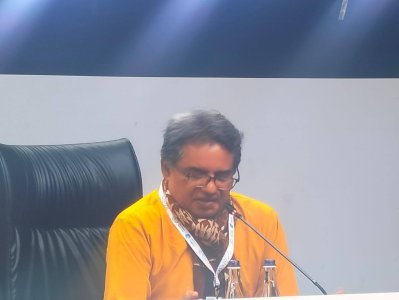
On 13 November 2026 I had the intervention of 2 minutes with a gathering of 1000 selected people. The Secretary General of UN, Mr. Atonio Guterres was in the chair. I represented the peasants of the world.
Honourable Secretary-General, distinguished delegates, sisters and brothers,
I am Badrul Alam representing the Bangladesh Krishok Federation, a movement of peasants and farmers.
As the Secretary-General concludes his term, our message is clear: the struggle for climate justice must continue.
Peasants, women farmers and Indigenous peoples face landlessness, climate disasters, corporate-controlled agriculture and fossil fuel expansion.
We will step up our organising to defend land rights, protect Indigenous territories, advance women’s rights, preserve local seeds and expand agroecology.
We will strengthen our fight for a just and equitable transition away from fossil fuels, community-based renewable energy, accessible climate finance and meaningful participation of grassroots movements in decision-making.
We appreciate the Secretary-General’s support for climate action and people’s movements.
Our struggles will continue beyond COP31 for food sovereignty, land rights, agroecology and climate justice.
The movement continues. The struggle continues.
Thank you.
Badrul Alam
13 November 2026
Source: ESSF.