
 Version imprimable
The debate was opened by several texts by Abdullah Öcalan, leader of the Kurdistan Workers’ Party (PKK) in particular his long letter sent to the PKK dissolution congress, held on 5 and 6 May 2025. In this text entitled “Perspective”, Öcalan takes up his interpretation of history in broad outline, stressing the importance of substituting “commune-state dualism” for the central role of the class struggle within the framework of historical materialism. According to him, the theory of conflict based on class division has been the main cause of the collapse of “actually existing socialism”. The historic leader of the PKK thus announced his objective of “founding contemporary socialism not on a communism based on class dictatorship, but on a conceptual set that organises the relations between the state and communality”. This would involve abandoning language centred on the nation-state and putting forward ethical and political concepts articulated around the idea of the commune and the “democratic nation”. Thus, the construction of a “democratic society”" could only be done through dialogue with the state, within the framework of a “democratic compromise”.
We all know that game where we are asked which three books we would take with us if we were stranded on a desert island, or which two people we would choose to accompany us there. If we ask the same question about Marxism, if we consider its theses and ask which one should be saved at all costs, which should be kept from Marxism or from the Marxist corpus, for my part it would be the statement placed at the very beginning of the statutes of the First International: “the emancipation of the working class will be the work of the workers themselves”. I consider this proposal to be the most fundamental rupture, the most decisive turning point between the conception of socialism borne by Marxism and all the revolutionary thought that preceded it. For when one examines bourgeois revolutionary political philosophy, but also other later socialist currents, one always finds a kind of myth of the supreme saviour. In other words, from Machiavelli to Rousseau, from Voltaire to Hegel, it is a question of either a prince, an emperor or even a legislator. Hegel, for example, calls Napoleon “the soul of the world sitting on a horse.” It is always a liberation from above.
This also applies to the socialist currents. In utopian socialism, we find models of society elaborated thanks to an extremely active creative imagination, but there is no subject capable of realizing them. In fact, there is no strategy for the conquest of political power either. Fourier, Owen, and Saint-Simon wrote to emperors, tsars, and kings, because they needed a force, a subject who could carry out their projects from above. The subject is always conceived as coming from above. Another important current – which can be observed in Babeuf, Buonarroti, Blanqui, and in a whole series of revolutionary societies, clandestine revolutionary organisations – is most often based on the perspective of the seizure of power by a very well prepared, determined revolutionary minority, acting in the name of the proletariat and replacing it. It is in fact a form of revolutionary putschism. The intentions are sincere, but the revolution is not seen as a process in which the masses take action.
The “genius” of praxis
In Marx, on the other hand, we observe precisely this rupture. The essential question is that the emancipation of the working class should be the work of itself, the product of its own activity. My friend Doğan Çetinkaya, in his intervention, explained it at length. [2] Marx highlights the dynamic by which the masses, by their own will, free themselves from existing conditions. Of course, this is not simply due to his genius – genius itself, as Marx asserted about the creativity of the Renaissance painter Raphael, is ultimately the product of social conditions – but because he was confronted with a rapidly developing workers’ movement, the struggles of the weavers in Silesia or the silk workers in Lyon, the insurrections of 1830-1832, 1848, because he observed all this and found himself confronted with a working class that was increasingly committed to struggle and forged within mass struggles, he was able to develop this perspective of self-emancipation. This is therefore also nourished by practical experience. Here, in addition to German philosophy, French social thought and English political economy, the decisive influence – as Michael Löwy has pointed out in particular – of the close relations, joint work and direct contacts with workers’ associations and groups during Marx’s stay in Paris is particularly important. This is a political, strategic and methodological break of considerable significance.
Of course, this must also be seen in relation to the conception of praxis. How can the masses free themselves from the rule of the bourgeoisie? Since, in a given society, the dominant ideas are the ideas of the dominant class, how can this ideological hegemony be broken? The most fundamental clue to this question can be found in the third thesis on Feuerbach. Marx asserts that there are processes in which the transformation of the consciousness of human beings corresponds to the transformation of social conditions. This manifests itself precisely in revolutionary praxis, that is, in the revolutionary struggle. As the masses raise their heads, as they engage in the struggle for their own rights, consciousness is transformed. And as consciousness is transformed, the conscious masses in turn transform conditions. This goes beyond the opposition between “is it the change of conditions that transforms consciousness?” or “is it consciousness itself that changes social conditions?” In reality, there is a debate here both with abstract idealism and with a form of vulgar materialism. Marx criticizes them both, integrates certain aspects of these positions and, at a higher level – in the Hegelian sense of the Aufhebung – goes beyond them by a dialectical leap to elaborate his conception of praxis. [3]
Councils, a universal form
If we take this fundamental breaking point as a starting point, many points can follow from it, especially from a strategic point of view. How, then, are these practices of self-emancipation of the masses realized? Historically, they have always taken the form of organizations in councils, soviets, committees. No one is telling the masses “do it this way”. It is partly instinctive, partly determined by concrete conditions: in moments when social anger erupts and when the workers, those at the bottom, the oppressed begin to organize; the other organs, the other apparatuses – namely the parties and the trade unions – are proving to be insufficient. The parties are already narrow and highly polarized; there are many of them – we can talk about a multiplicity of parties. The unions, on the other hand, are not broad enough. Councils therefore appear to be a model that is both flexible, capable of adapting to different conditions, and open enough for everyone to participate, speak up and get involved in one way or another.
The revolution of 1905 is undoubtedly the first fundamental example of this. But subsequently, this phenomenon can be observed in many other contexts: of course in October 1917, then in the German revolution, in the Hungarian revolution, in the councils movement in Italy. Then in Spain, Bolivia, Algeria, and for example again in Hungary in 1956: wherever the workers rose up, they first set up this type of organisation. As Ernest Mandel pointed out, once, twice, we can speak of coincidence; on the third occurrence, it already becomes strange; but when, in the course of history, this is repeated in ten or fifteen cases, when the workers turn to this type of organisation in councils in revolutionary situations, it means that we are faced with a natural and universal model of organisation of the working class. Moreover, within a certain mechanism of democratic representation, it becomes possible to structure and coordinate these councils at different levels – local, regional and national.
The councils revolution in Germany
Of course, 1905 and October 1917 are extremely important examples, but I would like to dwell on two cases that are less often mentioned. In the matter of councils, and in particular of workers’ councils, the fundamental example is in reality the German revolution. Today is not only the 108th anniversary of the Russian Revolution, but also the 107th anniversary of the German Revolution: 8 November 1918. We pay tribute to those who made this revolution and who fell for it. This is obviously a huge revolution. It is, in fact, the revolution that October was waiting for, the revolution that the Bolsheviks were hoping for. Their gaze was always turned towards this: a revolution had to break out also in an industrialized country, with a powerful working class, so as not to remain isolated and locked up.
This revolution actually lasted from 1918 to 1923, that is, until the defeat of the German proletariat and the German Communists, until the extinction of the revolutionary wave. But it is above all the first months that are decisive. For in the German revolution, the central question is war: in revolutions, there is always an external political factor determining it, most often an occupation, an attempted coup d’état or a war – and the poverty, the misery that it engenders. Here too, it is a war that has ended, but which does not manage to really end. And the formation of councils begins among the soldiers, the sailors. Once they disembarked on land, they fraternized with the workers. In a few days at the beginning of November, this form of council organisation spread throughout Germany. Everywhere. Nearly 10,000 workers’ and soldiers’ councils were formed. It’s something extraordinary. And in the streets, the memory of 1848 is still relatively alive. Thus, on the one hand, there is the general strike; on the other, flags in the streets, demonstrations; the workers arm themselves, attack the barracks, and the army withdraws. With the withdrawal of the army, the immense possibility of power being exercised from below opens up. The Empire has collapsed, the organs of the state are in a situation of bankruptcy. As a result, these councils are beginning to take on all the functions of local administrations.
In this movement of a few days, the Social Democratic Party (SPD) is doing everything in its power to take control; it literally runs behind the movement, trying to catch up with it and take command. The SPD is an extremely powerful party, in reality a right-wing social democracy; because there is also a more left-wing social democracy, the Independent Social Democrats (USPD). Rosa Luxemburg and the Spartacists were still inside the USPD at that time, but so were Kautsky and Bernstein. And the SPD affirms: “The revolution is the revolution of all of us, we are going to found a republic, a workers’ republic. Come and establish a superior representation of all these councils. Let’s create some kind of government in our own way.” Thus, from the formal point of view, they set up a government independent of the bourgeois state. Everyone votes, the SPD and the Independent Social Democrats participate. It is given a name such as the “Executive Committee of the Councils”. But the bourgeois state apparatus is not touched in any way. The state apparatus remains exactly as it is. Only its name changes.
The statist takeover
The Social Democrats very quickly infiltrated the councils. They placed their cadres there. They consolidated the strength they already had, especially in the soldiers’ councils. Immense enthusiasm continued to reign, and the SPD let the process take its course for a while. They make promises: “We are going to nationalize everything,” they say. The streets are covered with posters, decisions are made, but nothing happens. Within a few months, workers realized that in reality nothing had changed. The apparatus remained as it was. Even military command remains in the hands of former senior officers. The bourgeois army was reconstituted. Little by little, these councils were transformed into municipal councils. This means that they are fully integrated into the system. Elections to a Constituent Assembly are held and the bourgeois state is completely rebuilt – precisely by those who claimed to be acting in the name of the working classes and the workers’ councils.
Of course, there are forces against it. There is the network of Revolutionary Delegates, made up of vanguard metalworkers – who played a very important role in the revolution – the Spartacists, or the left wing of the USPD. These were bloodily repressed. As is well known, Spartacist leaders such as Rosa Luxemburg, Karl Liebknecht and Leo Jogiches were assassinated. Elsewhere, some councils refuse to hand over their arms. They are crushed. Thereafter, the upheavals continued, with phases of rise and reflux of the revolutionary movement. But, in the end, the whole dynamic of the council movement gradually died out, without the bourgeois apparatus being really affected, without property relations being seriously called into question. And this is happening precisely under the action of a workers’ party, a party claiming to act in the name of the workers. I think that is a major lesson.
Revolutionary Spain and the Committees
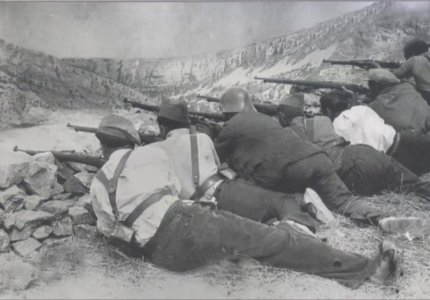
Our other example is Spain. When we look at the Spanish Revolution, we see that the civil war and the revolution are closely intertwined. For several years now, revolutionary workers’ uprisings have been taking place. On this basis, a Popular Front – i.e. a government dominated by left-wing parties – was formed. In response, the oligarchy, the big landowners and the Church launched an attempted coup d’état. These include a military insurrection led by Franco. But while this should have taken on a counter-revolutionary character – that is to say, crushed the workers’ movement and the left – it provoked on the contrary a revolutionary acceleration. Everywhere, in the face of the military, workers and peasants seized weapons. In much of the country, the state apparatus has already largely collapsed, and committees are being formed. There is already a highly politicized class movement. In particular, the very strong influence of anarchists in Spain must be emphasized. This is a somewhat different type of organization: committees shaped politically by the active participation of the popular classes, structured according to the regional weight of mass political organizations. But these committees remain permanently subject to the control of the rank-and-file. There were anarchists, social democrats, the Communist Party aligned with the USSR, and sometimes republicans – especially in Catalonia. Tens of thousands of committees are being formed everywhere. They are responsible for all the functions of the state and local administrations. Churches that were not burned were turned into hospitals. Schools replaced the stately homes. All means of transport were requisitioned. While continuing to resist fascism, they seized the land in a fully revolutionary dynamic.
There was an absolutely immense process of collectivization. Initially, the land of the large Francoist reactionary landowners – of those who had fled – as well as the factories of industrialists were expropriated. Then the movement gradually spread and, in the long term, almost all companies were collectivized. This can be observed particularly in Catalonia and in the regions where anarchists are strongly established. In Barcelona, 80% of companies are collectivized; for Catalonia as a whole, this figure rises to 40%. It is a revolutionary wave of considerable magnitude. But this is gradually beginning to worry different forces, because a strategic alternative arises: will fascism be defeated by defending the bourgeois republic, or, if one chooses to trust the will of the popular classes to defend the republic, will it then be necessary to support this revolutionary wave? And, of course, international power relations come into play. The Spanish Republic was supported militarily above all by the Soviet Union, but the latter did not want to break off relations with Great Britain and France either. We are in 1936-1937. From then on, demands came from the Soviet Union: private property should not be touched.
As part of the revolutionary dynamic, the militias operated according to profoundly egalitarian principles: after the hours of service, the military salute was forbidden; the wage gap between grades was abolished. These were egalitarian practices that were widely spread throughout society. But, little by little, all this is restricted. This process can be observed very clearly in George Orwell’s “Homage to Catalonia”, and Ken Loach reconstructs it with great force in his film “Land and Freedom”. In Turkey, this film has been translated as Ülke ve Özgürlük (“Country and Freedom”), which in itself sums up the whole strategic controversy. For the central question is not the country, but the land: more precisely, to save the “country” by expropriating the landowners, that is to say, by attacking property. In Turkey, a simple translation error thus comes to express all the tensions in which the Spanish Civil War and the Spanish Revolution found themselves trapped.
The militias were gradually integrated into the state apparatus. A more radical wing, such as the POUM – an anti-Stalinist left independent of the USSR – was declared illegal. Its leaders and activists, first and foremost Andreu Nin, were assassinated. Collectivisations, collectivised farms, are integrated into a framework of state legality. The fundamental dynamic is gradually neutralized, absorbed. There are other manifestations of this, such as the decision to pay compensation to those whose land had been expropriated. A certain “sacredness” of private property is thus gradually re-established. Once the revolutionary wave had been crushed both by blood and bureaucratic manoeuvring, the fascist forces became more and more dominant. International intervention intensified, and two years later, Franco imposed himself on the whole of republican Spain and established a fascist dictatorship.
I consider these two experiences to be among the most strategically important examples in the history of the 20th century workers’ movement, and that they were struggles capable of profoundly transforming the balance of forces of their time. It is precisely for this reason that their defeats were all the more tragic. Of course, other examples could be discussed, but these cases show particularly clearly that, if the bourgeois state apparatus is not dismantled and if property relations are not challenged, the revolutionary dynamic carried by the council movement is broken; that the possibilities of self-emancipation and self-management from below – those of the labouring classes, workers and peasants – are considerably reduced; and that we finally end up in defeat. We must constantly return to these historical experiences of revolutionary uprisings, resistance and councils, study them in depth, in order to be better equipped for the struggles to come.
November 2025
Retranscription of an intervention at a conference in Istanbul organized by the HDK (Peoples’ Democratic Congress) in November 2025.