
 Version imprimable
On 11 May 2026, Stéfanie Prezioso spoke with Salvatore Cannavò, a member of the editorial team of Jacobin Italia, contributor to Il Fatto Quotidiano and editorial director of Edizioni Alegre. The discussion centres on how the left of the left can regain a foothold in Italy.
Stéfanie Prezioso: Giorgia Meloni now appears weakened at home, after the defeat of the referendum on the judiciary, but also abroad — tensions with Donald Trump, Viktor Orbán’s defeat in Hungary, and so on. And yet Fratelli d’Italia (FdI, "Brothers of Italy") remains Italy’s leading party and she heads the second-longest-serving government in the history of the Italian Republic. How do you explain this apparent paradox?
Salvatore Cannavò: This paradox stems above all from electoral polling, so it will have to be properly assessed when the elections actually take place. The defeat in the referendum [1] marked a turning point, because for the first time Meloni’s strength — which had seemed beyond question — was shaken, with an unexpected turnout. That does not mean Meloni will lose the next elections, but her capacity to govern is now genuinely under strain. The government’s main dossiers are complex (the war, compliance with European deficit constraints, migration policy, industrial policy), and tensions within the right-wing coalition are intensifying by the day.
Meloni has certainly built a reputation as a competent leader, with a clear, direct discourse and a credibility that has only recently been shaken. What she does in the final year of the legislature — the elections are due in 2027 — will be fairly decisive. To date, however, she does not appear able to take political decisions capable of having any real impact on the living conditions of Italy’s poorest people and popular classes.
S.P.: How do you see Italy’s place in the global authoritarian turn we have been witnessing internationally for at least fifteen years? What is its specificity?
S.C.: It is regrettable that, for a country that invented fascism, the specificity of Italian sovereigntism lies in its capacity to recover, accumulate and relaunch the cultures and ideas of Italian fascism. This is particularly the case on the immigration question, which this right reads through terms such as "ethnic replacement", rediscovering concepts like "remigration", which can easily be understood as "deportation". Italian sovereigntism — or rather right-wing racist populism — cannot free itself from this heritage; on the contrary, it draws on it and uses it to give itself an ideological cement that it would otherwise lack.
The controversy over cultural hegemony bears this out, with the constant attacks on the intelligentsia, the world of cinema and the arts, aimed at silencing them — for example, by cutting subsidies — and at promoting dubious figures linked to the right. The Beatrice Venezi affair — the conductor first appointed and then expelled from La Fenice in Venice [2] — is one example. Another specificity, again in line with this recuperation of fascism, is the constant attack on the Constitution, the Resistance and the values of the Liberation, and thus the attempt to revise the founding pact of the Republic. A kind of "civil war" — fortunately unarmed — is being developed in the country through the poisoning of the political climate and debate, a tendency that, it must be said, began under Silvio Berlusconi.
S.P.: It is sometimes said that the Meloni government is, in the end, no more "illiberal" than that of Emmanuel Macron, for example. Have we witnessed, over these almost four years, the establishment of an increasingly authoritarian system in Italy? And if so, what have been its main manifestations?
S.C.: Another particularity of the Meloni government is that it has managed to reconcile and combine authoritarian ideas with a classically liberal economic line. On the authoritarian front, it is enough to recall that the government has adopted no fewer than four "security packages" — that is, laws by emergency decree aimed at reinforcing repression, particularly against migrants and youth revolt, thereby delivering to its electoral base the maximum possible in terms of "law and order". The Meloni government is the one that has guaranteed a preferential judicial pathway for police officers found guilty of offences during street demonstrations or even on duty; it is the one that has hardened conditions of life in prisons by giving free rein to the guards; it is the one that has made raves illegal and prosecutable, and punished unauthorised demonstrations with fines of several thousand euros, and so on.
At the same time, it is the government that has met all the wishes of the European Commission by complying to the letter with the Stability Pact, by seeking a line of compromise and rapprochement with industrialists through state funds and incentives, by attacking ecological policies in depth and relaunching fossil-fuel consumption, by reducing pension guarantees, by abolishing the citizenship income (reddito di cittadinanza) and by ideologically attacking the trade unions, in particular the Confederazione Generale Italiana del Lavoro (CGIL, "Italian General Confederation of Labour"): for instance, by constantly accusing it of always calling the general strike on a Friday, a way of spreading the idea that the unions think above all about not working rather than about workers’ rights.
S.P.: You wrote Si fa presto a dire sinistra [3] in which you highlight what you call the three lefts in Italy. What, in your view, are the spaces the left occupies in Italy today?
S.C.: In the book you mention I undertook a historical analysis of the evolution of the idea of the left, drawing in particular on the work of Marco Revelli [4] and taking inspiration from Georges Lefranc’s Les Gauches en France de la Révolution à nos jours. In that book the author analyses the six years of upheaval from 1789 to 1795, and shows how, from the very beginning of the revolutionary process, three currents took shape on the left. He distinguishes a "liberal" line, anchored in the anti-Ancien-Régime bourgeoisie, which places liberty in first position; a "democratic" left, the most radical component of the Jacobin petty bourgeoisie, which gives priority to "equality"; and finally a "left with a socialist tendency", though embryonic, which takes shape in Babeuf’s Conjuration des Égaux (Conspiracy of Equals).
This tripartition, understood not as a partisan triptych but as political tendencies, fundamental guiding lines, still holds today. The liberal line, for instance, is the one embodied by Matteo Renzi when he was leader of the Partito Democratico (PD, "Democratic Party") and today as a manoeuvrer of the liberal "centre"; the democratic line can be that of the current PD leader, Elly Schlein, but also of the Movimento 5 Stelle (M5S, "Five Star Movement") — a kind of radical-democratic, Robespierre-style left — within the progressive alliance (with a Democratic Party in which both lines, the liberal and the democratic, coexist). And, beyond that frame, there is the left with a socialist tendency, which in Italy is very deeply in crisis.
S.P.: Within that framework, what would you say about what Perry Anderson called the "disaster" of the Italian left?
S.C.: If we must use the category of "disaster", it should refer to the socialist or class component, today at its lowest ebb, which certainly cannot be embodied by the Alleanza Verdi-Sinistra (AVS, "Greens and Left Alliance") — a purely electoral assemblage that brings together, on the left, small parties of strong identitarian character, often entrenched in neo-campist positions, with no willingness to confront history and the necessities of the moment.
One could debate at length whether the "disaster" of the class left is entirely down to the suicidal choices of Rifondazione Comunista (Communist Refoundation), which, between 2005 and 2008, by tying its fate to that of the government dominated by the liberal left of Romano Prodi, disappeared from the political scene — or whether, as I believe, it has its origin in the final history of the Partito Comunista Italiano (PCI, "Italian Communist Party") and in the legacy it left to its epigones, all without exception incapable of facing up to its limits, of drawing a serious balance sheet of the past, and of approaching the new political phase opened after 1989 with a body of ideas and social practices at the level of the times.
S.P.: You place the M5S in the category of radical-democratic left — what exactly are you referring to? Its social base? In fact the M5S has changed a great deal in recent years, except perhaps on immigration (Sahra Wagenknecht was recently invited to their congress) and on the Ukrainian question.
S.C.: By "radical democracy" I mean an orientation that does not challenge capitalism, but seeks to reconnect with the democratic tradition of progressive liberal thought. After its initial phase and its surge at the 2018 elections, the M5S — under the presidency of Giuseppe Conte and with the marginalisation of Beppe Grillo — chose to position itself in the progressive camp by drawing on this definition. It put forward the most social aspects of its programme, beginning with the citizenship income and the minimum wage, banking on a decisive role for the state in the economy and on a limitation of profits through taxation of wealth.
On immigration, it has modified its initial orientations — it was the former M5S leader Luigi Di Maio who described the NGOs rescuing migrants in the Mediterranean as "sea taxis" — and now has a policy in line with the reformist left, which advocates "reception" of migrants, even within a regime of controlled flows and migration management, including through agreements with countries of origin. An orientation similar to that of the Democratic Party. The definition of radical democracy — obviously theoretical in nature, and certainly not of immediate political content — therefore helps to locate this tendency within a more coherent framework for grasping the orientations that exist today within the Italian "left".
It is no coincidence that this identification accompanies an increasingly intense competition with Elly Schlein’s orientation, which has given the PD a radical-democratic turn compared with the classically liberal orientation, first of Matteo Renzi and then of the Enrico Letta leadership. The real differences between the PD and the M5S now concern the war — particularly Ukraine — differences that, in my view, can nevertheless be managed.
S.P.: How can "the left of the left", as Bourdieu put it [5], regain a capacity for political and ideological initiative in a context where the right seems to have imposed not only its parliamentary domination but also the terms of public debate and its own narratives?
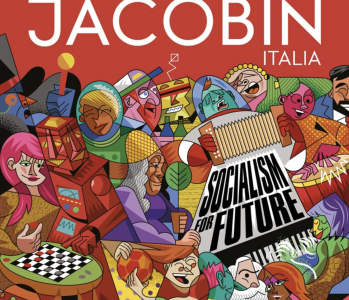
S.C.: I have long thought that two axes are necessary: strong ideas and innovative practices. By "strong ideas" I mean the capacity — especially in the face of a right that does not hesitate to take up the most horrible ideas of the twentieth century — to put forward a radical critique of capitalism and not to be afraid of relaunching reflection on socialism. In the latest issue of Jacobin Italia, "Socialism for future", we have begun to address this need, and I would point in particular to the interviews with Nancy Fraser on "the socialism of social reproduction" and with Cédric Durand on "socialism here and now", but also to many other contributions on ecosocialism or democratic confederalism. The discussion, however, is only beginning, and in particular the interweaving with the ecological struggle offers the most interesting lines — provided we measure up to the urgency, because the risk of ecological catastrophe demands urgent measures that cannot be postponed and require a certain degree of cohesion and determination.
In this debate I also believe that the theme of self-management (autogestione) and of organising in the "Commune" form of working-class strength must again be given a central place — and by "Commune" I mean precisely that of Paris, of 1871, and all the reflection Karl Marx developed on it, which was never at the centre of twentieth-century socialism. This discussion of socialism is very necessary, but it cannot be reduced to a commemoration of what has been or to a simple attempt to polish up traditional ideas. Many of them, of course, retain their relevance, but the capacity to reach younger generations demands a surplus of elaboration and imagination, and — I repeat once more — the terrain of ecosocialism can be an excellent channel of transmission. Then comes the problem of a social force endowed with the necessary power to take up this challenge. And here too, I believe, the necessary adjustments must be made.
S.P.: What exactly are those adjustments?
S.C.: The most radical or revolutionary left is accustomed to fighting battles to ensure that trade union and social organisations adopt the "right line" in the face of the drift of their leaderships. This approach, very typical of the twentieth century, does not really take account of the need to recreate a class dimension in which mutual confidence, the proper articulation between practices and ideas, and the recognition of one’s own role can be rebuilt. None of this is achieved simply through a "battle at congress", but by rebuilding social bodies that possess these characteristics. That is why I have thought for some time now that the practice of "conflictual mutualism" represents a tool — certainly not the only one, and certainly not generalisable to all practices, since the strike obviously remains a decisive tool — for building this reciprocal confidence and this "class for itself" whose very existence we have lost sight of.
By "conflictual mutualism" we mean bodies of direct solidarity — trade-union, cooperative, social, mutual-aid — that rebuild the horizontal relationship between workers, and that maintain a necessary dose of conflictuality to demand rights, resources and tools. It is not a matter of building "islands of happiness", as has been objected to the libertarian tradition, but rather an archipelago and an ecosystem of bodies that throw themselves directly into the struggle to obtain results, while at the same time trying to consolidate the capacities self-generated by the class itself and by its needs for reciprocal solidarity to resist the present moment.
It is no coincidence that, in recent years, we have invested a great deal of energy — with Edizioni Alegre and also with Jacobin Italia — in supporting the struggle of the former Driveline GKN workers [6] who are working towards worker self-management with an industrial plan elaborated in collaboration with the territory and a solidaristic intelligentsia [7]. We have indeed seen, in this very generous struggle — which has lasted nearly five years with a permanent picket in front of the abandoned factory — a resource for rebuilding a class dimension, even if only as an "exemplary" one, capable of speaking to everyone. And it is with the same approach that we have defined the activity of the Global Sumud Flotilla as a form of "conflictual mutualism".
S.P.: What role can the younger generations play, such as those who have mobilised for Palestine? Can you explain how those massive mobilisations were prepared on the ground by long organising work?
S.C.: The fact that the Meloni government has suffered a serious blow to its credibility and cohesion cannot be explained without understanding what happened in Italian streets last autumn. Millions of people took to the streets, outraged at the situation in Gaza and at Israel’s impunity, but also at Trump’s attacks on Iran. Something was triggered deeply, especially among the younger generations, the twenty-year-olds, who then went to the polls in the March referendum on the judiciary and demonstrated on 25 April, the day of the Liberation from fascism — a date constantly attacked by the right, and which continues to represent a variable to be followed closely [8].
This mobilisation is more ethical than political, motivated by moral outrage against the war, but it now understands — not least because it is attentive to the ecological crisis — that certain mechanisms of the capitalist world lie at the origin of certain failures. This mobilisation has not depended on organisational capacities, even if the trade union organisations, in particular, have been very useful — notably by calling the general strike. But it is a participation that has massively exceeded the mobilising capacities of the existing organisations, thus demonstrating the existence of a new potential. We do not know whether the "Gaza generation" can be compared with the "Vietnam generation" of the 1960s and 1970s: today there no longer exists that class consciousness, that political and social organisation, nor that deep unity that still existed in the factories, the neighbourhoods and the schools. There was also an ideological homogeneity — despite many divisions, we were all indebted to the Russian Revolution — a homogeneity that is now completely absent. That is why we do not clearly know where this indignation can lead.
I do not think our role, as journalists, intellectuals, journals, political or social forces, is simply to engage in propaganda, but rather to propose to this youth new forms of direct and collective engagement. That is where our capacity to invent structures at the level of our times is measured, in order to give young people the opportunity to mature their consciousness and to orient it politically [9].
S.P.: You were deputy editor of Il Fatto Quotidiano, you run the publishing house Edizioni Alegre and you also take part in the editorial team of Jacobin Italia. What role do you think the battle for cultural hegemony plays today?
S.C.: I am no longer deputy editor of Il Fatto, but I continue to contribute to that newspaper and I am of course very involved in setting up Jacobin Italia. I had a very intense and structured political life, from the mid-1980s to the mid-2000s — for more than twenty years. This new activity has allowed me to study a great deal, and I think this is an important task for politics, which still remains too vague and left to improvisation. More than "the organic intellectual" of which Gramsci spoke in another historical period, what is needed today for the class struggle is "organic ideas"; and the question of hegemony — also conceived by our dear Gramsci — is on the contrary a decisive question, and that intuition remains extremely valuable today.
Hegemony is built by circulating the right ideas at the right moment, by knowing how to make the best use of new tools, such as social media, but above all by taking the time to think, to write and to debate. One of the reasons for the crisis of the class left, for at least thirty years now, lies precisely there: the lack of journals, publishing houses and cultural houses. And I must say that, after twenty years of existence, the fact of having succeeded — with the comrades at Alegre — in giving strength to this cultural project makes us feel very useful in the disastrous landscape of the Italian left.
11 May 2026
Source: Marx21.ch. Translated and notes by Adam Novak for ESSF.