
 Version imprimable
Strengthening executive power, silencing dissent
Waging war on the “toghe rosse” (red togas) was the obsession of the Berlusconian right during the four terms of office of the “Cavaliere”. Today, the battle against the judiciary is part of an authoritarian project aimed at gradually emptying bourgeois liberal democracy of all substance while preserving its appearance. The provisions of the “security” decree, which came into force last February, had already alerted some legal experts who speak of a “genuinely subversive project aimed at preventing dissent and gradually transforming the state of law into a police state”. This is indeed a very serious attack on the freedom of assembly and demonstration, quite unprecedented in the recent history of the Italian Republic. Added to this are the already very strong restrictions on the freedom of movement of migrants, on lifestyles, as well as attacks on the right to strike and the working conditions of the subaltern classes.
The dangers of constitutional reform
Contrary to what is often claimed, the reform does not propose any remedy for the ills of the Italian justice system: the delays in justice, both criminal and civil, which allow the most powerful to delay trials and deny rights to the most vulnerable; miscarriages of justice; or the overcrowding of prisons and the disastrous state of prisons.
The reform also does not concern the separation of careers, as there is already a substantial separation between the prosecutor’s office and the judges, enshrined in the Cartabia law in 2022. In reality, it is a reform that questions the independence of the judiciary and limits the guarantees of the principle of separation of powers, favouring on the contrary the tendency towards centralisation characteristic of authoritarian regimes.
It is therefore not a technical and abstract question, but an eminently political question. According to constitutional law professor Alessandra Algostino, this reform is part of a context of concentration of powers and disqualification of the work of judges by the executive. This includes the duplication of the Supreme Council of the Judiciary (one for prosecutors and one for judges).
At present, this body of self-government of judges is composed of one-third so-called “secular” members, elected by Parliament, two-thirds members with togas elected by the judges, plus three members sitting ex officio: the President of the Republic, the First Prosecutor General of the Court of Cassation and the President of the Court of Cassation. This composition ensures a majority of magistrate members elected by the judges, who decide in particular on disciplinary sanctions.
The reform provides for this disciplinary jurisdiction to be taken away from the CSM and assigned to a new body, the High Disciplinary Court, composed of the judges who are the most advanced in their careers, which would imply a pyramidal logic. Another important change concerns the introduction of the drawing of lots for the appointment of members of the two judicial councils. This draw differs according to the type of member: lay people (law professors or lawyers with at least fifteen years of experience) would be drawn by lot from a list drawn up by the parliamentary majority. This means that this component of the CSM would be homogeneous and compact, while the drawing of lots for judges would be carried out on the basis of the complete list of judges in office.
The objective: to control the justice system
Under the pretext of countering the currents of the judiciary, this system leads to a form of fragmentation of the CSM, which would become, because of its fragmentation, more permeable to the influences of the politicized secular component. The reform is in fact based on a false conception of democracy, considering that the currents of the judiciary constitute in themselves a danger.
To deal with the “peril” of the currents, the government wants to impose political control of the judges drawn by lot by the parliamentary majority. Meloni says that this should also serve the interests of her opponents, leaving no doubt about her desire to control this body.
On the contrary, the pluralism of currents constitutes a democratic lever, allowing debating different interpretations of the law. This certainly does not guarantee the exercise of progressive justice: there are legacies of the patriarchal and racist system that run through legal cultures. However, it is known that in countries where such a system has been experimented with, it has led to a rapprochement between the public prosecutor’s office and the executive.
This rapprochement becomes indispensable for Meloni’s authoritarian government in order to ensure the application of repressive reforms towards exiled people, minorities, workers and, more broadly, all opponents. The Nordio “reform”", like every action of the Meloni government, ultimately serves to “distort the framework of rights and the balance of forces between the classes”.
Campaigning for a “No” vote in the referendum
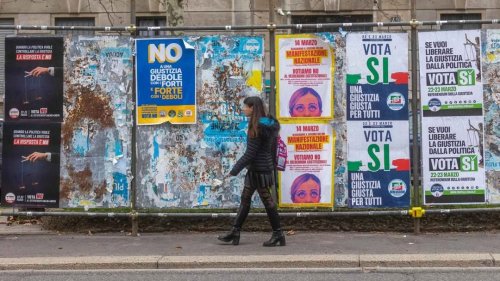
The campaign for the “No” vote is dynamic and brings together trade unions, left-wing parties in the country, as well as artists and civil society movements. On Saturday, 14 March, 20,000 people marched in the Italian capital to say “No” to the constitutional referendum and the imperialist war in the Middle East. This is an encouraging sign for a victory for the “No” vote in the referendum that could put a brake on the Meloni government’s repressive project and destabilise its hegemonic role within the government coalition.
L’Anticapitaliste 20 March