
 Version imprimable
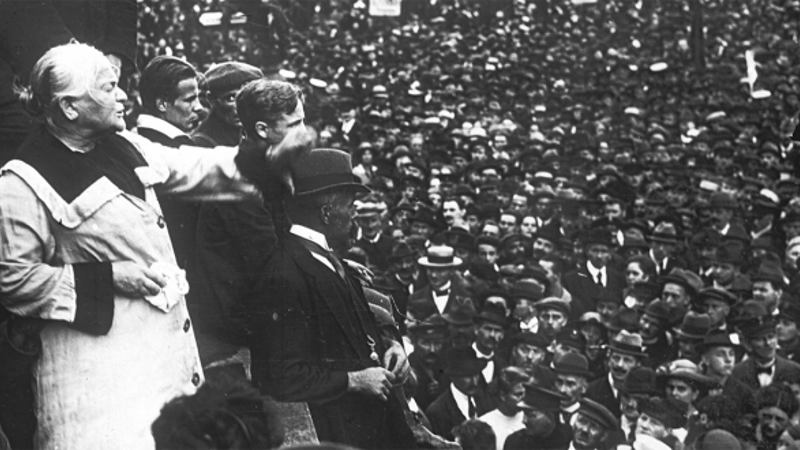
The text by Clara Zetkin given here is taken from her report for the Communist International of 1923 on the nature of fascism.
“It is evident that we will overcome this wily enemy all the sooner to the degree that we grasp its essential character and how that character is expressed. There has been great confusion regarding fascism, not only among the broad masses of proletarians but also within their revolutionary vanguard, among Communists. At first, the prevailing view was that fascism was nothing more than violent bourgeois terror, and its character and effects were thought to be similar to those of the Horthy regime in Hungary. Yet even though fascism and the Horthy regime employ the same bloody, terrorist methods, which bear down on the proletariat in the same way, the historical essence of the two phenomena is entirely different.
The terror in Hungary began after the defeat of an initially victorious revolutionary struggle. For a moment the bourgeoisie trembled before the proletariat’s might. The Horthy terror emerged as revenge against the revolution. The agent of this revenge was a small caste of feudal officers.
Fascism is quite different from that. It is not at all the revenge of the bourgeoisie against the militant uprising of the proletariat. In historical terms, viewed objectively, fascism arrives much more as punishment because the proletariat has not carried and driven forward the revolution that began in Russia. And the base of fascism lies not in a small caste but in broad social layers, broad masses, reaching even into the proletariat. We must understand these essential differences in order to deal successfully with fascism. Military means alone cannot vanquish it, if I may use that term; we must also wrestle it to the ground politically and ideologically. […]
Masses in their thousands streamed to fascism. It became an asylum for all the politically homeless, the socially uprooted, the destitute and disillusioned. And what they no longer hoped for from the revolutionary proletarian class and from socialism, they now hoped would be achieved by the most able, strong, determined, and bold elements of every social class. All these forces must come together in a community. And this community, for the fascists, is the nation. They wrongly imagine that the sincere will to create a new and better social reality is strong enough to overcome all class antagonisms. The instrument to achieve fascist ideals is, for them, the state. A strong and authoritarian state that will be their very own creation and their obedient tool. This state will tower high above all differences of party and class, and will remake society in accord with their ideology and program.
It is evident that in terms of the social composition of its troops, fascism encompasses forces that can be extremely uncomfortable and even dangerous for bourgeois society. I’ll go further and assert that these elements, if they come to understand their own best interests, must be dangerous for bourgeois society. Precisely! If this situation arises, then these forces must do what they can to ensure that bourgeois society is smashed as soon as possible and communism is achieved. But events up to now have nonetheless demonstrated that the revolutionary forces within fascism are outstripped and restrained by the reactionary forces.
What we see here is analogous to events in other revolutions. The petty-bourgeois and intermediate social forces at first vacillate indecisively between the powerful historical camps of the proletariat and bourgeoisie. They are induced to sympathize with the proletariat by their life’s suffering and, in part, by their soul’s noble longings and high ideals, so long as it is not only revolutionary in its conduct but also seems to have prospects for victory. Under the pressure of the masses and their needs and influenced by this situation, even the fascist leaders are forced to at least flirt with the revolutionary proletariat, even though they may not have any personal sympathy for it. But when it becomes clear that the proletariat itself has abandoned the goal of carrying the revolution further, that it is withdrawing from the battlefield under the influence of the reformist leaders, out of fear of revolution and respect for the capitalists—at this point the broad fascist masses find their way to the spot where most of their leaders were, consciously or unconsciously, from the very start: on the side of the bourgeoisie. [1]
Clara Zetkin (1857-1933) was entering her 67th year when she wrote this report on the nature of fascism. She was ill when she presented it to the enlarged plenary session of the Executive Committee of the Communist International (CI); one of the three "small world congresses", as Zinoviev called them, organised between 1922 and 1923, but undoubtedly the first to examine the causes and nature of fascism.
Zetkin was a seasoned activist, at the head of the “International Provisional Committee against Fascism.” Exiled after the promulgation of Bismarck’s anti-socialist laws, she moved to Paris in 1882 and participated in the founding congress of the Second International. From 1907, she presided over its women’s secretariat and included 8 March in the socialist calendar. A friend of Rosa Luxemburg, she first joined the Independent Social Democratic Party of Germany (USPD) and then the Communist Party (KPD).
In June 1920, she was one of the two KPD deputies elected to the Reichstag with Paul Levi. She remained there until 1933. She was a member of the Executive Committee of the CI and President of International Red Aid. In her capacity as the oldest member of the Reichstag, she spoke at the opening of the parliament on 30 August 1932, after the NSDAP’s landslide in July (37% of the vote, 230 seats), and called for the formation of a “united front of all workers to repel fascism”.
Can fascism, a phenomenon that appeared in Italy, be translated into other political and social realities? Can fascism be assimilated to a conservative reaction like any other, or should it be analysed in terms of its “specific differences,” in particular its social base? Is the regime it introduces a simple variant of bourgeois power or is it something else?
Since the autumn of 1922, the CI had been conducting an intense debate on fascism. Its Fourth Congress began a few days after the march on Rome. Until then, the International seemed to follow the reductive interpretation of the Italian Communists, marked by the figurehead of Amadeo Bordiga, who saw in fascism “the natural continuation of the method applied before and after the war by ’democracy’.” [2] However, the CI’s analyses were developed in a context where revolutionary perspectives were moving away, which fuelled orientation debates marked by trial and error, hesitation and contradictions.
If the German Communist Paul Levi had already defended, between March 1920 and January 1921, the option of the workers’ united front – that is to say, the unity of action of the forces of the entire workers’ movement, beyond distinctions of organisations and programmes – Clara Zetkin’s report was, in June 1923, the first to clearly characterise fascism as a mass reactionary movement. It insisted on the need to have a “clear and precise vision” of its “nature” and its “effects” in order to combat it effectively, and thus produced, without question, the most important early contribution within the CI.
A “white terror” like any other?
Clara Zetkin identifies the main lines of a movement that differs from other post-war counter-revolutionary phenomena, even if it employs the same “bloody terrorist methods.” In Hungary, the Republic of Councils (April-July 1919) was crushed by the Franco-Romanian military intervention, while Admiral Miklós Horthy organised the White Terror by occupying Budapest (November 1919) and imposing himself as regent (from March 1920). It was not fascist “punishment” that sanctioned, as in Italy, the abandonment of the revolutionary struggle initiated in Russia, but military “revenge,” carried out by “a small caste of feudal officers,” which targeted a briefly victorious revolution.
Zetkin’s analysis is similar to that of Fabbri and Gramsci, who was then in Moscow. Against the tide in the CI, they stressed the novelty and relative autonomy of fascism, while the president of the International, Grigory Zinoviev, likened it to a “white terror” that necessarily fell on a proletariat betrayed by social democracy (Fourth Congress of the CI, November 1922). This vision is close to that of Bordiga, making no distinction between bourgeois democracy and fascism, and considering social democracy to be the ultimate safeguard of the bourgeois order.
At the enlarged conference of June 1923, Zetkin’s report took up elements raised at the Fourth Congress, notably by Lenin and Karl Radek. [3] The former had insisted on the analogy between fascism and the Russian anti-Semitic counter-revolutionary movement of the Black Hundreds, based on the well-to-do peasantry and the urban petty bourgeoisie, in reaction to the revolution of 1905. The latter had argued that “the most conscious counterrevolutionary elements” could seek to overthrow democratic constitutional legality by violence. Zetkin and Radek tried to convince the Italian representatives of the validity of their analysis and of the need for Communists to adopt a united front policy.
In June 1923, the Zetkin Report was widely accepted. However, a year later, the resolution “On Fascism” of the Fifth Congress of the CI (July 1924), held just after Lenin’s death, would revert to Zinoviev’s interpretation, presenting Social Democracy as “a wing of fascism”, asserting that “if the fascists are the right hand of the bourgeoisie, the Social Democracy is its left hand”.
Zetkin adds a key difference between “classical” counterrevolutionary movements and fascism: the latter is not borne by a small caste, but by broad masses that can reach even the proletariat. This essential distinction is undoubtedly one of her major contributions to the understanding of this phenomenon. In doing so, she insists on the moral disorientation of the “masses in their thousands,” the “socially uprooted,” the “destitute,” the “disillusioned” who have “streamed to fascism.”
She highlights the heterogeneous character of its social base, which appeals more particularly to the petty bourgeoisie, but not only – which makes it impossible to equate fascism with a reaction of the layers ruined by the post-war crisis and threatened with proletarianization. Just before it took power, and if its internal statistics are to be believed, the National Fascist Party was made up of agricultural workers (24.3%), industrial workers (15.5%), students (13%), landowners and small farmers (11.9%), employees (9.9%), civil servants (4.7%), shopkeepers and craftsmen (9.2%), self-employed (6.6%), industrialists (2.8%), teachers (1.1%).
It embodied the “party of the bourgeoisie” of the “new type,” to use the words of the Italian Communist Palmiro Togliatti in his “Lessons on Fascism” of 1935, achieving the unification of the bourgeoisie around a composite industrial and agrarian nucleus in the defence of its own interests. A relatively autonomous political phenomenon, fascism has its own ideology which tends to bring together those who no longer expect anything from the proletariat and socialism.
From then on, it drapes itself in the rags of anti-capitalism to win over those whose daily struggle for survival, but also nobler aspirations, naturally leads to sympathy with the proletariat. It calls on them to place their hopes in the elements who, from various social backgrounds, plead for social peace and the return to order.
From this point of view, without a constant ideological struggle, a “military” conception of the fight against fascism will not be enough. Worried by endless and seemingly intractable class conflicts, the supporters of fascism fell back on the promise of civil peace in the midst of a strong nation, purged of its ferment of dissolution. They are promised that their idealized nation, led by an all-powerful authoritarian state, will be both “their creature and their obedient tool.”
The transnational dimension of fascism
Zetkin’s analysis certainly focused on Italian fascism, which had come to power a few months earlier, but her gaze also fell on Germany, where the battle was not yet lost. In January 1923, the occupation of the Ruhr by French and Belgian troops gave new impetus to nationalist movements, while the abortive Communist insurrection of October marked the end of the revolution.
It was in this context, in November 1923, that Hitler attempted his so-called “beer hall” putsch in Munich. But the NSDAP, with its 50,000 members, was still only one of the many nationalist and paramilitary forces, which had hundreds of thousands of members. In this boiling maelstrom, there were many elements that were embarrassing, even dangerous, for the restoration of bourgeois order, elements that the Nazis tried to channel into a counter-revolutionary perspective.
In short, Zetkin emphasizes the novelty of fascism as a mass reactionary movement, while pointing out its links with the unprecedented offensive of the bourgeoisie and monopoly capital against the organizations of the workers’ movement. It cannot therefore be combated without a clear understanding of this reality, which accounts for its power of attraction on broad social strata, as well as its potential for spatial expansion.
In the Europe of the 1920s and 1930s, the “party of counter-revolutionary despair” became a transnational phenomenon, capable of adapting to each national terrain by combining its specific ideas and practices. It would amalgamate themes borrowed from conservatism, militarism, expansionist nationalism, anti-Semitism, racism, anti-liberalism, anti-socialism, anti-communism and so on, while attaching itself to a revolutionary mythology.
Translated by International Viewpoint from Contretemps.