
 Version imprimable
Anne: The work of remembrance is fundamental, it means considering that we are a human chain and that if we are what we are today, it is because there have been a certain number of events, a certain number of battles before us and this is what forges us.
Hélène: Yes, but what is the purpose of memory, if you only deal with memory, at that point, you only think about preserving what you have learned, you don’t want to go any further.
Anne: No, because it can be the beginning of an action; it’s not necessarily a passivity. If you tell girls who scream when you say the word feminists that if they can have sex without being afraid of getting pregnant, it’s thanks to these women, they may have another vision of things and maybe afterwards they will go further.
Chrystelle: It’s been since I’ve been an activist that I’ve realized that things have happened and that I’ve been informed. [1]
At a time when we would like to see “surging” mobilizations in the face of an exponential rise of the far right, we take a closer look at what the feminist mobilizations of the autumn of 1995 can teach us about the possibilities of unity today.
Staying at the bottom of the wave
Under a left-wing government, in 1982, the “Assises sur les femmes au travail”, organized by the feminist class struggle current, mobilized 2000 feminists from associations, trade unions, and political parties at the Sorbonne. While it is possible to make broad common reference to the conquests of the 1970s, few of them take into account the low points far from the “feminist waves”, a common periodization of the history of feminism(s). However, what allows the maintenance of a strong awareness of oppression and domination is the “ordinary” activist work that makes it possible to build mobilizations that do not occur spontaneously. But, as Josette Trat reminds us: “After that, there were several years of atomization and withdrawal of the feminist movement into associations specialized by theme or locally based.” [2]
And yet, the question of women’s rights, particularly in terms of employment, arose with the nurses’ strike (more than 100,000 people demonstrated in support in October 1988), and the nurses’ coordination from 1989 onwards “which imposed a different mode of organisation on the trade union federations, by denouncing their working conditions in the world of health, but especially in these so-called feminized professions where equality is supposedly natural. “Neither good, nor nuns, nor stupid” meets with many echoes within feminist circles on employment law but also on questions of trade union democracy and the place of women”.
[3]
The Feminist Collective Against Rape was created in 1985 “to react against rapes committed in public places in the Paris region, in the middle of the street or on public transport, in front of passive witnesses “and allowed the opening on 8 March 1986 of a national telephone hotline, anonymous and free. [4] Claudine openly accused her father of rape on 27 March 1989 on TF1, and he filed a complaint against her. During the hearing in St Brieux, the Feminist Collective against Rape was mobilized. The law of 10 July 1989 amended the statute of limitations and also created the telephone number 119. [5]
From 1990 onwards, the anti-abortion commandos began their actions in orthogenic centres. Masculinist movements emerged, such as SOS Papas.
In defence of women’s rights to control their bodies while the 1975 law was directly attacked, and to demand resources for abortion centres, the CADAC, Coordination of Associations for the Right to Abortion and Contraception (associations, unions, political parties), was created in the same year as the anti-fascist organisation Ras l’Front. The Neiertz Law for the offence of obstructing abortion was passed in 1993 following the “General Assembly for the Right to Abortion” promoted by the CADAC. Commandos were also deployed in the United States with Operation Rescue, and in 1991, Susan Faludi published “Backlash” in the United States, which explained the reactionary attacks underway in reaction to the feminist gains of the 1970s.
The power of unity as fuel for a feminist movement
Responding to the call of fundamentalist Catholic associations and the extreme right, 10,000 people demonstrated against abortion in January 1995 and in June 1995, the Front national won control of three cities. Following the election of Chirac and the proposed amnesty law for the commandos, the mobilization and the Neiertz amendment (again) made it possible to make the government back down.
“We have called for a mobilization on 27 June in front of the National Assembly. The union leaderships were told: “You have 48 hours to say if you are part of the demonstration”. In the meantime, we thought that it was not enough and that we had to go further.” [6] 25 November, which became the International Day for the Elimination of Violence against Women in reference to the Mirabal sisters only in 1999, was chosen to give time to prepare for the mobilization. The CADAC convened unitary meetings of the feminist movement at the Paris Labour Exchange, which was not used to having such meetings there. The Louise Michel room was full at every meeting. “We were all together, and it was a contrast, it was a different period compared to the usual practices of the feminist movement in the 1970s when the unions were not present, but where we operated by women’s groups, by general meetings and so on. It was a concern of the CADAC in 1990 to integrate trade unions and political parties.” [7]
In this appeal, the right to abortion is mentioned, but also imposed part-time work, equal pay, the family law of C. Codaccioni, parental allowance for the second child... The demands are broad since it was the class struggle tendency of the movement that was leading the mobilization.
November 1995
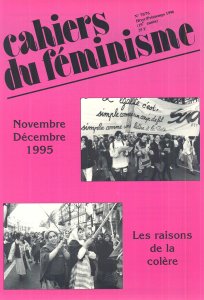
149 organizations, including feminist associations, trade unions and political parties, called for the demonstration on November 25, relayed by 56 city collectives. It brought together 40,000 people, a third of whom were men. Suzy Rojtman remembers “we were happy, we were joyful, and really the fact that we were in the street, it was a balm in our hearts, and we were there with everyone”. The demonstration came the day after an interprofessional mobilization and the first day of a renewable strike by railway workers. Maya Surduts: “It was for the real right to abortion and contraception, for real equality between women and men and against the restoration of moral order.” [8] “In 1995, new unions were present in the streets, and female teachers were also present in inter-professional general meetings alongside railway workers...” [9]
“But as soon as the railway workers took the lead in the renewable strike, women disappeared from the public scene, they were ‘absorbed’ in the general movement. The presence of men, even if in the minority, during the demonstration of 25 November 1995, was systematically noted by the press.”10
From now on, there was a feminist cortege at each demonstration. The momentum of mobilization was such that the unitary collective that organized the demonstration would prepare feminist meetings and make itself permanent. The demands were not — yet — taken up by the entire social movement.
What revival of feminism after 1995?
It was therefore on 24 January 1996 that the National Collective for Women’s Rights (CNDF) was created. It was preparing and calling (with 170 organizations) for a “National Conference for Women’s Rights” on 15-16 March 1997, which brought together 2,000 women. Several themes were addressed in the various committees: Poverty, precariousness, immigration/Violence against women/Women in public life (which ended with “we demand a law on parity” but pointed out that this issue was not dealt with by consensus but “by a large majority”)/They choose — in which the creation of the Contract for Gender Equality was addressed. The social union (CUS), the future PACS, and “the demand for a certain number of concrete acts, such as the allocation of couples’ rooms for lesbians in retirement homes”. [10]
Anne Leclerc: “It’s a refounding event where we are speaking out again and where we are setting a certain number of demands in terms of demands. On this occasion, women trade unionists find themselves in unity and say to themselves, how can we take into account several things at the union level, equal pay and professional equality, which make little progress, and at the same time the place of women in trade unionism?” ` [11]
The women’s inter-union days began in 1998. Feminist trade unionists need to think together about the dynamics they wish to implement. Today, 27 years after their creation, they bring together almost 400 to 500 people, on themes prepared with feminist associations, so as not to limit the debates solely to work.
In November 1997, the CNDF organised a demonstration on the employment of women and for the reduction of working hours for all, and continued with a campaign on compulsory part-time work. This was the beginning of the anti-globalization mobilizations but also of the World March of Women against Violence and Poverty, which was being prepared on an international scale (2000, 2005, 2020, 2025) with a first meeting in 1998. Feminists participated in social forums such as the one in Saint Denis in 2003 where 3000 women of all generations meet on the first day. In December 2005, the CNDF organized the “Alternatives feministes”, twelve meetings with workshops on four major themes: precariousness and employment, feminism or feminisms, liberalism and choice, and generational transmission. The feminist militants of the LCR (including Maya Surduts) took a large part in this revival, as they had been able to do since the end of the 1970s, notably with Les Cahiers du Féminisme, with broad unitary work as well as union unitary work.
Violence against women at the centre of demands and mobilisations
Suzy Rojtman: “In the Sarkozy (then Minister of the Interior) bill on internal security, there are measures that further stigmatize prostitutes such as those fighting against ‘passive solicitation’. On 10 December 2002, we organized an abolitionist demonstration in Paris to say, “No to the prostitution system, no to the Sarkozy bill, yes to a world without prostitution.” [12]
In 2006, the CNDF wrote and proposed a Framework Law against Violence against Women, inspired by the Spanish Framework Law, several of whose proposals were included in the law of 9 July 2010. (The Framework Law was revised in 2013). [13] “The law passed, the result of a long work between parliamentarians, the CNDF and associations, includes advances: the creation of a protection order, the (not complete) recognition of psychological violence within the couple, the modification of the offence of slanderous denunciation, the recognition of forced marriage as an aggravating circumstance of violence and so on. But there are significant stagnations: the improvement of the consideration of sexual harassment in the workplace has been blocked by the Senate; the law, at the request of the government, concerns almost solely domestic violence; prevention is minimal, the Observatory of Violence and training have been rejected by the Finance Committee.” [14]
The unitary collective also prepared a demonstration for 6 November 2010 that linked the right to abortion and the dismantling of public hospitals.
During the General Assembly “Women’s Rights in All Their States!” on 3 -4 December 2011, several themes were addressed by activists from all organizations: sexual violence, women’s right to control their own bodies, equality in employment, work, precariousness, poverty, women’s rights: a planetary issue?, feminism, democracy, freedoms put to the test by the extreme right and the moral order, Families: I hate you, families: I love you. They were an important base of demands in the following years, particularly during the 2012 presidential campaign.
Until the autumn of 2017 and the #MeToo movement, the mobilizations would continue with less strength, less digital presence. The feminist movement was struggling to regain the strength it once had. Disagreements weakened the movement and therefore its demands, but the community activists on the ground remained present and the union and political activists were still active.
The common construction of unitary mobilizations, in which each organization cannot fully recognize itself, remains an objective to be achieved even today. Unity is a tool to build strong mobilizations in the face of the far right, masculinist movements, racist and LGBTPHOBIC attacks and the liberal and imperialist violence that is unfolding everywhere. Today, it is not a question of saying “who does what?” but “how do we do it together?”
In the end, this is the only challenge for a feminist movement that wants to be broad and powerful, which, at a time when the far right is at the door of power, we must build, despite everything.
*.
Translated by International Viewpoint from l’Anticapitaliste.