
 Version imprimable
When weather ceases to be just weather
To grasp the magnitude of what we are facing, it is essential to examine a phenomenon often presented as purely “natural”: El Niño and La Niña—phases of what is known as the El Niño-Southern Oscillation (ENSO). Yet, far from being a simple meteorological event, its increasing intensity and devastating effects are inextricably linked to the capitalist production system, the destruction of ecosystems, and social inequality.
This text does not merely aim to explain what El Niño is; it seeks to dismantle the notion that its consequences are “natural” and inevitable—because they are not.
What are the El Niño and La Niña phenomena?
The El Niño-Southern Oscillation (ENSO) is a natural climate pattern that arises from the interaction between the ocean and the atmosphere in the equatorial Pacific. It has two opposing phases—El Niño (the warm phase) and La Niña (the cold phase)—with an intermediate, neutral state.
During La Niña, the trade winds—constant and regular air currents—strengthen and push warm surface waters toward Indonesia. This triggers an upwelling of cold, nutrient-rich waters off the coasts of Peru and Chile, which boosts fishing activity but also leads to extreme rainfall in Oceania. The overall global effect is a temporary cooling of the atmosphere.
During El Niño, the trade winds weaken. Warm waters remain in the central and eastern Pacific, blocking the thermohaline circulation that normally cools the surface. The result is ocean warming, which translates into an increase in global temperature.
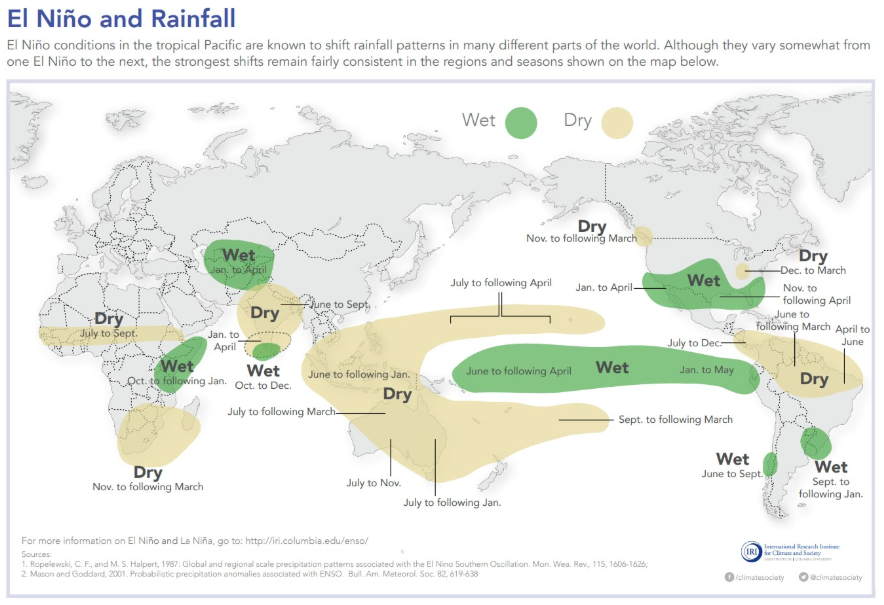
Map: ‘El Niño and rainfall’. El Niño conditions in the tropical Pacific Ocean are known to alter weather patterns in many parts of the world. Although they vary from one El Niño event to the next, the most significant changes remain fairly consistent across the regions and seasons shown below.
An El Niño episode is officially declared when the sea surface temperature in the central and eastern tropical Pacific exceeds the average by at least 0.5 °C for several consecutive quarters. A “super El Niño” entails much larger anomalies and particularly severe effects.
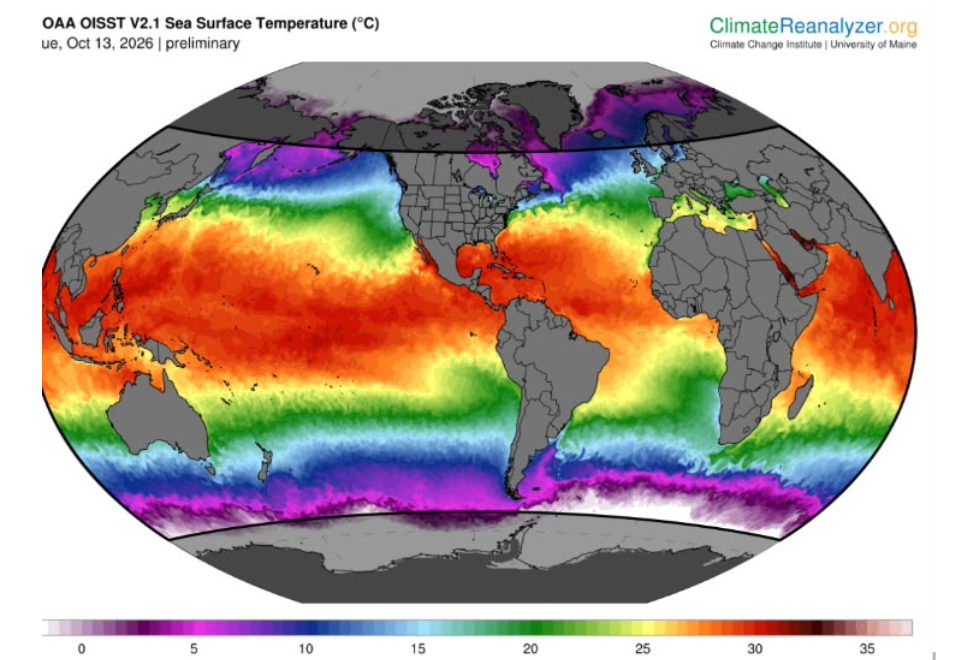
The 2015–2016 episode was one of the strongest ever recorded. Sea surface temperatures in the tropical Pacific exceeded the average by more than 2 °C. The World Meteorological Organisation (WMO) described it as “exceptionally intense” and warned that its effects would persist for months. [1]
The ocean: a buffer that can no longer be sustained
There is one fact that changes everything: more than 90% of the excess heat generated by greenhouse gases has been absorbed by the oceans. The seas have acted as a gigantic buffer, preventing atmospheric warming from being even more severe. [2]
But that buffer has its limits. Each year, the oceans absorb more energy, and this energy fuels phenomena such as El Niño, making them more intense and frequent. As a result, 2024 was the warmest year ever recorded in 175 years of observations, surpassing—for the first time—the 1.5°C threshold relative to the pre-industrial period (1850–1900). And the trend continues: the decade from 2015 to 2024 has been the hottest in history. [3]
The Paris Agreement established 1.5°C as a desirable limit, but we have already temporarily exceeded it. The most optimistic scenarios project that the peak of warming will reach at least 1.8°C—a threshold that separates a still-possible reversal from permanent warming. [4]
The impacts are not “natural”: the rupture of the society-nature metabolism
The El Niño phenomenon, on its own, does not account for catastrophic floods, devastating fires, or extreme droughts. What turns a climatic event into a disaster is the way in which societies have transformed—and destroyed—ecosystems.
Here, a key concept—which warrants further exploration—comes into play: the rupture of the society-nature metabolism. The capitalist model of production has imposed an extractivist logic that disrupts natural cycles, renders soil impermeable, clears forests, and confines streams into pipes. When the heavy rains associated with El Niño arrive, there is no soil to absorb the water, no forests to regulate it, and no natural watercourses to drain it.
The role of speculation and the real estate model
Waterproofing of the ground and soil is one of the factors that most exacerbates the impacts of extreme rainfall. The loss of permeable surfaces reduces filtration capacity, increases runoff velocity, and saturates drainage systems. Each new real estate development entails more asphalt, more land clearing, and less absorbent soil.
Added to this are the enclosing of streams in pipes, indiscriminate dredging, and the pollution of watersheds. Rivers and streams, which should function as natural drainage systems, are transformed into artificial channels that fail during extreme rainfall.
Deforestation and desertification
Deforestation is another decisive factor. In the Argentine Chaco region, nearly 9 million hectares have been cleared since 1976—an area equivalent to 440 times the size of the city of Buenos Aires. Without roots to retain water, and lacking the “sponge effect” provided by forests, the land loses its capacity to absorb and regulate the hydrological cycle.
Unplanned urbanisation encroaches upon high-risk areas, while desertification diminishes the productive capacity of the land and displaces rural communities.
Social vulnerability as a product of class
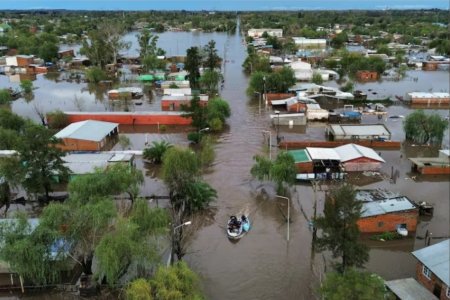
The consequences of these phenomena are not distributed equally. One in three people in Argentina lives in areas highly exposed to flooding. But it is no coincidence who is the most affected.
Working-class and marginalised groups, excluded from the formal real estate market, are driven to occupy low-lying, flood-prone land. Geographic vulnerability thus becomes a direct expression of social inequality and economic exclusion. Flooding disrupts access to essential services—such as healthcare, education, and transportation—thereby deepening exclusion and reinforcing structural conditions of vulnerability.
Imperialism interferes
The reemergence of “El Niño” created conditions that opened the door for greater United States intervention in Latin America. In Peru, this played out in an initial phase on August 17, when a meeting—organised by the Southern Command and held in Miami—brought together officials from the Donald Trump administration and their counterparts from the Keiko Fujimori camp; there, they agreed on joint policies for addressing these events. [5] These are not naive or merely circumstantial instances; rather, they are part of the "Shield of the Americas" initiative promoted from Washington, which—alongside "cooperation" in the realms of security, trade, and investment—also incorporates a focus on natural "disasters." [6]
Such interventions have been expanding in Latin America, as was demonstrated during the earthquakes in Venezuela [7] and Colombia [8], where the catastrophes extended and deepened direct subordination to imperialist directives.
Towards organising from below
In the face of state inaction and the commodification of land, the response cannot be an individual one. It is necessary to politicise the socio-environmental conflict and build popular, community-based organisation to confront both the limits imposed “from above” and the consequences of capitalist ecological collapse.
Within this context, for years we have been developing organisational initiatives in low-income neighbourhoods, shantytowns, and informal settlements—territories abandoned by the State to real estate speculation and large-scale garbage dumps. These are the very conditions that allow phenomena like El Niño to trigger extremely serious social consequences, as was the case in La Plata (the provincial capital of Buenos Aires) in 2013. [9]
There are valuable initiatives in this regard: neighbourhood emergency committees or environmental assemblies that identify vulnerable areas in collaboration with local residents, community-based climate monitoring networks, and participatory ecosystem restoration projects.
Adaptation to climate change cannot be a privilege reserved for those who can afford it. It must be a collective endeavour, built from the ground up, that challenges the structural causes of vulnerability.
The coldest summer of the rest of our lives
There’s a meme circulating on social media: Homer Simpson tells Bart not to complain because “this is the hottest summer of your life.” The updated version would be: “Just think—this is the coldest summer of the rest of your life.”
El Niño and La Niña are not “natural” phenomena in the sense that their impacts are inevitable. They are climate phenomena intensified by global warming, and their devastating effects are compounded by a production model that destroys ecosystems and by a society that excludes the most vulnerable.
The question is not whether there will be another super El Niño. The question is what will we do, collectively, to ensure that its consequences are not so unequal and so destructive. Because the climate changes, but the structural causes of vulnerability remain the same. And those, we can indeed transform.
22 October 2026
Translated by David Fagan for International Viewpoint from Punto de Vista Internacional.