
 Version imprimable
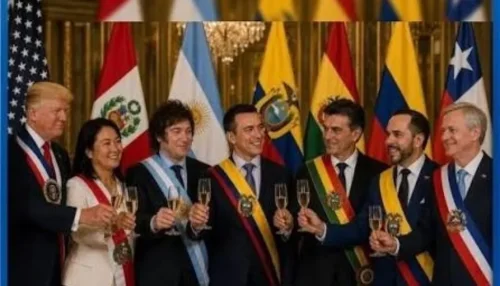
At the end of 2022, I published an article in this very column entitled: ‘Latin America: The far right is already amongst us’. [1] Today, this fact is undeniable. Looking at the period 2023–2026, far-right victories can be seen in 13 of the 16 presidential elections held during that time. However, it is since Donald Trump took office as President of the United States 18 months ago that this political shift has intensified, with far-right candidates winning the region’s last seven presidential elections.
Whether due to the simultaneity of these processes or the depth of the regressive reforms and structural changes they propose, one might consider this to be a new kind of political phenomenon that may not be merely episodic. In any case, its effects will be long-lasting.
A strengthened right wing
These new right-wing movements are far more radical and far-reaching in the structural changes they promise, in the dismantling of the democratic consensuses achieved in the previous period, and far more conservative. They promote the most extensive deregulation of capital flows, the curtailment, if not the elimination, of social and political rights (the removal of protections for workers, women, peasants, indigenous peoples, the commons and nature; the dismantling of education and health policies; the dispossession of indigenous peoples and their identities; and the use of public debt as a justification for policies of permanent austerity). And they are far more market-driven. It is an all-out attack on working people and in favour of capital, seeking to establish a long-term, regressive balance of power
Junior partners of Trumpism
This is a group of leaders who have attained political power in their countries through liberal democracy by capitalising on popular frustrations stemming from previous periods and governments. All of them have adopted as their own—despite their differences and heterogeneity—the style, rhetoric and agenda of Trumpism (authoritarianism, racism, sexism, homophobia, anti-environmentalism, the reconstruction of patriarchy, and hatred as a form of politics).
This shift towards right-wing extremism is entirely in line with the US’s New National Security Strategy (November 2025), which has been implementing a far more aggressive imperialist policy, launched under the pretext of combating drug trafficking and the indiscriminate bombing – without evidence and in breach of international agreements – of small vessels in the Caribbean. The military invasion of Venezuela and the abduction of the president and his wife (a member of the national parliament) on 3 January this year were a continuation of that offensive. At the same time, it threatened to annex Greenland until it secured the establishment of three military bases on the island, and to rename the Gulf of Mexico the Gulf of the Americas. He succeeded in getting Panama to expel Asian companies from the canal, forced Chile to suspend the project for a submarine fibre-optic cable from Concón to Hong Kong, whilst Argentina suspended the agreement to build a radio telescope in the province of San Juan…
Trump has realised that the era of unilateralism in the world has come to an end, and with it the US’s role as a hegemonic power. He is therefore seeking to redraw the global map, reorganising it into spheres of influence and security dominated by the major powers (the US, China, Russia), whilst retreating to the Western Hemisphere (from the Arctic to Antarctica). Through this withdrawal, he aims to address issues he considers strategic: blocking China’s access to the region, ensuring political stability for his allies (both subordinate and unconditional), and securing free access to the region’s natural resources – which are essential for his value chains and the energy transition.
However, this retraction does not mean turning a blind eye to its interests in other regions of the world. On the contrary, it seeks to strengthen control over its ‘backyard’ so that, from there, it can implement a policy that addresses its strategic weakness in the face of an emerging power such as China. The Milei government, in a state of total subordination to the US, is at the forefront of this process and aspires to lead a regional bloc of countries aligned with Trumpist policies. The current diplomatic crisis with Brazil is an expression of this intention, whilst also forming part of the global China–US conflict.
Of course, much depends on the outcomes of the forthcoming elections in Brazil and the US, which may influence the region and, in particular, next year’s presidential elections in Argentina.
The future hangs in the balance
Most of these electoral victories were decided in run-offs and by a very narrow margin, meaning that governments take office in deeply polarised societies, which casts doubt on future governability. So far, they have focused more on dismantling the achievements of the previous period and on altering the role of the state than on charting a course for the future.
The fact is that the extreme ultraliberalism they espouse faces serious difficulties in relaunching the process of capital accumulation and reproduction; they are increasingly dependent on foreign investment, which demands ever more concessions (tax breaks, legal guarantees and capital mobility) that undermine the sovereignty of peoples and nations.
Thus, these projects are caught up in the contradictions of the current situation, with the particularity that the long progressive decade established a baseline of social and democratic rights which workers and the popular sectors do not seem willing to relinquish without a fight (Bolivia, Chile and Argentina are examples of this resistance). However, workers’ and popular struggles against these far-right forces and imperialist domination remain fragmented and scattered – not only at the level of individual countries but also on an international scale. This places solidarity and the combination of anti-fascist and anti-imperialist resistance with the defence of national and popular sovereignty at the forefront.
Faced with an utterly radical agenda from the far right and the failure of progressive movements—which lack the courage to transcend the limits of capitalism—a space is opening up for the ideas of anti-capitalism and socialism. We see this in New York and other American and European cities. We also see it in our own country with the rise in popularity and voting intentions for Myriam Bregman, the leading political figure of the Argentine left.
A perspective
At the end of last March, thousands of people from more than 30 countries, gathered “…to combat imperialist and colonial aggression and to coordinate the struggles of the peoples resisting them”, met in Porto Alegre, Brazil, giving rise to the 1st International Anti-Fascist, Anti-Imperialist and for the Sovereignty of the Peoples Conference, seeking to share analyses, strengthen ties and agree on concrete actions.
This work will be continued by the Regional Anti-Imperialist and Anti-Fascist Conference of Latin America, to be held in Buenos Aires in December this year, followed by another in Mexico, possibly in March 2027.
The path of resistance and proposals has been mapped out, along which the anti-capitalist left can and must play a role by initiating debates and practical actions. It will be difficult to achieve, but not impossible.
4 August 2026
Translated by International Viewpoint from Huella del Sur.
This article is a summary of a longer piece that will form part of a forthcoming book.