
 Version imprimable
Only a few days now until the Landtag elections in Saxony-Anhalt (6 September) and Mecklenburg-West Pomerania (20 September), and the debates about how the party Die Linke should conduct itself towards the apparently unstoppable rise of the AfD are sharpening by the day.
For one part of the party establishment, led by the Bundestag vice-president Bodo Ramelow but solidly anchored in the party executive and in the parliamentary groups in the Bundestag and in the Land parliaments, it is entirely clear that what is at stake here is a crisis of "democracy" in its struggle against "authoritarianism". Die Linke must therefore live up to its overall responsibility for the endangered democratic state. In practice this means: incorporation into an all-party alliance of the "democratic parties" against the AfD, including possible arrangements with the CDU about governing together in the Länder.
The numbers
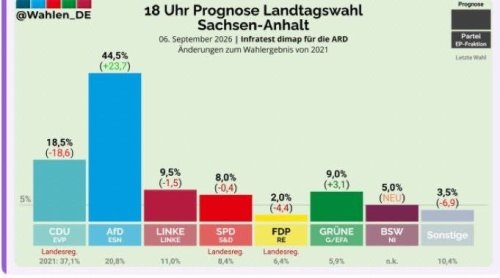
In Saxony-Anhalt the AfD has 3,500 members. In the polls among the 1.7 million people entitled to vote it takes 42.1 per cent; at the 2025 Bundestag elections it actually received 498,100 votes, 37.1 per cent. On the current polling, as of 25 August, the AfD would occupy 41 of the 83 seats in the Magdeburg Landtag. In Mecklenburg-West Pomerania the AfD has 2,700 members and reaches 36 per cent in the polls among 1.3 million voters; at the last Bundestag elections it actually brought in 357,356 votes, 35 per cent. If the polling result is reached, the AfD would take 28 of the 71 seats in the Schwerin Landtag. In Saxony-Anhalt it is expected that only the CDU, on 22.9 per cent in the polls, Die Linke on 13 per cent and perhaps the SPD on 6.6 per cent will win seats in the Landtag. Considered purely arithmetically, an AfD takeover of government can be prevented only by a governing alliance of CDU, Die Linke and SPD. In Mecklenburg-West Pomerania the SPD, on 29 per cent in the polls, Die Linke on 11 per cent and the CDU on 10 per cent, and perhaps the Greens on 5 per cent, will be represented in parliament. If the Greens enter the Landtag, coalitions with the SPD and the CDU or with the SPD and Die Linke would be possible; if they do not get in, then here too only an alliance of SPD, CDU and Die Linke would prevent an AfD participation in government.
There is no parliamentary solution, but let’s use that route anyway
The federal party congress of Die Linke has unfortunately given the Land organisations in Mecklenburg-West Pomerania and Saxony-Anhalt a free hand to embark on any parliamentary adventure. Motions to maintain the old tradition of left and workers’ parties, and to enter into no governing alliance and no toleration agreement with the bourgeois parties, found no majority. Now those responsible in both Land organisations are signalling that they would enter into arrangements with the CDU and, if need be, support a government under CDU leadership. Such a decision would be fatal for Die Linke and a step backwards from the successful phase, under way since 2024, of building the party as a left, independent class party.
The success of the AfD and its broad support, both of them still a long way from reaching a level of votes and above all of anchoring in society comparable to that of the NSDAP in its model Land of Saxony-Anhalt in 1932, cannot be separated from the actual politics that the CDU, SPD and Greens have been conducting for years at federal and at Land level. It is a politics carried on the backs of wage-earners and especially of migrants; of the smashing of welfare-state structures in health, care, pensions and education; of the refusal of real solutions to the crises of rents, of the climate and of transport; and of the structural neglect of the east German Länder. All of that constitutes the driving forces behind the rise of the parties of the right and above all of the AfD. Added to this is the permanent crisis of the EU, which is miles away from its promise to create a flourishing future for European capitalism, and the war orientation of the governing parties, which has not only revived old fears of war and destruction but has led directly to an enormous rise in the cost of daily life. A survey has just found that anxiety about this inflation is the population’s principal fear in east Germany.
Minority government with shifting majorities
The rise of the AfD is not only a result of these policies and of the fears of social decline bound up with them. The party has also managed to turn both of them into the basis of a broad anchoring in society. That can be reversed only if, first, the concrete policy of governments changes, and second, the broad left, together with the party Die Linke itself, sets about building a broad societal front against the right and advancing its own anchoring in society as a socialist alternative.
With an alliance with the CDU and the SPD in government, however it were arranged, the concrete policy will of course not change. The tiny concessions that Die Linke could obtain in return for a coalition, or for tolerating a CDU or SPD minister-president, would be nothing set against the concessions that would have to be made to bourgeois politics, and a death blow to any credibility of the left. A coalition with the CDU, or toleration of it, would above all be a kowtow to the federal government, would be a further building programme for the AfD, and would surrender the whole role of opposition to that same AfD.
Parliamentarily there is no "solution" to the AfD problem. In parliament only a minority government is conceivable, one in which Die Linke supports only those things that are socially acceptable. An all-party government, like a party-independent "government of experts", must be prevented. For Die Linke there is no alternative to the construction of a politically independent class party.
27 August 2026
Translated by International Viewpoint from Sozialistische Zeitung.