
 Version imprimable
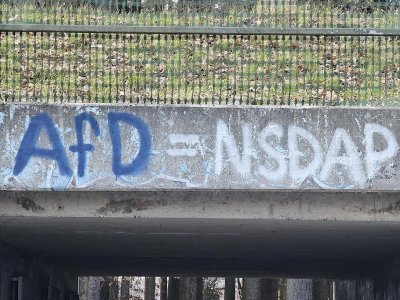
The fact that the AfD is now able to participate in governing coalitions at the regional, and even federal, level has reignited the debate about banning it. This debate is based on the idea that the AfD is a fascist party that stands outside the "consensus of democrats" and should therefore be ostracised – which, however, does not prevent it from gaining popularity. The debate has been raging for some time now, without reaching a conclusion. One might ask: where is this discussion going?
The dangers posed by the rise of the AfD to democratic and social rights are undeniable: the hunt for migrants ; hate speech against minorities and those who think differently; attacks on women’s rights; manipulation of institutions – particularly the media, the justice system and education – with the aim of controlling them, if necessary through corruption; the growing weakening of parliaments; attacks against trade unions, etc. Left-wing activists often use the term "fascist" in this context to refer to "the end of our freedom of action" or "maximum repression" – formulations that are more an expression of an emotional reaction.
While this aspect is important and useful for countering those who downplay the threat posed by the AfD by considering its electoral success as already a sign of "normality," is it sufficient to formulate a strategy capable of pushing back this party?
Many analyses emphasize that the AfD "is not fascist as a whole, because in addition to fascist ideology, it also defends other ideologies which, although reactionary, contradict – through their fanatical positions on property and their Christian fundamentalism – the authoritarian and völkisch state conception of fascism, at least as far as the society this formation intends to achieve is concerned" (as explained by Andreas Kemper , an AfD specialist , on his website).
Such a definition might suggest that the fascist element will eventually gain the upper hand once the AfD takes control of certain institutions.
Is this really the case? Would we describe Italy today as a country under a fascist regime? This, at the very least, demonstrates how vaguely, even casually, this term is used. In Genoa last year, dockworkers threatened to strike if weapons were to be loaded for shipment to Israel. Can one imagine a strike under Mussolini?
In reality, the so-called "centre" parties are rapidly moving closer to the AfD —particularly on deportation policy, or when Interior Minister Dobrindt wants to lift the separation of the intelligence services and the police. It is especially with the right wing of the CDU that the lines are sometimes blurred—as also demonstrated by the recent mass migration of CDU voters to the AfD . (Moreover, in its distancing itself from the AfD , the CDU cites less the latter’s attacks on democratic rights and procedures than its position on Russia and the EU.)
Are these signs of a slide towards fascism? The question is more complex: given the general and profound systemic crisis of capitalism, one can assume that fascist solutions are being considered by the ruling classes, as is evident in the case of American tech billionaires like Peter Thiel. However, one cannot say that such solutions are already on the agenda. What is emerging, on the other hand, is a move towards an authoritarian state that will not hesitate to dismantle social and democratic gains and violently repress any resistance. This authoritarian shift is reflected in the growing desire of certain factions within the CDU and the FDP to form governments with the AfD in one way or another.
Violence and terror
A comparison with the classic fascist parties of the 1920s and 1930s reveals the vast differences. The AfD emerged from the national-conservative rebellion against the euro and European integration. It seeks a return to "national sovereignty" and German greatness, whatever that may mean today. It originated from the CDU, but was unable to prevent the infiltration of far-right, even fascist, elements within the AfD , pushing it far to the extreme right. From the outset, it has combined nationalist and liberal positions.
And the NSDAP? Its core consisted of the SA, the "Storm Troopers," which acted as a paramilitary bodyguard, security service, and shock troops. Its leader, Ernst Röhm, had joined in 1919, the EPP Freikorps, which had participated in the violent suppression of the Munich Soviet Republic: Röhm recruited members of the SA from among the Freikorps and certain factions of the Reichswehr, even before the NSDAP was founded in 1920, and he was one of its first members. These were frustrated soldiers and officers, war-wounded veterans, who didn’t know how to cope with their defeat except by embracing the infamous "stab in the back" myth. They possessed weapons and transferred the experience and practice of violence acquired during the war to peacetime.
The political personnel of the NSDAP had grown from this fertile ground. Mussolini, too, recruited his "Fasci" from among these demobilized soldiers, ragged and disoriented, who carried within them the nationalist disappointment in the face of the "mutilated victory" ( vittoria mutilata ) and whose civil war against the "red menace" was their baptism of fire. These were hardened Nazis who terrorized the population with their parades.
These parties had a deep aversion to liberalism.
The Party
This cannot be compared to the current situation. Today, those who make up the far-right parties enjoying widespread popular support grew up in societies that experienced 80 years of relative peace. The Nazis wanted a return to a pre-modern state based on medieval feudal law (Mussolini dreamed of the return of the Roman Empire). The AfD , on the other hand, wants a return to the sovereign nation-state based on extreme economic liberalism.
For the Nazis, the party was the core of the new state, and their goal was to create a vast pool of cadres capable of occupying leadership positions in the most diverse sectors of society. The party was their instrument for controlling society down to its smallest corners.
The AfD needs the party, in a perfectly classic way, to win seats in Parliament and gain access to other levers of power. On election night, September 6, the party leader, Chrupalla, didn’t declare, "Now we’re going to clean the pigsty from top to bottom." He declared, "We are democrats and we engage in dialogue with everyone." This means nothing more than: "The time for breaking chairs is over. We can now access power, and to do so, we will make the necessary compromises."
At the end of 1932, the NSDAP had 850,000 members; only the SPD had more, with one million. (By the end of the war, the Nazi party had increased its membership tenfold.) The AfD has barely more members nationwide than the FDP (73,000); In Saxony-Anhalt, it has only 3,000 members, fewer than Die Linke in Cologne, even though the population there is twice as large. It can only govern through existing state institutions, which it must, however, share with others. It can cause considerable damage and even distort them. This would be enough, in the worst-case scenario, to establish a dictatorship, but not a fascist regime.
The NSDAP succeeded (after seizing power), thanks to its considerable weight and organization, in what no state institution, even the most repressive, nor any secret service can accomplish on its own: to monitor and terrorize the population in every aspect of life.
Sources of danger
There are certainly many parallels between the current crisis and the end of the Weimar Republic. However, this does not mean that the solutions will be the same. Dangers also lurk elsewhere – perhaps particularly due to the social consequences of the AI revolution: the concentration of vast amounts of data in the hands of a few, which can lead to the creation of a total surveillance state.
By labelling the AfD as fascist, the hope is that establishing a taboo will deter people from joining or voting for the party. This approach has failed. The taboo hasn’t worked because the historical comparison is flawed. Furthermore, there is currently no answer to the question of what can prevent the radicalisation of the extreme centre.
Confrontation with the bourgeoisie and petty-bourgeoisie is inevitable. However, the fact that, among workers, the AfD has been the strongest party since the 2025 federal elections, with 38 per cent of the vote, far ahead of the CDU/CSU (22 per cent) and the SPD (12 per cent) was not a foregone conclusion. It is the result of the political suicide of the SPD and the trade unions, which, in a tragic repeat of 1933, prefer to rush headlong to their own destruction rather than defend their organization and their members.
In the United States, we have seen that in unions facing this type of existential crisis, new figures have emerged, courageous activists who have been able to respond to the profound need for combative resistance and bring about a change of course. Will we achieve the same in Germany? It is becoming urgent.
September 26, 2026
Translated by International Viewpoint from Sozialistische Zeitung.