
 Version imprimable
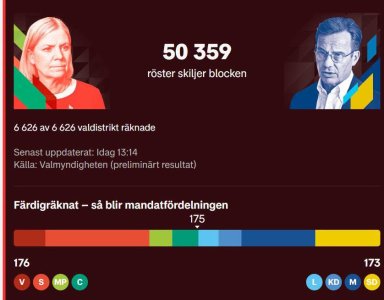
The racist far right nationalist Sverigemokraterna, SD - the Sweden Democrats - suffered a severe setback in last Sunday’s Swedish general election. It was the first time since 2010 the party declined in an election and is no longer the second largest party in the parliament. At the same time the Left Party obtained its biggest score for a quarter of a century.
The failure of the SD also means that the right-wing Swedish government - the most extreme one since the late 1920s - has had to resign. But simultaneously the Swedish Social Democracy had their weakest election result since 1908, that is before general suffrage. As all the conservative and liberal parties except the SD gained, the labour movement together with the Greens is not in a majority or able to constitute a government without the Centre party with its neoliberal economic agenda.
The Centre party has promised to never let the Left Party enter a government and the Left has promised to vote against any government which does not include it. So a period of complicated bargaining is going to follow. The Social Democrats leader Magdalena Andersson will form the government but with whom? On the left and the union movement, worries are strong that it will be a government leaning rightwards in economical politics. And both the Greens and the Left are in opposition to the anti-immigration politics of the Social Democrats, copied from the Danish social democracy.
The Left Party’s success relied largely on turnout in so-called neglected suburbs, where it won more than 40–50 per cent of the vote in some districts after an energetic door-knocking campaign inspired by Mamdani’s example in New York. The racist right wing dismissed the result as stemming from the “import of Muslims as voting fodder for the left”.
In reality it is above all the result of the anti-migration politics of the right-wing government with attacks on asylum rights, residence permits and citizenship for immigrants, together with expulsions of children and teenagers, and obligations for authorities and institutions to report undocumented immigrants. The Left and the Greens oppose these policies.
But another explanation is also the strong agitation from the Left Party on affordability, that is to say: lower rents and food prices, tax the rich and introduce a billionaire tax and de-privatize the health care and school system. This agitation on the redistribution of wealth, a pure economic policy of class interest has met with growing support from “the new” mixed working class of the suburbs.
The Left Party’s solidarity with Palestine is also an important factor here. While the party has been constantly attacked by the media for housing terror-romantic and antisemitic candidates from the Palestine solidarity movement, such attacks have little effect in the suburbs.
As almost a paradox, some leading members of the Left Party, including three MPs, left the party in protest against expulsions of some Palestine activists, accused in the media of posting on Facebook support for Hamas and antisemite tropes. Their new party ran candidates in only a few local elections and gained only marginal support of less than half per cent of the voters there - while their former party gained 30-40 per cent in the same areas.
Another criticism from left wing activists was that the campaign of the Left Party almost omitted climate change, ecological issues and opposition to nuclear power - questions that were raised only by the Greens who gained their best election result in many years.
Now the discussion within the left, both in the Left Party and broader circles will develop around which compromises will be acceptable for entering a government (for the first time ever since the foundation in 1917) or voting for it with demands without participating. The congress of the Left Party last spring decided on an ultimatum, either the party enters a new government or will vote against it, no matter what. If that would be possible will be decided in the coming weeks.
But to many activists the main issue is another: how to gather and form the many thousands of new voters and members of the left into a growing political force that can keep pushing back both the most racist right-wing populists and the whole right-wing bloc - and force a more open door to social reform and rebirth of a stronger labour- and left movement in Sweden.
Election results in % to Swedish parliament (a few votes still being counted Thursday). In brackets the results of the last election of 2022.
Left Party 8,4 (6,7)
Social Democracy 28 (30,5)
Greens 6,1 (5)
Center Party 7 (6,7)
Liberals 5,3 (4,6)
Christian Democrats 6,2 (5,4)
Conservatives 20 (19,1)
Sweden Democrats 17,5 (20,6)