
 Version imprimable
We now face the biggest fight ever. We intend to introduce a billionaire’s tax, reduce working hours, freeze rents and introduce a high-cost protection scheme for dental care to ensure a smiling Sweden. Our opponents will do everything in their power to stop us, but they will not succeed. The entire history of the Swedish labour movement shows that the struggle pays off. The ground is burning beneath our feet! If not us, then who? If not now, then when? We are not here to win the game but to change the rules and make hope normal again.
Nooshi Dadgostar’s rallying speech at the Left Party Congress last weekend evoked the image of a “now or never” moment. The Left Party’s election campaign is about seizing political power and initiating a drastic shift in Swedish politics, away from bourgeois class politics towards a welfare policy based on solidarity. The chair of Young Left, My Kårlycke, addressed the congress by stating that the election is about the struggle between labour and capital: “Which side are you on? Are you a billionaire or a proletarian?” And the speeches rattled on about seizing power for the sake of the many, the wage earners and the welfare state. Yes, the feeling that everything was at stake was intense: “the most important election of our lives” against the “most reactionary government Sweden has ever seen.” “A socialist change of power” was the slogan in the party’s election newspapers. Meanwhile, the [independent left] newspaper Flamman ran the headline “Communism is freedom”. Hmm.
Nooshi Dadgostar, Ida Gabrielsson and the rest of the party leadership received a warm reception for their political line at the congress.
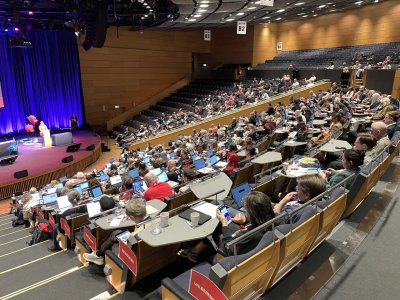
But amidst the almost revolutionary atmosphere, a sort of culling was simultaneously taking place among the 557 diverse and sometimes rambling motions concerning the election platform, statutes, organisation and general policy. This was partly due to the system introduced at the previous congress whereby ten per cent of the delegates—that is, 23 delegates—must support a motion for it to be put to a vote. The background to this is the experience of how previous congresses had turned into endless voting mills with very little time for debate. With the party’s membership having doubled and every individual member having the right to table a motion, a vote on every motion would have exceeded the time available. As a result of the ten per cent rule, the vast majority of motions did not now qualify for a vote. In fact, only a few dozen votes on motions were held.
Rules limiting speaking time have also been introduced. Whereas speaking slots at previous congresses were often monopolised by eloquent (and long-winded) male party leaders, delegates now had to register digitally in order of priority for different blocks of motions. In this way, delegates were given the chance to make a two-minute statement within the agenda’s time limits, and hundreds of voices from across the country were able to make themselves heard. At the same time, however, many registered speakers did not get the chance to speak on issues other than those they had pre-selected.
The majority of all motions failed to reach ten per cent support, even though several people argued in their favour from the podium. These included a wide range of motions, from animal rights, AI taxes and curricula to rules against corporate relocations and closures, the reinstatement of the Employment Protection Act (LAS), and support for socialism and social movements. To name but a few from the vast number. Another example was the many motions against NATO, the DCA (Defence Cooperation Agreement with the USA) and continued military armament. Most did not reach a vote, with a couple of exceptions that were rejected by acclamation. However, a motion on peace work and against the DCA from the Left Party in Gothenburg did reach a vote and was defeated by just seven votes, with 102 in favour of the motion and 109 in favour of the party executive’s motion to reject it.
Other motions that reached the vote and were debated intensely were the one-per-cent aid target and nuclear power. Several speakers criticised the party’s budget motion for not sticking to the one-per-cent target as a tool for international solidarity. The party executive argued that it certainly did so, but that following the Tidö cuts, the level could not be restored immediately. The fact that both the Centre Party and the Green Party had included it in their budget proposals was, according to the executive, because the Centre Party includes aid to Ukraine in its calculations and the Green Party chooses to invest less in welfare. The motion was defeated despite vocal support.
On the issue of nuclear power, many proposers wanted to include opposition to nuclear power in the election platform and to use the term ‘renewable energy’ instead of ‘fossil-free’, which could also be interpreted as referring to nuclear power. The party executive really appealed to the congress not to bring nuclear power into the election campaign. Not on the grounds that it would complicate negotiations with the Social Democrats, but because the parties at Tidö and the media would then focus on nothing else. And the executive got its way against a significant minority.
And so it went with the vast majority of motions put to the vote. Asylum and migration, with more precise wording on permanent residence permits and changing political affiliation; a few climate motions; the legalisation of cannabis; the use of the term “apartheid” in relation to Israel; and others. It should be noted here that, in its rejections or proposals that “the motion is deemed answered”, the party executive rarely distanced itself from the substance or justifications of the motions. It was, the executive committee argued, a matter of the campaign strategy itself, and explained in a copy-and-paste justification that the proposed election platform “presents the party’s overall political direction and focus areas” for this particular election rather than highlighting “specific proposals or individual areas.” But everything in the party programme, previous proposals and parliamentary motions remains in place. The tricky nature of this stance became apparent immediately after the congress when Nooshi Dadgostar, on SVT’s Agenda programme, tried to avoid answering a question about permanent residence permits. General statements about a humane migration policy were not enough.
Although the odd motion slipped through, such as removing the term “employees” and inserting the word “worker” somewhere, it was on issues concerning organisation and statutes that the executive committee was challenged. Several motions and speakers expressed concern that members’ right to table motions would be restricted by a new provision in the constitution stipulating that all individual congress motions must pass through the association or district level. Not to be blocked, but to be subject to collective assessment. The new constitution was adopted by a decent majority despite the criticism.
Another issue concerned lobbying, where many advocated zero tolerance both towards membership for business lobbyists and strict requirements for a cooling-off period for transitions from political office. The executive committee justified the rejection by arguing that the party cannot impose a professional ban and that cooling-off periods should be regulated by legislation. This was accepted by a narrow majority.
On the issue of party tax [for elected representatives], however, the tone changed. [1] Speaker after speaker from across the country railed against reducing party tax by five percentage points. Even now, argued one delegate, elected representatives get to keep just over 37,000 kronor of their salary, nearly twice as much as a nursing assistant. “In practice, increasing elected representatives’ net incomes by several thousand kronor when people are struggling and we are pushing for higher taxes on high earners simply doesn’t work,” argued another.
“Our elected representatives should not live under completely different economic conditions to those we represent,” argued the delegates, and board member Samuel Gonzalez Westling stood little chance of defending the proposal. In particular, the argument that elected representatives work hard became a red rag to members who are already working themselves to the bone both at work and in their free time. “Standing for election is entirely voluntary,” the critics emphasised. And besides, working on left-wing politics as an elected representative enriches one’s life, testified a delegate who had burnt out in a “normal” job.
So the board’s proposal to reduce the party tax lost by thirty votes, with 122 against the reduction and 92 in favour. However, the proposal that the party tax for any ministers and state secretaries should be waived also lost, with 110 against and 100 in favour. All elected representatives must pay the agreed party tax.
Otherwise, the congress proceeded in line with the executive committee’s proposals. One-tenth of the local party associations’ income is still to go to Ung Vänster (something that has been questioned). Gender-segregated preliminary meetings are to remain compulsory. And a motion from the trade union left that the national trade union conference should be held separately and not be lost in Vänsterdagar or other events was passed, against the Executive Committee’s motion to reject it. Furthermore, it was adopted by a narrow majority (104 to 101) that the Left Party should campaign for standard time (i.e. against the division into winter and summer time) and by a large majority (122 to 82) that the party should campaign to repeal the law against insults to public sector staff – legislation which the Left Party itself had contributed to and supported. Many argued that it was a pure class law.
But the key issue for the party leadership – and the congress majority – was to “tie Nooshi to the mast” regarding the demand to be part of a future government and not to “let through” any other government alternative. The opposition and criticism of this ultimatum voiced from various quarters prior to the congress fell almost completely silent. Perhaps because, as a delegate from Gothenburg put it, the party leadership had, long before the congress discussions, gone out and publicly committed itself to this line. Who, then, could vote against it – and was that democratic? At the same time, it is quite striking that the discussions preceding the motions on the government issue from, among others, the party branches in Gothenburg, Malmö, Uppsala and Umeå were not reflected at all at the congress. The question is whether the concerns that existed – and still exist – among many Left Party members regarding the consequences that may result from this hardline stance have been allayed. For example, a snap election offering far-right leader Jimmy Åkesson a new opportunity.
At the same time, the Left Party’s 46th congress expressed an almost deafening confidence and fighting spirit ahead of the upcoming election. Countless international messages of support, from North Macedonia to the USA, from Palestine to the Ukrainian left-wing organisation Sotsialnyi Rukh, who spoke from the platform, not to mention all the video messages from Swedish social movements, trade unions, the Swedish Society for Nature Conservation, PRO, ROKS and many others, conveyed the message: We are part of a broad movement that will challenge the right in Sweden [in the general election] on 13 September – and win.
22 April 2026
Translated by International Viewpoint from Internationalen.