
 Version imprimable
The election result of September 13 has, for the time being, brought the conservative right and the far right to a halt. The opposition parties, the Social Democrats, the Green Party, the Left Party, and the Centre Party, together received 49.5 percent of the vote. The right-wing parties, the Moderate Party, the Liberals, the Christian Democrats, and the far-right Sweden Democrats, received 48.8 percent. The far-right Sweden Democrats, a party with Nazi roots, has increased its support in every election since entering parliament in 2010, finally experienced setbacks as they lost three percentage of support in this election. However, this may partly be explained by the traditional right now more openly pursuing the Sweden Democrats’ policies, but perhaps also because some voters increasingly perceive the party as part of the political establishment. The outgoing Prime Minister, Ulf Kristersson, has formally submitted his resignation but refuses to concede defeat, hoping that Social Democratic leader Magdalena Andersson will fail to form a new government.
Among those who voted against the right and the far right, there is a certain sense of relief. The risk that the right and the far right would remain in power was very real. The election result has prevented this, but the margin was small, around 50,000 votes. The right as a whole lost, but it can hardly be described as a crushing defeat. After four years of what can best be described as Swedish-style Trumpism, the margin of victory over the right should have been considerably larger.
This points to a fundamental problem. The Centre Party is also a bourgeois liberal party but currently chooses to cooperate with the red-green bloc because of its refusal to rely on the support of Sweden Democrats to form government. At the same time, the Centre Party opposes the Left Party joining a new government, whereas the Left Party insists on being part of it. Negotiations on forming a new government are ongoing. If these efforts fail, Sweden could be faced with a snap election.
It is therefore difficult to speak of a landslide victory for the red-green parties. The election also contains a paradox: the Social Democrats remain the country’s largest party while simultaneously achieving their worst election result in more than a century, the worst since 1908. The result is even more remarkable considering that, since coming to power in 2022, the right-wing bloc had lagged behind the red-green parties by a wide margin in opinion polls for long periods. At the beginning of 2026, the election seemed almost certain to be won by the red-green bloc. Yet the Social Democratic leadership managed to squander much of this advantage. Instead of presenting a clear alternative to four years of right-wing policies, the Social Democrats continued to shift to the right and, on some issues, even adopting elements of far-right rhetoric in an attempt to win voters. While seeking agreements and governmental cooperation with the Centre Party, the party simultaneously showed a reluctance to cooperate with the Left Party.
This strategy has had serious consequences. Support for the Social Democrats among workers fell from 42.4 percent in 2022 to 38.7 percent in this year’s election. The political responsibility for this is considerable. Although the far right has lost ground, it continues to challenge the Social Democrats for the position of the largest party among workers.
The problem therefore extends far beyond parliamentary arithmetic. The Social Democrats and the Left Party, the two parties that have historically had their strongest social base within the working class, together managed to secure only slightly more than one-third of the vote. From a class perspective, there is therefore a clear bourgeois majority in parliament.
The major success story on the left belongs to the Left Party. It achieved its best election result in 25 years and made particularly strong gains in several working-class areas of the major cities, especially Stockholm, Gothenburg, and Malmö. This success comes despite an election campaign during which the Left Party was subjected to intense media attacks, particularly accusations of antisemitism and alleged indulgence toward supposed “romanticization of terrorism.”
The Left Party has also adopted a defensive position on the issue of Palestine, as the party leadership’s primary objective has been to gain entry into a Social Democratic-led government. Nevertheless, the need to defend itself against the brutal attacks of the right weighed heavy on people in the most economically and socially segregated and marginalized areas. In these communities, a large majority voted for the Left Party and the Social Democrats. Voter turnout among these groups increased in this election. However, the Left Party’s success does not in itself alter the balance of political power, which in parliament remains highly unfavorable to the left. Over recent decades, Sweden has undergone a clear political shift to the right.The election campaign itself focused partly on voters’ personal finances, at a time when around 500,000 people are unemployed in Sweden, and partly on various forms of agitation against immigrants, people with foreign backgrounds, and especially Muslims. This extensive repressive attack in both public debate and legislation created fear among racialized groups.
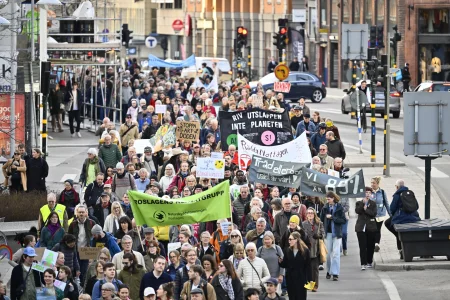
The climate crisis also failed to become a central issue in the election campaign, despite major demonstrations demanding strong climate and environmental action. The same was true of the genocide in Gaza and questions of war and peace. This did not prevent the right from allocating billions to military rearmament, deepening Sweden’s role in NATO, and continuing the military cooperation agreement with the United States, which grants U.S. forces access to 17 Swedish military bases and other military areas.
At the same time as government formation negotiations are ongoing, allegations of electoral fraud have been directed at several Left Party members of parliament of Somali background. This campaign is clearly orchestrated by the right, with substantial support from the media and almost no support from the individuals’ own party, the Left Party. The racism, class prejudice, and hostility toward the left reflected in this campaign and in the unfounded accusations are painfully obvious. Moreover, the allegations concern relatively minor matters, such as people being given rides to polling stations or pre-marked ballots being distributed, and only on a limited scale. Nevertheless, the issue has been magnified by the media into a major controversy and an attack on the Left Party, which has responded defensively rather than offensively.
Regardless of the political composition of the next government, we anti-capitalists remain committed to our position. Until September 13, we argued that the immediate task was to remove the right and the far right from government power. Now the task is to build resistance within the social movements against all right-wing policies, regardless of who implements them. The balance of power is not determined in parliament. It is determined above all in workplaces and trade unions, in the defense of welfare, in the climate movement, through antimilitarism, consistent anti-racism, and the struggle for a humane migration policy. It is through the resistance of social movements that a fighting left can be strengthened.
24 September 2026