
 Version imprimable
The World Cup semi-final between Argentina and England produced an unexpected scene. At the final whistle, several Argentine players unfurled a banner on the pitch that read “Las Malvinas son argentinas (The Falkland Islands are Argentine.)” The gesture was surprising coming from a team that, in recent years, had at best shown apathy towards politics and, in the few public statements made by some of its members, had often been openly right-wing.
This time, however, the players defied an explicit FIFA ban, which had prevented the entry of flags and symbols linked to the Malvinas, a measure supported by the far-right Argentine government itself. Milei, who like any president hoped to benefit from the atmosphere of optimism created by a sporting victory of that magnitude, suddenly found himself uncomfortable with the political turn the celebrations had taken. After the display of the flag, he went so far as to call the players “one-track minded,” in a reaction typical of his excessive nature.
The players knew they could face sanctions, as FIFA indeed began to consider after the match. But they grasped something fundamental: against England, the Malvinas resonated with a popular sentiment that predated the game and extended far beyond football.
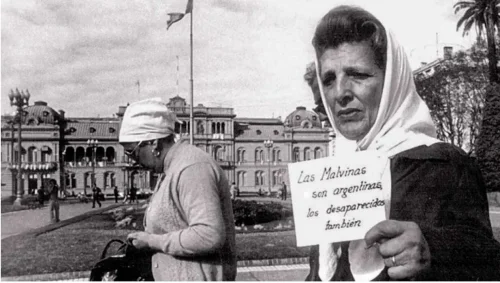
Upon seeing this image, Bhaskar Sunkara, founder of Jacobin in the United States, observed that “The Malvinas are Argentine” had been the slogan of a military dictatorship that murdered thousands of activists and sought to save itself through an irredentist adventure. He argued that there had never been a displaced native population and that, in any case, it was a matter of two equally colonial states disputing a territory. He added that the will of the islanders should be respected and that the left should not get lost in an unnecessarily nationalistic stage of the political struggle.
The Argentine responses were immediate, massive, and often aggressive. Many went beyond questioning their interpretation of the Malvinas/Falklands issue. They denied the existence of a left wing in the United States or Europe that is not, ultimately, an instrument of imperialism. In the relatively moderate version, the American left would be merely an appendage of the Democratic Party; in the most rudimentary, an extension of the CIA. I will return to this reaction later, as it reveals a different, though complementary, problem to Bhaskar’s error. First, it is necessary to establish the basic elements of the Argentine claim.
A colonial issue
Bhaskar’s position stems from a misinterpretation of the Argentine claim. In 1833, the United Kingdom occupied the islands by force, expelled the authorities and the core population of gauchos, Creoles, [2] and workers established under the jurisdiction of Buenos Aires, and instituted a colonial administration that Argentina never recognised. Since 1965, the UN itself has considered this to be an outstanding case of decolonisation and does not recognise the kelpers (islanders) [3] as a people with the right to settle the dispute through self-determination.
The kelpers are not an indigenous population, but a community formed under the occupying power and whose composition was shaped by it. To make the demographic outcome of colonisation the foundation of sovereignty would be tantamount to recognising the completed colonial act as a source of law. The criminal war of 1982 neither created nor nullified Argentina’s claim; it merely allowed the dictatorship to attempt to appropriate a cause that predated it.
Nor are we dealing with a mere cartographic relic. The Malvinas Islands are a British military enclave in the South Atlantic. The Mount Pleasant complex houses air, naval, and land infrastructure and forms part of the overseas military apparatus of one of NATO’s major powers. Its position facilitates British power projection in the South Atlantic and access to Antarctica.
Territorial control also allows for the management of fishing, maritime, and hydrocarbon resources. The Falklands/Malvinas issue thus encompasses territory, military force, resources, and strategic position. It is not merely a dispute inherited from the 19th century, but a still-active colonial relationship.
None of this alone explains the unique place the Malvinas occupy in Argentine political culture. While numerous territorial disputes survive only in diplomatic archives, the Falklands/Malvinas issue has transcended governments, generations, and very diverse political cleavages. It has long since ceased to be merely an occupied territory, becoming instead the focal point of multiple unmet demands, articulated around the aspiration for a still incomplete national sovereignty.
Socialism and the national question
The issue of the Malvinas, therefore, transcends the territorial dispute. It compels us to revisit a question that socialist politics has still insufficiently explored: what meaning does the nation and national demands have today for an emancipatory project?
For much of the 20th century, the nation occupied a central place in Marxist thought. The controversies between Lenin, Rosa Luxemburg, and Austro-Marxism, Gramsci’s elaboration on the national-popular, or anti-colonial theories all stemmed from a shared assumption: the nation constituted a political reality that could not be ignored. This debate, however, gradually faded over the decades.
The nation does not have a political content fixed in advance. Nations do not act or speak. There are always social forces that speak on their behalf, dispute their representation and try to identify their own interests with those of the group. The nation does not constitute a homogeneous subject. It is the terrain on which a struggle to define the general interest is waged.
The Austro-Marxist Otto Bauer defined the nation as a “community of character” historically formed by a “community of destiny.” The emphasis was on material history, not on nature. The nation is not a race, a language, or an immutable essence, but the sediment of a shared experience. Bauer understood the nation as the historical space in which profoundly different groups, united by the material conditions of their common life, forge an intertwined culture and destiny.
In this sense, the nation should not be understood primarily as a cultural identity. It is, above all, the historical form that the aspiration to democratic self-government takes. Globalisation has not altered this fact. Rights, citizenship, political representation, taxation, public goods, and distributive conflicts continue to be organised, in essence, within national communities. The nation is not the ultimate horizon of emancipation, but it remains the primary scale at which societies attempt to govern themselves.
In a similar vein, Gramsci shifted the discussion from national identity to hegemony. The crucial question is not what the nation expresses, as if it possessed a voice of its own, but rather what force manages to construct a collective will capable of presenting itself as national. The term “national-popular” designates the process by which initially particular interests are transformed into a project for organising the entire society. The nation ceases to be a static tradition and becomes a political construct.
That is why it is wrong to hand over patriotism to the right, as Jacopo Custodi has pointed out. Withdrawing from the national sphere allows others to occupy one of the most resilient sentiments of modern societies and define common belonging in ethnic, authoritarian, or exclusionary terms. The risk is even greater in a context of crisis of partisan and ideological identities, when the nation retains a capacity to engage that other forms of belonging have lost.
The Malvinas then take on a different meaning. They do not merely represent the return of some islands. They embody the aspiration of a political community to collective self-determination. Its persistence stems from a historical experience: the widespread perception that fundamental decisions about the country are too often made outside of it. “In” Gramscian terms, this perception contains a kernel of common sense, even if it appears imperfectly formulated. Unpopular decisions are not made solely by external powers, but also by a local ruling class that actively participates in these relations of subordination. But this kernel still offers a point of reference within the realm of common sense for a socialist policy.
Imperialism after Lenin
The importance of the Malvinas/Falklands issue thus points to the unequal relationship between a military and colonial power and a peripheral society. Classical theory on imperialism (Hilferding, Bukharin, Lenin) correctly demonstrated that capitalism does not produce a homogeneous world market, but rather a hierarchy of states with highly unequal economic, political, and military capabilities. But that theory is insufficient today. Concentration and monopolies did not eliminate competition; the export of capital does not in itself imply stagnation in the periphery; capitalism did not enter a phase of definitive exhaustion; and rivalry between powers does not inevitably lead to direct wars, as shown by a postwar period without inter-imperialist conflagrations comparable to those of the first half of the 20th century. Many of these weaknesses led some Marxists (from Hardt and Negri to William I. Robinson) to consider the very category of imperialism outdated. But the limitations of classical theory do not imply that imperialism has disappeared; rather, it must be understood differently. Although this would be a topic for another article, I will limit myself to clarifying a few points.
David Harvey proposed a useful distinction between the logic of capitalist accumulation and the territorial logic of states. The former seeks profits, markets, and resources; the latter, strategic control, security, and geopolitical position. Imperialism can be understood as the always unstable point of intersection between the two. An updated theory must retain Lenin’s insight, but recognise that these logics are not identical and have distinct origins: the territorial expansion of states predates capitalism, while bourgeois accumulation responds to competition for profitability. It must also abandon any notion of the definitive exhaustion of capitalism. Imperialism thus designates the variable interplay between the global expansion of capital and competition within an unequal system of states.
The Malvinas make this connection visible. The British military enclave, its projection over the South Atlantic and Antarctica, respond to a geopolitical logic; the control of fishing, maritime, and hydrocarbon resources, to a logic of accumulation. The occupation persists because both dimensions reinforce each other.
Fake anti-imperialism
The reactions to Bhaskar’s comment highlighted a reverse problem. An old idea within Argentine conservative nationalism holds that in the core countries there is no true left, but only different political variants of imperialism.
The thesis, of course, lacks historical support. Since the 19th century, the working classes of Europe and the United States have built trade unions, socialist parties, communist organisations, and movements against war and colonialism. Some of the largest contemporary campaigns of international solidarity have also emerged from within these societies and against their own governments - from the mobilisations against the invasion of Iraq to the current movement in support of Palestine.
Behind this supposedly anti-imperialist denial, a familiar topic reappears: left and right are foreign categories, incapable of capturing Argentina’s uniqueness. This "exceptionalism" often recycles the anti-communist clichés of right-wing nationalism: Marxism as an imported doctrine and the conviction that all left-wing movements in core countries ultimately end up being a political expression of their own imperialism. The journey is undeniably paradoxical. It begins by denying the existence of a left wing in the United States or Europe and ends by questioning the very distinction between left and right. Those who deny the existence of a genuine left in developed countries end up denying the left itself, even in their own country, and emptying anti-imperialism of its meaning, which requires internationalism and solidarity among the struggles of different peoples. As Alain Touraine ironically observed, when someone claims that left and right no longer exist, they are most likely right-wing.
The political effect is clear. If the nation constitutes a homogeneous unit facing external enemies, an alliance with some faction of the local bourgeoisie or with a right wing that proclaims itself patriotic appears as a natural consequence. Outside, everyone is an imperialist; inside, everyone is a brother. The most simplistic nationalism replaces the class struggle.
It is very common in these debates to invoke the name of José Carlos Mariátegui [4] against Marxism originating from developed countries. His formula "neither imitation nor copy" is often repeated like a mantra to distrust any category produced outside of Latin America. But Mariátegui, an author far more often cited than read, as Martín Bergel insists, was the exact opposite of a thinker confined to Peruvian particularity. He analysed his country in dialogue with the best of Marxism and European culture of his time. His originality did not arise from isolation, but from a cosmopolitan and creative appropriation. “Neither a copy nor an imitation” meant critical translation, not confining oneself to Latin American particularity.
Anti-imperialism and class struggle are not mutually exclusive. Some erase the former and reduce the world to an abstract opposition between capitalists and workers. Others erase the latter and transform the nation into a unified entity devoid of antagonisms. The former fail to distinguish between an imperial power and a subordinate society. The latter erase the class struggle in the name of anti-imperialism and subordinate the popular classes to the local bourgeoisie or a nationalist right wing in the name of national interest.
Sovereignty as a democratic undertaking
The Malvinas matter because, in a peripheral country, they embody deeply rooted aspirations for national and popular sovereignty. That undertaking goes beyond territorial restitution. It includes control of resources, the capacity to resist external pressures, and the possibility of organising collective life without imperial tutelage. These are precisely the dimensions that a far-right government, unconditionally aligned with the United States, jeopardises.
This does not make every national claim progressive. The national question is always a terrain of dispute. It can take militaristic, xenophobic, or authoritarian forms. It can be instrumentalised for reactionary ends, as happened when the dictatorship tried to appropriate the Malvinas banner in 1982. But it can also become the political language of a demand for democratic emancipation.
That is precisely the political significance of the Malvinas in contemporary Argentina. It expresses the deeply rooted perception that the country’s sovereignty remains incomplete. That is why the flag unfurled by the players after the match against England found a much broader consensus than any government or political force. It represented a shared historical experience.
The Malvinas survived the dictatorship because they never truly belonged to it. The Junta attempted to appropriate a cause that predated it, but failed to definitively define its meaning. Reducing the claim to the 1982 military adventure is, paradoxically, tantamount to accepting that the dictatorship was able to transform the Malvinas into the exclusive domain of its reactionary nationalism.
The task of an internationalist left is not to abandon this terrain, but to contest it. It must link national sovereignty with popular sovereignty, anti-imperialism with the class struggle, and democratic patriotism with solidarity among peoples. As long as imperialist relations exist, the national question will remain one of the fundamental forms that the struggle for democracy and socialism takes.
19 July 2026
Translated and annotated by David Fagan for International Viewpoint from Jacobin América Latina.