
 Version imprimable
Trump’s failures
Not only has his popularity declined in his country with the outbreak of war against Iran, in collaboration with his sidekick Netanyahu, but he is also losing the external conflict itself. Right now, the White House is trying to cover up this humiliating defeat. On the economic front, the tariff war it is waging against the entire world has yet to achieve favourable macroeconomic results – in particular the fall in prices and the utopian return of industries that the United States has relocated over the past 35 years. It may not prove to be a winner at all.
On the level, which is fundamental for Trump, of technological competition with China, the situation seems to be at an impasse, despite the large-scale protectionist measures targeting its electronic chips and AI – to which Beijing responds with a conciliatory discourse that does not mask the retaliatory measures put in place “an eye for an eye, a tooth for a tooth”.
Progress in Latin America
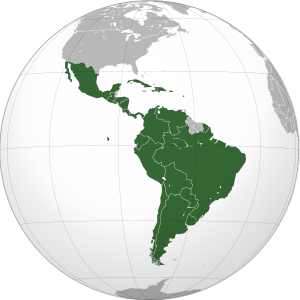
The only region on the planet where Trump, his billionaire friends and the global far right can rejoice in their progress is, without a doubt, that large region of the world that stretches south of Mexico’s Rio Bravo, which the Yankees insist on calling Rio Grande. Latin America is besieged, so far successfully, by the colonialist and authoritarian attacks of the world leader. Hegemonic imperialism is launching a series of offensives, with the aim of building the Shield of the Americas. [1] This situation would not be possible without the more or less enthusiastic support of large sectors of the bourgeois oligarchies in Latin American countries, which are making a visible turn towards neo-fascism.
These far-right governments open their territories to US companies and troops, apply ultra-neoliberal adjustment plans at the service of the most retrograde local bourgeoisies and suppress democratic and social gains. The objective is to eradicate all memory of progressives, of regimes that have put in place, even in a limited way, social policies, respect for human rights and defence of national sovereignty. In June alone, Trump and the far right won three important victories in the region. Or, seen from another angle, the social movements and the left suffered three consecutive defeats, two electoral failures – in Peru and Colombia – and a direct social confrontation lost in Bolivia.
The shadow is spreading
Hegemonic imperialism has already invaded Central America and the Caribbean with an unprecedented military contingent, thanks to which it maintains, together with allies such as Bukele in El Salvador and Mulino in Panama, total domination in the region. It is also trying to suffocate Cuba and advance capitalist restoration—a direction that the latest economic plan announced by the Cuban Communist Party seems to conform to.
Trump’s strategists include, in the Greater Caribbean, Colombia and Venezuela – currently rocked by devastating earthquakes which Rodríguez’s puppet regime is not competent to deal with. [2] Since January, the land of the Bolivarian revolution has become a colonial protectorate and Colombia will soon be ruled by an extremist who came from nowhere, inspired by Bolsonaro and Milei. With the narrow election victory of Keiko Fujimori in Peru, the right and the far right are casting a shadow over South America of governments that will only aggravate overexploitation, corruption, privatization, land transfers, environmental degradation, resource plunder, and intense repression.
Growing polarization
Without minimizing this difficult reality and the setback that these governments represent for the peoples of the region, we must take a closer look at the contradictions. And to answer the question: do these recent victories guarantee imperialism a pacified, stable and submissive “Western hemisphere” (according to the formula of the neo-fascist in power in the White House)? What is happening in Peru and Colombia seems to show that this is not the most likely hypothesis: in these two countries, the left and social movements have created a surprise. In Peru, one would not have imagined, before the election campaign, that a progressive representative from the provinces would make it to the second round. This confrontation ended in a near draw that heralds the continuation of the regime crisis that this Andean country has been going through for decades. In Colombia, in addition to the likely fraud and brazen intervention of imperialism in the electoral campaign – with financial and technological support for the wave of disinformation – everything has been facilitated by a privatized political system. But never has a left-wing pole been so united behind the same candidacy and obtained such a high score, which suggests difficult consequences for the government of La Espriella.
In Bolivia, the result is more difficult: we witnessed the defeat of a peasant, indigenous and worker-popular uprising, led for the first time in decades by (divided) forces different from the former Movement Towards Socialism (MAS). It is too early to draw definitive conclusions, but this fragmentation – engendered by the self-destruction of the leaders of the former party-movement – and the immeasurable difficulty of overthrowing an elected government in a very unfavourable regional context, will force the protagonists of the uprising to ask themselves whether it would not have been more prudent to back down in an organized way, after the movement had achieved the precious victory of having blocked the neoliberal decrees on the price and land ownership.
The Brazilian battle
The next big battle has already begun in Brazil. The latter, Mexico and Uruguay are currently the three Latin American countries whose governments are, in one way or another, on the left. It is crucial for the global far right, and for Trump in particular, to defeat Lula in the October elections.
There is no doubt that Trump and the tech giants will replicate in Brazil the disinformation war they waged in Colombia. The leader of Yankee imperialism has already declared his support – with photos and publications to back it up – for Flávio Bolsonaro, the eldest son of the former putschist president, who is the only viable candidate on the right. But there is more: the United States is trying to interfere directly in the vote of Brazilians. This is the case on the issue of public safety, with Trump having labelled two Brazil-based criminal organizations as “terrorist organizations” and having stepped up, under U.S. trade law, the tariff war against the country’s products.
Direct U.S. interference in Brazil’s affairs is frowned upon in the country, even among some sectors of Bolsonaro’s son’s electorate. But the weaknesses and limitations of the PT governments, and of Lula in particular, will have a cost in the electoral campaign. In particular, it supported President Rodrigo Paz at the height of the Bolivian popular revolt and is procrastinating instead of quickly and ruthlessly getting rid of its members who are involved in financial scandals.
None of this, however, should prevent the entire left, progressives and democratic sectors in Latin America and around the world from supporting Lula’s candidacy. For a new mandate, against the return of green-yellow and international neo-fascism. Just as the Cuban government’s steps towards capitalist restoration do not prevent us from being unconditionally at Cuba’s side in its struggle for sovereignty against the giant of the north.
Unity against imperialism and the far right
In Latin America, more than in any other corner of the world at the moment, the question of national sovereignty in the face of imperialism is a central axis of the program of resistance to neofascism. From the historic Colombian Pact, now legalized and with the support of half the country, to the broad left-wing coalitions in Peru, Argentina, Chile, Mexico, to the resistance fighters of heroic Venezuela and Central America, we need unity and mutual support in this new period of struggle that is opening up against the far-right governments (or any other government under Trump’s thumb) already in power, while hoping for an electoral reverse for Trump in the US midterm elections in November.
2 July 2026