
 Version imprimable
What is the situation following the movement against Bolsonaro?
The protests were massive; Bolsonaro was convicted and is in prison, but we remain in a highly polarized political situation. Just as elsewhere in the world, where Trump advances his agenda by relying on a global far-right movement, here in Brazil, the far right remains strong and polarizes the debate. On the one hand, Lula’s government represents a bulwark against this advance of the far right, but on the other, it faces numerous difficulties because it has not implemented enough policies favorable to the working class, which also generates discontent. The political situation is therefore very delicate, hence the need for us to demonstrate unity against the far right.
How do you see the role of the working class in this movement?
Despite a significant lack of movement from traditional unions, the working class continues to respond to specific agendas, such as the reduction of working hours. This is a factor that has concretely helped energize the labor movement. The goal is to reduce working hours in the country to put an end to the six-day workweek with one day off. But I would also say that other sectors have been at the forefront of the mobilizations lately, such as the indigenous movement, which has embodied a fundamental struggle against the privatization of the Amazon’s rivers.
This is an environmental issue that affects a very influential sector in Brazil, namely agribusiness. Thus, when we wage a concrete struggle like this one, we are also discussing a model of the country—the model applied by the agribusiness sector, by the bourgeoisie… I therefore believe that this helps to raise consciousness in general and to fight against the far right.
How does the population perceive the international situation and imperialist attacks in the region? Do they make the connection with the domestic situation?
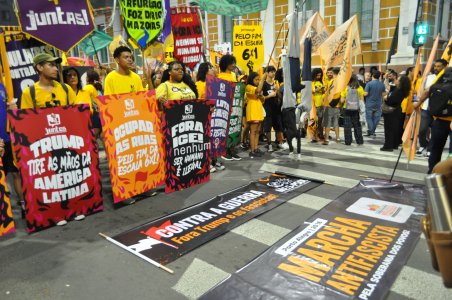
The U.S. offensive against Latin America is reigniting calls for national sovereignty. It also opens up a space for us to discuss the role that imperialism plays in the world today, and the rise of the far right. It also helps foster a political debate with society as a whole, which generally recognizes that there is an imperialist advance by the United States across all of Latin America and the world. This therefore allows us to broaden this dialogue and bring back to the forefront issues that were once very important , such as the struggle against the FTAA (Free Trade Area of the Americas). These are issues that, a few decades ago, mobilized many people, and for which we now have a space once again. Today, polls show that 70% of the population is against the war waged by the United States against Iran. The defense of Palestine against the Israeli genocide also has significant support, with the important impact of the Global Sumud Flotilla, where Brazilian militants, including those from MES, accompanied the latest mission. The imperialist issue in Brazil is also strongly linked to the environmental question, the defense of the Amazon against the exploitation of our forests and other natural resources, such as the current discussion regarding rare earths We can advance an anti-imperialist orientation within this context.
Can you tell us about the debates within the PSOL and its leadership?
The PSOL was founded over 20 years ago as a party created to serve as a counterweight to the PT, at a time when the PT was adapting to the institutions, abandoning its anti-capitalist project, and adjusting to govern. The PSOL was thus founded to revive a left-wing program and defend the demands of the working class. In this context, in recent years, many sectors have joined the PSOL, including Guilherme Boulos, a leader and longtime activist in the homeless movement. Recently, he has initiated a significant political rapprochement with the PT. He became Minister-Secretary General of the government, despite a party resolution stating that PSOL would not participate in the Government.
According to our analysis, he has not played a positive role in relation to social struggles and movements. And it is Boulos and his group who have pursued a policy aimed at building a federation between the PSOL and the PT. This federation would be an instrument obliging the federated parties to act in concert for four years during elections and in parliament. Thus, in practice, the PSOL, the PT, and the other parties comprising the federation with the PT would function as a single party under the leadership of the PT, which would be the largest party in this federation. This would therefore mean a loss of independence for the PSOL and the loss of the role it plays today, namely that of adopting an independent critical stance to the left of the government.
He submitted this issue for discussion and a vote within the party, but his faction lost the vote by a large majority: 75% of the party opposed this federation with the PT.
After that, he launched an initiative to leave the PSOL and bring other prominent figures with him to the PT. He eventually backed down, but his group stated that he still intended to leave the party and join the PT after the elections. I believe a shift is currently underway within the party, as it has become clearer to those sectors that were counting on Boulos as the party’s leader that he does not align with the interests and policies that—in my view—the PSOL stands for. I therefore believe that a new phase is about to begin to reaffirm the importance of the PSOL’s independence and the role the PSOL has played during this period as a left-wing alternative.
How do you see the possibility of revitalizing the PSOL and the left through social movements, and what is the role of the conference in building a unified and radical perspective?
I think the conference played a very important role, because today we have an objective need to build a front to block the path of the far right and fascism. We are going to go through an extremely polarized electoral process, in a context of significant influence from artificial intelligence and big tech, with Trump openly supporting the Bolsonaro family. We need not only an electoral and party alliance, but also one rooted in the grassroots and social movements. We believe that PSOL is fundamental to this process—combining the re-election of our combative legislators with increasing our seats in Congress and state assemblies, while simultaneously driving social struggles forward. This conference fulfilled its role in broadening this resistance, both nationally and internationally, through the unity of the parties and movements present. It brought together over 100 convening organizations and 4,000 registrants from nearly 40 countries across every continent, and the Fourth International and also CADTM played a leading role and were fundamental in making it happen. The diversity this conference demonstrated in this regard undoubtedly takes us to a new level in confronting the far right.
30 March 2026