
 Version imprimable
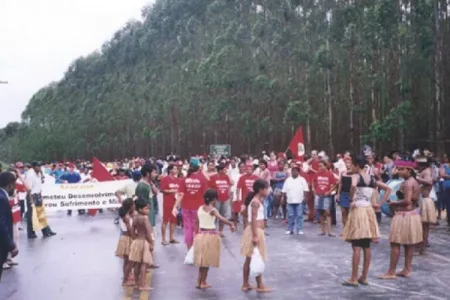
The women destroyed Aracruz Celulose’s eucalyptus saplings under the slogan “No to the Green Desert”, in protest against the vast monoculture plantations of eucalyptus. This multinational corporation has impacted numerous indigenous territories and traditional communities, depleting water supplies in many communities through the exploitation of nature’s common goods, all to ensure profit and more profit.
This was a radical direct action which, as well as combating the direct enemies of capital—the billionaires and the large corporations and multinationals in the agro, hydro and mining sectors—was fundamental in enabling women to advance feminism within their political organisations, bringing more women into the struggle and broadening participation. We can say that it awakened, in more women, a sense of belonging to the struggle within the framework of a collective victory, achieved through women’s leadership.
The power of women’s struggle is now viewed from a different perspective, within their own organisations, securing a vast space for feminism within the political programme, centred on the construction of socialism and popular agrarian reform. The struggle for the construction of popular agrarian reform has taken on an anti-patriarchal, anti-racist and agroecological character.
The radical nature of the popular feminist struggle, which we address here, highlights the contradiction of the capitalist system in the conflict between ‘capital and life’. Bodies, territories and beings that are disposable and expendable will be destroyed to ensure greater profit accumulation for the owners of capital
For this reason, popular feminism affirms feminist economics in its struggle against patriarchy, racism and capitalism, as it presents an alternative through the sustainability of life, highlighting our eco-dependence and the urgency of not allowing imperialism to collapse socio-environmental systems and extinguish all forms of life on Earth.
A sustainability of life that guarantees the socialisation of domestic work, of the care of life and nature, of productive and reproductive labour with the State and men; that combats machismo and misogyny; that demands an end to wars and the demilitarisation of territories. An alternative capable of putting an end to femicide and all forms of violence against women and the exploited and oppressed peoples of the world.
What can we learn from the radicalism of the Popular Feminist Struggle 20 years on from this milestone?
Amidst a backdrop of intense global wars and conflicts, we have continued the struggles in 2026, facing many challenges and an urgent need to halt the rise of the far right and fascism worldwide.
Women in the feminist movement continue to champion radicalism, defending the self-determination of peoples and sovereignty over their territories, and advancing ever further in the unity of our struggles. This unity in Brazil took shape with the National Manifesto, which called, in a united manner, our occupation of the streets and lands on 8 March 2026, International Women’s Day, without relinquishing any of our central demands, including the struggle against femicide and for the decriminalisation and legalisation of abortion, as well as internationalist solidarity with Cuba, Venezuela and Palestine, which have been brutally attacked by Donald Trump and Netanyahu.
Another international call to action that brought together hundreds of organisations worldwide, highlighting the internationalist nature of feminist struggles, was the call by the Fourth International, under the slogan: “8 March: Long Live Women in Struggle Against the Far Right”.
A recent example of this unity is the leading role played by women in the struggle against the Lula government’s decree authorising Cargill, a multinational agribusiness corporation, to appropriate and privatise three Amazonian rivers, including the Tapajós. This was a successful struggle in which the radicalism of indigenous women in defence of their territories played a major role, forcing the Brazilian government to revoke the presidential decree that permitted the construction of waterways for the transport of ore and soya for export.
The Indigenous Women’s Movement of the Middle Xingu (MMIMX) is also currently fighting against the Canadian company Belo Sun and its mining project planned for the Volta Grande of the Xingu River, which poses a direct threat to the territories, waters and way of life of the communities. The movement demands the revocation of the project’s environmental licence and calls for the guarantee of the right to free, prior and informed consultation, as enshrined in Convention 169 of the International Labour Organisation (ILO).
We can highlight the occupation of mining companies’ railway tracks by over a thousand (1,000) women from the Via Campesina and the MST during their March campaign in the south-east region, in a direct challenge to one of the world’s biggest environmental problems: the crimes of predatory mining. They brought Samarco’s trains to a standstill under the slogan: “No amnesty for mining crimes”.
Also in March, women from the Olga Benário Movement carried out more than 15 occupations of “abandoned” properties with no social function across several Brazilian states, transforming them into Reference Houses, offering shelter to women victims of violence and promoting political education.
March draws to a close and April arrives, bringing with it the Terra Livre camp (organised by the indigenous movement), with indigenous women taking the lead in affirming ecofeminism and demanding immediate land demarcation, amongst many other struggles. The Anacé indigenous people, who live in a territory located in the Brazilian state of Ceará, are organising a strong campaign and daily struggles against the construction of the TikTok Data Centre, which threatens access to water in the Caucaia region. Struggles against the spraying of pesticides and against the predatory production of renewable energy are sweeping across the entire Northeast, led by Black, Indigenous and Quilombola women from the countryside, the city, the waters and the forests.
We will mark Red April with the Landless Rural Workers’ Movement (peasant movement), demanding justice for the Eldorado Carajás massacre, which marks 30 years of impunity. We will continue with popular feminism present as the sickle, the hoe, the pencil and all the tools necessary to ensure the defence of our territories.
1 April 2026
The Mudas have broken the silence (Rompenda el silencio, 2015).
https://www.youtube.com/watch?v=VNpAm_SMxxg&t=209s
There was a deathly silence surrounding the 18,000 hectares stolen from the Tupi-Guarani peoples.
Regarding the 10,000 quilombola families expelled from their territories.
Over millions of litres of herbicides poured onto the plantations.
There was a shameful silence over the chlorine used in paper bleaching, producing carcinogenic toxins that harm plants, animals and people.
Over the disappearance of more than 400 species of birds and 40 of mammals in northern Espírito Santo.
There was an insurmountable silence regarding the nature of a plant that consumes 30 litres of water a day, yet produces neither flowers nor seeds.
Regarding a plantation that generated billions upon billions for just a handful of gentlemen.
There were thick silences over thousands of hectares accumulated in ES, MG, BA and RS
There was a complicit silence regarding the destruction of the Atlantic Forest and the pampas by the monoculture of a single tree, the eucalyptus.
There was a paid silence regarding the lust for profit.
Yes, there was a global silence surrounding Swedish capital, Norwegian companies, and the major national banks.
Finally, there was an immense green desert in harmony with the silence.
Suddenly, thousands of women came together and destroyed the saplings, the oppression and the lies.The saplings suddenly screamed, and no sooner than that, the bourgeoisie’s laughter turned to scandal, became a grimace of bewilderment.
The establishment rose up in disbelief, clamoring for progress and science, cursing in vulgar terms, obscenities and slang.
Newspapers, radio, magazines, the internet, TV, advertising firms, smooth-talking executives, grovelling advisors, self-righteous experts, wavering governments, the vociferous right wing and all the usual extremists joined in unison, echoing, forming committees and issuing statements: “I defend Capital”.
They cannot break the Silence and have called for bloodshed.
Suddenly, and quite unexpectedly, thousands of women shattered the silence, on that day on the so-called lands of Aracruz.
They were our gesture.
They were our voice!