
 Version imprimable
In recent days we have been subjected to a series of attacks, accusations, attempts at delegitimization, and threats of violence against us and our events that we cannot ignore. In some cases, these have led to previously granted availability to host the initiatives we announced being called into question.
These are not simple political disagreements, but a campaign aimed at undermining the work we are carrying out, isolating those who build concrete solidarity, and discrediting anarchist comrades who are today participating in the Ukrainian resistance.
These attacks do not affect only us. They also target the self-determination of a collective process that brings together different subjectivities, anarchist and non-anarchist alike, united by the will to support those resisting a real act of aggression. Claiming the authority to decide from the outside what is “legitimate” to do, which practices are acceptable and which are not, means arrogating a power we reject.
This is also why we are speaking out: so that those who read us clearly understand the context, and because we do not intend to leave space for distorted narratives or self-serving reconstructions.
There is something profoundly indecent in the writings of those who, while a people is being bombed, occupied, and deported, find the time and tone to pontificate against those who resist. It is not only a political mistake: it is a moral inversion.
To turn concrete solidarity into “complicity with militarism” means having completely lost contact with the material reality of war.
Those who write about the “normalization of militarism” do so from a position of safety, far from the front line, far from the rubble, far from the brutal choice that millions of people have faced: to submit or to resist. Speaking of “refusal of conflict” as a general line, while an invading army advances, is not radical: it is an elegant way of telling others to surrender.
The Ukrainian resistance exists, and it is made up of real people, not abstract categories. Among them are also anarchists who have chosen not to flee, not to submit, not to hand over their cities to an authoritarian and imperial power. Dismissing them as “enlisted” means denying their autonomy and reducing them to extras within an ideologically constructed narrative.
The equivalence between aggressor and aggressed is the most convenient of positions: it allows one not to choose, not to take a stand, not to risk anything. But it is also the most hypocritical. Not all violence is the same, not all wars are symmetrical, and pretending otherwise means obscuring the responsibility of those who invade.
To say that materially supporting the resistance strengthens the “war machine” is a sophism that ignores a basic fact: without means, those who resist are crushed. There is no form of “pure” resistance capable of opposing an army without tools. Demanding it is pure abstract moralism, useful only to those who do not bear the consequences of their words.
The obsessive call for desertion, detached from any concrete analysis, sounds like an escape from reality. Desertion can be a political act in certain contexts; in others, it means leaving the field open to oppression. Turning it into a universal solution is a theoretical shortcut that completely ignores real power relations.
Those who speak of “two barracks of the same prison” construct an imaginary world in which differences disappear and everything is equivalent. But in the real world there are those who invade and those who are invaded, those who bomb and those who defend themselves, those who impose and those who resist. Refusing to see these differences is not clarity: it is political blindness.
The anarchists participating in the Ukrainian resistance have not ceased to be anarchists. They are operating within a real contradiction, trying to defend spaces of existence against an immediate threat. This is not a surrender to the state, but a difficult choice within extreme conditions. Criticizing it from the outside, without taking any risk, is easy—much easier than living it.
So-called antimilitarist “purity,” when it becomes a refusal of any concrete solidarity, turns into its opposite: a sterile position that changes nothing and helps no one. Worse still, it ends up objectively aligning with those who hold more power, because it leaves the weakest without means.
Solidarity is not a slogan. It is a material stance. It means choosing a side when no perfect options exist. And today, choosing means standing with those who resist, with those who do not surrender, with those who try to defend their lives and their freedom even within a terrible context.
Everything else is rhetoric. And rhetoric, when it covers the abandonment of the oppressed, ceases to be harmless. It becomes complicity.
26 March 2026
Source: Anti-authoritarian space.
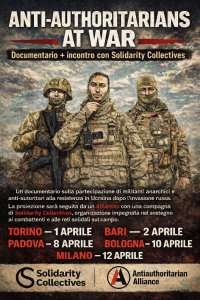
Documentary: Anti-authoritarian fighters in Ukraine
Documentary film, 1 hr 10 mins, produced by l’Anticapitaliste
In contrast to abstract geopolitical narratives, this documentary gives a voice to Ukrainian anti-authoritarian left-wing activists facing the harsh reality of war. Through their journeys and choices, it explores commitment, international solidarity and the ability of peoples to resist the imperialist invasion on their own.
Interview with Manon Boltansky and Nico Dix.
What is this film about?
This documentary focuses on the Ukrainian resistance. More specifically, it gives a voice to anti-authoritarian left-wing activists (anarchists, libertarians) who, at various stages of the war, chose either to enlist directly in the Ukrainian army or to actively support left-wing activists on the front line. It is a film that explores commitment: the way in which a concrete, extreme situation tests, transforms or strengthens a militant commitment to an emancipated society.
Where did this project come from?
We have been involved in practical solidarity with Ukraine since the start of the large-scale invasion. We travelled there to meet people we had previously known only through online exchanges.
The idea to film arose from the realisation that here, very little is said about Ukraine and that, when it is discussed, it is essentially leaders and geopolitics that dominate the media landscape — Macron, Putin, Trump, Biden, NATO — at the expense of the people and their concrete forms of resistance.
It is essential to hear what the Ukrainian left has to say
We also wanted to address those on the left who deny Ukrainians any agency, sometimes going so far as to refuse dialogue with the Ukrainian left. It is essential to hear what this left has to say; we even have a great deal to learn from our comrades.
How was the film made, and by whom?
This is a deliberately ‘guerrilla’ documentary. We set off with our phones, without a predefined shooting plan or a precise itinerary. The film took shape through the encounters and contacts we made on the ground.
We always began with long discussions before filming, in order to build a relationship of trust, to better frame the interviews and to adopt an activist rather than a journalistic perspective.
We filmed what we could, as best we could, without preconceived ideas, which made the editing process complex. As the amount of footage gathered was substantial, the project will ultimately take the form of a trilogy. This film constitutes the first part; the next two will focus respectively on civil self-organisation to aid displaced populations or those living near the front line, and on political and trade union activists committed to fighting both social breakdown and the Russian invasion.
Who are the people featured in the film?
We meet Sergey, an anarchist activist, co-founder and coordinator of Solidarity Collectives, responsible in particular for logistics and communications. Mobilised a few months ago, he is now serving in the army.
There is also Ilya, a revolutionary socialist activist, who volunteered from the very first days of the invasion as a combat medic in the infantry, and is supported by Solidarity Collectives.
Finally, there is Yuri, an anti-fascist activist from the hardcore punk scene in Kharkiv, who has been active since 2019. After sustaining two serious injuries during assaults, he now serves in the artillery.
Are there any particularly memorable anecdotes from the shoot?
One image left a deep impression on us: as we set off towards Izium, in the east of the country, we saw almost nothing but military vehicles travelling in one direction and hearses in the other.
During a visit to a shelter for displaced people, we met elderly women who had lost everything but were determined to feed us, to share the little they had.
Finally, witnessing the bombing of Kyiv first-hand was a brutal reminder of the daily reality endured by the local population.
Sometimes, in life, you have to make real and precise choices
Were there any scenes that particularly struck you?
The walk through Izium with Ilya, who doesn’t mince his words and explains to us that we don’t really know Ukraine, and so we cannot fully understand what is happening there.
One quote sums up the film’s message particularly well: Ilya explains his commitment by saying that “sometimes, in life, you have to make real and precise choices”. It is, he says, a choice of survival. This statement is essential, for there is a fundamental difference between engaging in theoretical reasoning from France and actually living through an invasion, with its accompanying violence, looting and massacres.
Here, war is thought of in abstract terms; there, it is lived through. We have no lessons to give.
What role can this film play in the current climate?
In a context marked by ‘campism’, we believe it is essential to make the direct voices of Ukrainian left-wing activists accessible. The bourgeoisie, governments and ‘campist’ currents often share the same denial of the existence of peoples and their capacity for action.
We hope this film will help shift the stance of part of the left on the issue of supporting the Ukrainian resistance, and that it will encourage some to engage in concrete forms of solidarity, notably through fundraising for comrades on the ground.
The reactions reveal the glaring absence of Ukrainian voices in activist and media circles
What feedback have you received from people who have seen the film?
Viewers often come out deeply shaken. This highlights the glaring absence of the Ukrainian voice in activist and media circles. Several people have spoken of a realisation of the human dimension of war and the way it crushes lives.
The film has inspired some to take action in solidarity with the Ukrainian people.
How is the film being distributed? How can a screening be organised?
At present, distribution is mainly taking place outside France. The film is being made available to Solidarity Collectives networks and European anarchist circles. Screenings combined with fundraising events have already taken place in Finland, the Netherlands, Poland, Germany and Ukraine.
The film is available to all activist collectives wishing to organise a screening. It has been shown in Denmark, Portugal, Sweden, Spain, Canada as well as Italy.
The film is available to all activist collectives wishing to organise a screening, on the sole condition that a fundraiser in support of Solidarity Collectives is organised.
Contact us if you would like to help distribute it!
15 January 2026
Translated by International Viewpoint from l’Anticapitaliste.