
 Version imprimable
More than 100 women gathered at the city hall, marching to the civic center’s Opera House and back. As I was the oldest woman in the crowd, the young women were eager to take my arm as if I were their own grandmother.
The speakers focused on sexual harassment in the workplace and at the university, a very lively topic since a university student had recently accused her professor of inappropriate behavior. The speakers discussed how several male professors attempted to play down the consequence, as if it were a joke to laugh off.
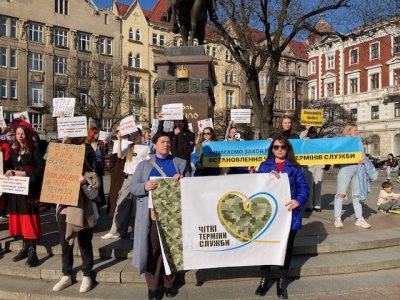
Shortly afterwards there was a second demonstration. The majority were a slightly older group of women, several of whom came with their children. They hold a monthly march, not only in Lviv but in other cities across Ukraine, calling on the government to set a fixed term for military duty.
Unlimited military service not only places severe hardship for their fathers, brothers, husbands and sons who are serving, but also inhibits others from joining. As these women marched throughout the central district, stopping at several sites to make short speeches, men passing us by thanked us.
Discussing U.S. Feminism
Lviv was the third and final stop of my week in Ukraine. The day before the IWD demonstration I gave a talk to the Direct Action club at the university on U.S. feminism. I spoke about the struggle for reproductive justice.
While the U.S. Supreme Court’s 1973 Roe v. Wade decision had established the right of women to early abortion, that right had never been secure. After 49 years, the Court overturned its decision, leaving it to state law.
Along with struggles over abortion were other related issues the movement had taken up including access to birth control and a sterilization policy that included forcibly sterilizing women of color, disabled people, those receiving welfare or those suffering from mental illness.
Because women are treated differently depending on their class or social status, it was necessary to develop the concept that in order to protect all we must find a way to protect the most vulnerable.
In the case of abortion, our demand is for access so women can make their decision and implement it quickly. In the case of sterilization, we called for a 30-day period so that the woman can decide whether to have the operation. That prevents doctors from demanding to sterilize a woman at the time she is delivering — or even performing the sterilization at childbirth without her knowledge.
In Michigan, where I live, once Roe v. Wade was overturned the previous law, from 1856, came into effect. It punished any health care provider who performed an abortion. While a challenge to that law prevented it from immediate implementation, a coalition organized a referendum to establish reproductive rights for pregnant people in the Michigan state constitution.
That referendum included access to information and the procedures necessary. This ranged from birth control information to abortion as well as fertility treatments, and outlawed forced sterilizations. Since we won the referendum by a wide margin the Michigan legislature has repealed not only the 1856 law but 11 of the 12 laws the right wing had passed over the years.
Unfortunately, the one remaining law is about “parental consent.” Those under 18 who become pregnant must obtain one of their parents’ approval. The reality is that most pregnant teenagers do discuss their decision with a parent, but those who don’t usually have a compelling reason not to do so.
This discussion on the range of reproductive issues revealed some interesting debates within the U.S. feminist movement. These may not be the same as movements in other countries but the principle of defending the most vulnerable as the best way to defend the entire group is a key acquisition.
My Trip to Ukraine
Since I was in Europe for a conference, I decided I might be able to visit Ukraine. I’d gone to demonstrations in Detroit when the Russian invasion occurred in February 2022 and joined the Ukraine Solidarity network.
This enabled me to reach out to activists in the Ukrainian organization Sotsialnyi Rukh (Social Movement). They invited me to meet some of their members and arranged for me to speak to a student organization, Direct Action. I traveled from Warsaw by train, first to Kyiv, then to south to Kryvyi Rih, finally to Lviv and then back to Warsaw.
I was impressed by the efficiency and inexpensive trains, the way most Ukrainians travel. Especially during the war, trains play a critical role in transporting people and goods. Trains near the front lines have been outfitted with hospital cars to help the injured and bring them to safety.
In each city I was able to meet with a union organizer. Even before Ukraine won its independence in 1991, independent unions began to form, particularly in mining. Over the years the struggle has been to build them in the face of capitalist development and massive corruption.
Given the war and emergency rules that have outlawed strikes, I asked how workers were able to make demands on the companies or state enterprises. One organizer, who represented train workers, said it was important for the manager/boss/owner to understand workers still had power: power to slow down, power to fail to produce.
In some cases, the threat produced results; in others, follow-up action such as a slowdown proved necessary. Even if workers do not win, they are not powerless.
The capital, Kyiv, where I started my trip is a glorious and stunning city overlooking the Dnipro River. I stayed in an apartment that was next to the complex of Saint Sophia’s Cathedral, whose foundations were first laid in 1037. (It was partially damaged by Russian airstrikes in June 2025.)
The neighborhood is filled with old apartment buildings and stores. My translator was kind enough to give me the opportunity to explore it and tell me stories of how neighbors were able to save some areas from being taken over by wealthy homeowners who wanted to expand.
As we were on our tour, I noticed that almost every single person was walking a dog. I remarked the city must be full of dog lovers only to discover that because of the Russian attacks, people found caring for a pet emotionally supportive.
Dialoguing with Kyiv University Students
In Kyiv I had an interview with university students who asked me how I became a political person. I explained that the two events that had been central were the civil rights struggle and Washington’s war on Vietnam. I had gotten involved in the section of the antiwar movement that called for “Bring the troops home now.”
They asked, “what might be the lessons for us?” They were particularly thinking about the war Ukraine is currently fighting against the Russian invasion. I had no parallel I could draw between my experience and theirs! The similarity would be between a Russian citizen and myself — but although I’d been arrested several times for antiwar protests, that‘s hardly comparable to the brutal repression in Putin’s Russia today.
But in both the U.S. civil rights and antiwar movements, we started as a minority. Segregation was a norm, applied differently North and South but a fact of life in America. And when men became 18, they had to register with the draft board.
Few questioned the government laws. Yet we have been able to change people’s understanding of what equality and justice we should demand from our society. That is, a minority can become the majority.
That was a powerful lesson I was fortunate enough to learn in my early 20s, and it has sustained me. Perhaps a second lesson is that life isn’t one step forward after another, or what folks call “progress.”
For those of us living in the United States, we learn that following the Civil War and an end to slavery, the passage of three constitutional amendments and an army backing the Black communities’ initiatives led to a period historians call Radical Reconstruction. Those steps forward were stopped when Congress withdrew federal troops and allowed states to implement Jim Crow laws.
Hitler’s officers in Nazi Germany studied and adapted those laws. And today the Trump administration Is attempting a similar counterrevolution. It’s up to us to resist that rollback.
I know I appreciated the discussion and how it clarified what we must do in our different situations. I also got to appreciate some of the work the Direct Action students were carrying out.
A student from Crimea told me that when she was eight years old, Putin’s troops invaded. She had always thought that she needed to leave; when she finished high school, she decided that was the moment. However, when she arrived at the airport in Moldova, officials would not allow her to board a plane to Kyiv. She refused to return home, sitting in the airport for several days.
She contacted Direct Action, which successfully raised the demand that she be allowed to proceed to Kyiv. Now she is studying at the university and proudly showed me her Ukrainian passport.
Traveling South
The furthest south and closest to the fighting I traveled was to Kryvyi Rih (“Crooked Horn”). Situated where two rivers come together, the river curves around part of the highly industrialized city.
We arrived in Kryvyi Rih before 6AM but given the nightly curfew, we had to wait for our host to arrive. Dotting open fields were several iron ore mining shafts, some of which are abandoned. The city also has two huge steel factories. When my guide took me to one, he explained that production was down to about 10-25%. All the workers were women.
Since the Russian invasion the city has become a regular target. The night I spent there a missile attack destroyed the last of the city’s hotels. We went to visit the site the next morning and saw how the strike sliced off the top floor. Four people had been killed and 32 injured. By the time we arrived, the injured and dead had been taken away although a team was still checking to see if anyone was buried under the rubble.
I asked why the Russians target hotels; people thought that perhaps they assumed troops might be stationed there; in fact, a group of humanitarian volunteers from the United States and Britain had just checked in.
At a nearby restaurant, our server told us she had been in the area the night before but had boarded a bus minutes before the hotel had been hit. She realized that this time luck had been on her side.
In the early evening, I talked with a group of workers in the mining industry. They were particularly interested in how I’d carried out a campaign to defeat a two-tier autoworkers’ union contract. They were especially interested in how the workforce understood the need to protect those not yet hired from lower wages and inferior benefits.
I also talked with a group of pre-teenagers who were eager to ask questions. I found that several had fled to Poland at the start of the invasion only to return home. Of course, all were surviving frequent missile and drone attacks. Just before Christmas, Russia launched 86 drones. While most where shot down, it caused fires in parts of the city.
All over the world children are facing daily attacks. Even if they survive physically, what trauma are they suffering from? How many have lost family members and friends especially in Ukraine, Gaza or Sudan. How have we diminished their lives?
A Year Later
At the end of February, it will be a year since I was in Ukraine. I arrived just after Trump and Vance had insulted Zelensky and thrown him out of the White House. On the train to Kyiv Ukrainians asked me what I thought would happen.
I was most afraid of Washington cutting Ukraine off from U.S. intelligence, which has been crucial in finding where the missiles, drones and military are. I hadn’t quite understood the roller coaster ride that has been forced on Zelensky.
What struck me then was the determination of those I talked with that they needed to continue to fight against Putin’s army. They know the suffering that brings both soldiers and civilians. They recognize that Putin wants their land and their enforced loyalty under pain of death. Their resignation to go it alone if necessary is based on that reality.
Even those in Lviv, a relatively privileged area of Ukraine far from the fighting, have suffered. I stayed with a young couple who came from a city in the east that was destroyed and then occupied by the Russian military. Not only were they forced to flee, but since they were from a Russian-speaking area, they had to learn to speak Ukrainian, find jobs and a new home. Lviv is full of people like them.
What strikes me now is the intensity of the attacks on Ukraine’s infrastructure. In the middle of a harsh winter, there is little heat and electricity. Schools are forced to operate in basements. Those who can leave Kyiv are urged by the government to do so, those who stay spend most of their time finding places to charge their phones and keep from freezing.
The destruction of a people and their culture takes many forms. This includes the seesaw of Trump’s demands while he revokes the right of Ukrainian families to seek asylum. Although considered “white,” and highly educated, Ukrainians have little value to Trump and his administration.
They are “losers” from Trump’s vantage point. From my perspective, the Ukrainian people have a lot to teach us about resilience. We owe them our solidarity.
Source: March-April 2026, ATC 241.