
 Version imprimable
According to data from the Climate Prediction Center (CPC), part of the U.S. National Oceanic and Atmospheric Administration (NOAA), there is an 81% probability that El Niño will fall into the “very strong” category. In other words, scientifically speaking, the conditions are in place for one of the century’s largest climate events, with significant repercussions for Brazil.
It seems strange that, in a scenario where the pre-election debate already dominates the agenda, little or nothing is being discussed regarding how to respond to this situation.
We are facing extremely serious climate events around the globe. A more serious debate is needed on the centrality of the environmental agenda in general—and within the left—regarding an ecosocialist solution in light of the upcoming programmatic and electoral debates.
Warnings and an Emergency Brake
The front page of Folha de São Paulo on Sunday, July 12, caught my attention. The headline warned of major difficulties in livestock farming and a likely delay in grain planting, which would disrupt and reduce the harvest. The threat combines excessive rainfall in the southern region—which is jeopardizing wheat planting— d with heat waves in the Midwest, which are damaging soybean crops, whose planting is scheduled for the period between September and December.
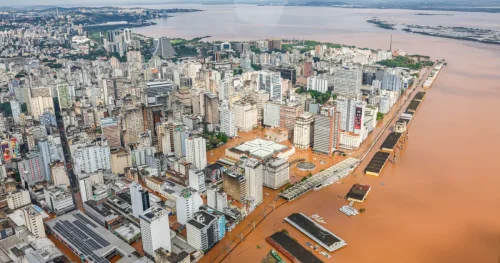
The warnings from key sectors of the press, governments, and the scientific community cannot be downplayed. The effects on Europe are devastating. The greatest heat wave in the European continent’s recent history is causing deaths and disasters, such as the wildfire that claimed 13 lives in southern Spain. Brazil experienced the climate disaster that ravaged Rio Grande do Sul in 2024. Only two years separate us from the true trauma endured by the people of Rio Grande do Sul, with hundreds of fatalities, tens of thousands affected, and entire cities destroyed.
What is most concerning is that the far right continues to advocate a denialist agenda, which not only prevents the ability to forecast and adapt to such events but also ends up amplifying their impacts, especially on the poorest. This debate will be unavoidable in the October election, given the mass support enjoyed by Bolsonarism and its various candidates across Brazil.
The Super El Niño and the Elections
The key issue is the role that agribusiness plays in the national economy. On the one hand, it is one of the main culprits behind the devastation that causes profound environmental imbalance; on the other hand, in the face of El Niño, it will seek compensation through heavy public investments.
As a base of support for the most reactionary sectors of politics, agribusiness thrives at the expense of the environment and the interests of the majority of the population. Therefore, there is no other way out but to break with the agro-export model that has led us to our current dead end.
In the elections, both Bolsonaro’s denialism and the auxiliary wing of the “centrão”—mobilized by the BBB (Cattle, Bible, and Bullets) caucus coalition—will faithfully defend the interests of agribusiness. On the other hand, the PT and parties that are part of the government are caving in and watering down their agendas in a supposed quest for greater electoral gains.
We must transform the food production system and build a new paradigm as an economic model that guarantees food sovereignty for the entire Brazilian population. The best way to address El Niño is to combine adaptation measures—both in rural areas and, above all, in cities—with the struggle for a fundamental shift in the economic model.
Take the defense of water, for example. While dozens of data centers are being installed, driven by the logic of mining and “data extractivism,” the state of São Paulo—to cite just one example—risks facing new water rationing in light of the climate events forecast for the second half of the year.
A Program for the Present and the Future
The PSOL faces an enormous challenge. Together with its alliance with Rede Sustentabilidade, it is viewed by hundreds of thousands of people as the party capable of fearlessly tackling environmental issues, bringing the need for profound change to the center of the political agenda. This challenge will play out in the upcoming elections.
A change that challenges the “development” model, advocating for the need to resume agrarian reform and reverse the direction of current food production. Thus, the PSOL platform, updated last year, incorporated parts of the MST’s platform regarding the transition to an agroecological model.
Furthermore, the renationalization of companies such as SABESP, the need for a national climate emergency plan, and the uncompromising defense of rivers are fundamental parts of the immediate platform of our candidates and leaders.
The recent discussion between the PSOL Foundations (the Lauro Campos and Marielle Franco Foundations) and the Rede Foundation regarding an ecosocialist program for Brazil was a major step in this direction. To confront the climate catastrophe—accelerated by neo-fascist denialism—the emergency brake lies in the struggle and mobilization of the social majority.
16 July 2026
Translated by International Viewpoint from Revista Movimento.