
 Version imprimable
I begin with the question you must be tired of seeing badly formulated. In Fire Alarm, you show that Benjamin inverts Marx’s metaphor. Revolution is not the locomotive of history; it is the act of pulling the emergency brake. In Brazil, the image has become common currency for describing catastrophe and almost never for describing an election. So I ask, with all the risk that entails: is a vote for Lula on October 25 an emergency brake in the Benjaminian sense, or is it exactly the opposite, boarding the locomotive and asking it to go more slowly? And does the concept survive being applied to a ballot, or does applying it there dissolve it?
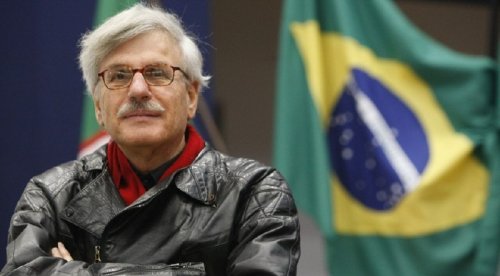
Michael Löwy – For Walter Benjamin, the emergency brake is a revolution, not a simple presidential election. In Brazil’s case, revolution would be a rupture with the foundations of modern industrial capitalist civilization and the beginning of a process of radical change whose horizon would be a new civilization, which I call ecosocialist, based on solidarity, social justice and respect for nature.
A vote for Lula is obviously something far more modest, yet extremely important, because it allows the driver of the locomotive to be someone willing to slow down this suicide train. We need to buy time! Slowing down is essential. The other candidate, Flávio Bolsonaro, is clearly determined to throw more wood on the fire or, if you prefer, more coal into the locomotive’s furnace. From the standpoint of preserving the Amazon rainforest, a decisive issue not only for the peoples of the forest but for all of humanity, Lula, unlike his opponent, tries to limit the damage. That is not the case, unfortunately, with the oil of the Foz do Amazonas, which Lula is willing to exploit.
In The War of the Gods you established something that Brazilian political science still digests poorly: that the PT, the CUT and the MST were born, to a decisive extent, inside the Church, in the ecclesial base communities, and not in defiance of it. The Lula of 1980 came from the CEBs and from the ABC region. The Lula of 2026 negotiates with the evangelical caucus. What is left of that origin within the party, and does a fourth term still owe anything to it, or has the genealogy become mere history?
Michael Löwy – The legacy of what I would call liberation Christianity, linked to the Church but not necessarily within the Church, still exists in the PT and in Lula’s government. But it is far more important in the social movements, in the struggles of residents, peasants, Indigenous peoples, ecologists. The Landless Workers’ Movement, for example. Its founders were pastoral agents of the Pastoral Land Commission. From the beginning the MST defined itself as a secular movement, with no religious affiliation, but its political culture and its rituals, such as the Movement’s famous “mística,” have deep roots in liberation Christianity. Other movements, such as the Homeless Workers’ Movement, have many members who are Christians, Catholic or even evangelical. The base communities no longer have the same impact they had in the 1960s or 1970s, but they are still quite present in the popular movements of the peripheral neighborhoods. Besides the PT, other left parties, such as the PSOL, have a significant presence of liberation Christians among their activists.
You are one of the founders of ecosocialism, co-author of the manifesto with Joel Kovel. [1] The Lula government reduced deforestation and, at the same time, pushed the oil frontier toward the Equatorial Margin. In strictly ecosocialist terms, not electoral ones, is this government part of the solution or a more presentable version of the problem? And here comes the discomfort I don’t know how to resolve. Does ecosocialist criticism have the right to be voiced in the week of a runoff, or is it precisely this purism that has historically done the right a favor?
Michael Löwy – Lula’s program is obviously not ecosocialist, and it has serious social and ecological limits. Oil exploration in the Equatorial Margin, a disaster for the forest, for the local population and for humanity if that oil is extracted and burned, is only the most obvious example. Ecosocialist criticism of Lula is therefore exercised in the first round, in the runoff and after the elections.
That said, we ecosocialists know that a Lula government is infinitely preferable to a government of the Bolsonaro clique, which is ecofascist in character and totally opposed to any social or ecological measure. Such a government would be directly ecocidal, and a catastrophe for Brazil, Latin America and the planet. It would be a dramatic regression in terms of democracy, Indigenous rights, women’s rights, the environment, education, culture, society. It would hand Brazil over to the destructive rage of Donald Trump’s United States, the number one enemy of the peoples of Latin America and of nature. Therefore, without any hesitation, ecosocialists will vote for Lula da Silva, who, with all his limits, is the only alternative to the Bolsonarist catastrophe.
In Romanticism Against the Tide of Modernity, you and Robert Sayre establish that romanticism forks. There is the restorative way out, which wants the past as destiny, and the revolutionary way out, which steals from the past the spark to ignite the future. Bolsonarism seems to me anticapitalist romanticism in the first key: nostalgia for a lost order, the family, the nation, the barracks, all against modernity without ever touching capital. If the far right has occupied the romantic critique of modernity, what is left for the left? Is there revolutionary romanticism available in the Brazil of 2026, or has the left been left with the role you always feared, that of the party of modernization and administration? And, in this typology, what is a fourth Lula term?
Michael Löwy – Look, romanticism, as Sayre and I defined it in Romanticism Against the Tide of Modernity, is a revolt against capitalism in the name of the values of a pre-capitalist past, real or imaginary. Bolsonarism does not fit this definition. It does not criticize capitalism, quite the opposite, and the past it refers to, the military dictatorship, is merely a more authoritarian and brutal form of the capitalist system itself. It is, as in the case of fascism, what the historian Jeffrey Herf called reactionary modernism. It identifies with capitalism, with industry and with modern technology, today artificial intelligence, and rejects only the legacy of the French Revolution: liberty, equality, fraternity.
Who are the representatives of revolutionary romanticism in Brazil? Those communists, ecologists, ecosocialists and Indigenous-rights advocates who reject capitalist civilization and believe we have much to learn from the way of life of Brazil’s Indigenous peoples. We cannot go back to living in the forest, certainly, but we should study with interest and respect the critique that Indigenous peoples make of the world of commodities in which we live, and the relationship of harmony they maintain with the environment, the trees, the animals, the rivers.
The governing left, the fourth Lula term, belong more to what I would call progressive modernism. Without questioning the capitalist system itself, they seek progressive social reforms. It is a kind of social liberalism. It does not break with the neoliberal model, but tries to do everything possible for the disadvantaged, the poor, the excluded, on the condition of not touching the privileges of the oligarchs. The limits of this policy are evident, but it cannot be denied that it lifted millions of Brazilians out of poverty and carried out important reforms, such as the end of the 6×1 work schedule and the income tax exemption for the poorest.
You edited and defended Mariátegui, and his phrase that Latin American socialism can be neither imitation nor copy, that it has to be heroic creation. What, in the Lulism of 2026, is creation and what is imitation? I link this question to Redemption and Utopia, where you showed the elective affinity between Jewish messianism and libertarian utopia, and the Benjaminian idea of a weak messianic power entrusted to each generation. Does that force still exist in Brazilian politics, or has the messianic migrated entirely to the other side?
Michael Löwy – When it emerged in 1979, under the leadership of the ABC union leader Lula da Silva, the Workers’ Party was a true heroic creation. Heroic because it immediately confronted the military regime in the great workers’ strikes of those years. Creation because it is neither imitation nor copy, but something new: a workers’ party that brings together the working class, the base communities, left-wing intellectuals, veterans of the class struggle such as Mário Pedrosa and Apolônio de Carvalho, and Marxist, Trotskyist and Maoist groups. A party that manages to integrate all these components into a democratic organization, rooted in grassroots committees. And that would adopt, in 1990, after the fall of the Wall, a socialist, democratic, explicitly anticapitalist program.
Obviously, the Lulism of 2026 is very far from that first version of the PT. It is merely a variant of the so-called progressive governments of Latin America, which manage to carry out some significant reforms but have lost their subversive, anti-systemic dynamic. In Lula’s case, the limits are even more evident, partly owing to the control of Congress by the corrupt and reactionary right.
That is exactly where I am going now. Dark Horse, the biopic of a convicted and imprisoned Jair Bolsonaro, financed with money linked to Banco Master, a bank liquidated for insolvency, has Jim Caviezel in his role, the actor who played Christ for Mel Gibson. You have spent your life studying the elective affinity between religion and emancipation. Here there seems to be the exact opposite: messianism without utopia, redemption without emancipation, the face of Christ pasted onto a leader who attempted a coup. Does this have a name in your work? Is it the aestheticization of politics that Benjamin spoke of, or is it a new figure, which the categories of Redemption and Utopia do not reach, because there the messianic still pointed toward someone’s liberation?
Michael Löwy – For Walter Benjamin, fascism is a false messianism, and its leaders are figures of the Antichrist, a miserable caricature of liberating messianism. The history of religions, and of politics, is full of false messiahs who present themselves as saviors and redeemers and are nothing but tyrants in the service of the ruling elites. Such is the case of the Jair in question, regarded as a messiah or myth by his admirers, but who is nothing but an obscure horse, a dark horse, mounted by the Brazilian oligarchy. It is worse than the aestheticization of politics that Benjamin referred to, in another context. It is a mythification, a mystification of politics. Jair is far from the only one. His great friend and ally, Donald Trump, is another false messiah, who has the gall to have himself represented, in an image created by artificial intelligence, as a kind of new Christ. Some Roman emperors, such as Domitian, already demanded to be worshipped as dominus et deus. It is an old story.
In 2021, you reviewed in En attendant Nadeau the book by Leneide Duarte-Plon and Clarisse Meireles on Frei Tito de Alencar, the Dominican friar kidnapped and tortured by the dictatorship, exiled in France, dead in 1974. Fifty-two years later, a presidential candidate campaigns for the freedom of a man convicted of attempting a coup, and Congress debates an amnesty for the coup plotters. An important part of the Brazilian religious field asks for this amnesty. You, who worked on the Benjaminian thesis that not even the dead will be safe if the enemy wins, what do you say about an election in which amnesty is a platform? What does an amnesty do to Frei Tito?
Michael Löwy – An amnesty for the 2022 coup plotters would be a direct attack on Brazilian democracy and a green light for future military coup attempts. The same goes for an amnesty for Jair Bolsonaro, with an aggravating factor. He never ceased to express his admiration for the military dictatorship and, in particular, for the torturer Colonel Ustra. His amnesty would be an insult to the memory not only of Frei Tito but of all the victims of the military dictatorship, the thousands who were tortured and the hundreds murdered by the barracks regime. Among them a friend of mine, Luiz Eduardo Merlino, a twenty-three-year-old journalist, killed under torture on the orders of Colonel Ustra. As Walter Benjamin said, if fascism wins, not even our dead will be safe.
Thesis VIII says that the tradition of the oppressed teaches us that the state of exception in which we live is the rule. I apply it to the concrete: the hundreds of thousands dead in the pandemic, January 8, the coup plot that has been tried. If Flávio Bolsonaro wins on October 25, is that a rupture, or the continuation of a normality that Brazil’s oppressed have always known, and the astonishment is only ours, of those of us who thought we were outside it? And, of your eighty-eight years, sixty-five of them looking at Brazil from the outside, is there a Brazilian specificity here, or is it one more chapter of the wave you have been describing since the nineties?
Michael Löwy – In the history of the class struggle, the rule is domination by the elites. The exception is the revolution of the oppressed: the revolt of the slaves with Spartacus, that of the peasant serfs with Thomas Müntzer, that of the proletarians in the Paris Commune and in the October Revolution. But there are differences within that domination. Fascism is the most violent, barbaric and destructive form of the power of the oligarchies. It is not an exception; it is the most brutal and inhuman form of the rule. That is why we must do everything possible so that the nightmare that was the father’s government does not return with the son. Hoping that one day, with the ecosocialist revolution, we can establish what Walter Benjamin called the true state of exception, the emancipation of the oppressed and the exploited.
The neofascist wave is not a Brazilian specificity. It is planetary. It already governs the leading imperialist power, with Trump, and the most populous country on the planet, Modi’s India, as well as several countries in Latin America, and it already threatens several countries in Europe. If Brazil manages to stop this catastrophic wave in the October elections, it will be an encouraging sign for the whole world. Otherwise, the whole of the American continent, with the exception of Mexico and Canada, will be under the neofascist boot.
For me, Trump, Bolsonaro and Milei are manifestations of neofascism. It is not a repetition of the Nazi-fascism of the 1930s. We do not have totalitarian states, concentration camps, uniformed shock troops, national-corporatist economic policies. The main difference is economic policy, because neofascism is fanatically neoliberal. But it has in common with classical fascism racism, xenophobia, hatred of communism and of any form of the left, the cult of the Leader and authoritarianism.
Translated by International Viewpoint from Outras Palavras. 5 October 2026